


 Cart
Cart
 sales@molnova.com


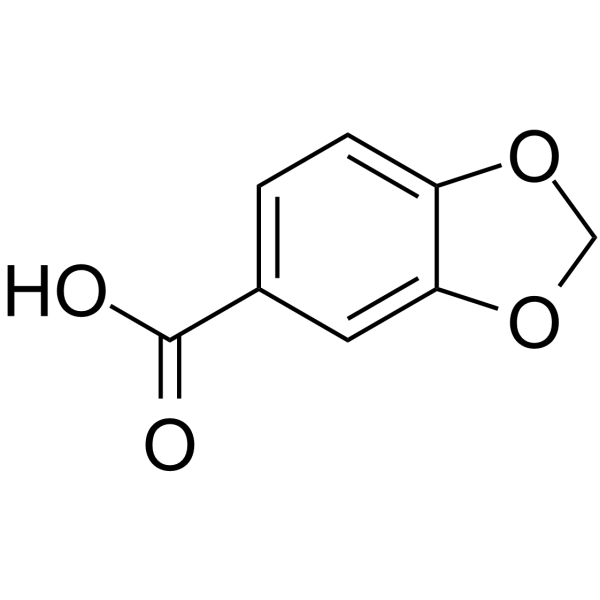
Piperonylic acid
CAS No. 94-53-1
Piperonylic acid( 2H-1,3-benzodioxole-5-carboxylic acid )
Catalog No. M29388 CAS No. 94-53-1
Piperonylic acid is a natural molecule bearing a methylenedioxy function that closely mimics the structure of trans-cinnamic acid. Piperonylic acid selectively inactivate the CYP73A P450 subpopulation.
Purity : >98% (HPLC)
 COA
Datasheet
HNMR
HPLC
MSDS
Handing Instructions
COA
Datasheet
HNMR
HPLC
MSDS
Handing Instructions
| Size | Price / USD | Stock | Quantity |
| 1 mL x 10 mM in DMSO | 28 | In Stock |


|
| 100MG | Get Quote | In Stock |
|
| 200MG | Get Quote | In Stock |
|
| 500MG | Get Quote | In Stock |
|
| 1G | 27 | In Stock |
|
Biological Information
-
Product NamePiperonylic acid
-
NoteResearch use only, not for human use.
-
Brief DescriptionPiperonylic acid is a natural molecule bearing a methylenedioxy function that closely mimics the structure of trans-cinnamic acid. Piperonylic acid selectively inactivate the CYP73A P450 subpopulation.
-
DescriptionPiperonylic acid is a natural molecule bearing a methylenedioxy function that closely mimics the structure of trans-cinnamic acid. Piperonylic acid selectively inactivate the CYP73A P450 subpopulation.
-
In Vitro——
-
In Vivo——
-
Synonyms2H-1,3-benzodioxole-5-carboxylic acid
-
PathwayMetabolic Enzyme/Protease
-
TargetP450
-
RecptorP450
-
Research Area——
-
Indication——
Chemical Information
-
CAS Number94-53-1
-
Formula Weight166.132
-
Molecular FormulaC8H6O4
-
Purity>98% (HPLC)
-
SolubilityIn Vitro:?DMSO : 100 mg/mL (601.94 mM)
-
SMILESOC(=O)c1ccc2OCOc2c1
-
Chemical Name——
Shipping & Storage Information
-
Storage(-20℃)
-
ShippingWith Ice Pack
-
Stability≥ 2 years
Reference
molnova catalog



related products
-
Pregnenolone Carboni...
Pregnenolone Carbonitrile is an activator of rodent-PXR and induces the expression of CYP3A.
-
Ambroxol
Ambroxol is indicated as "secretolytic therapy in bronchopulmonary diseases associated with abnormal mucus secretion and impaired mucus transport.
-
CAY10462
CAY10462 (CTK8E8405) is an effective and selective inhibitor of the 20-HETE synthase CYP4A11 with an IC50 of 8.8 nM.
