


 Cart
Cart
 sales@molnova.com


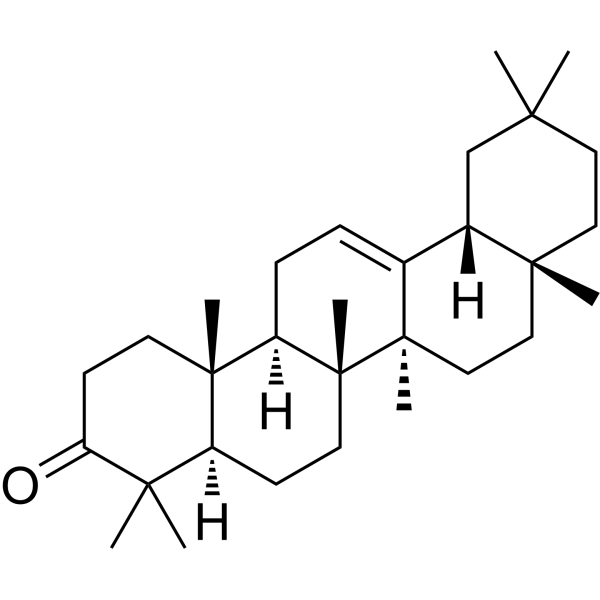
beta-Amyrone
CAS No. 638-97-1
beta-Amyrone( β-Amyron )
Catalog No. M29286 CAS No. 638-97-1
beta-Amyrone has antifungal activity against Chikungunya virus replication with an EC50 of 86 uM. beta-Amyrone has anti-inflammatory activity through inhibiting the expression of COX-2. beta-Amyrone exhibits anti-α-glucosidase inhibitory activity and moderate AChE activity. β-Amyrone can be used in the research of disease like inflammation, infection, and obesity.
Purity : >98% (HPLC)
 COA
Datasheet
HNMR
HPLC
MSDS
Handing Instructions
COA
Datasheet
HNMR
HPLC
MSDS
Handing Instructions
| Size | Price / USD | Stock | Quantity |
| 5MG | 353 | In Stock |


|
| 10MG | 567 | In Stock |
|
| 25MG | 888 | In Stock |
|
| 50MG | 1172 | In Stock |
|
| 100MG | 1572 | In Stock |
|
| 200MG | Get Quote | In Stock |
|
| 500MG | 3143 | In Stock |
|
| 1G | Get Quote | In Stock |
|
Biological Information
-
Product Namebeta-Amyrone
-
NoteResearch use only, not for human use.
-
Brief Descriptionbeta-Amyrone has antifungal activity against Chikungunya virus replication with an EC50 of 86 uM. beta-Amyrone has anti-inflammatory activity through inhibiting the expression of COX-2. beta-Amyrone exhibits anti-α-glucosidase inhibitory activity and moderate AChE activity. β-Amyrone can be used in the research of disease like inflammation, infection, and obesity.
-
Descriptionbeta-Amyrone has antifungal activity against Chikungunya virus replication with an EC50 of 86 uM. beta-Amyrone has anti-inflammatory activity through inhibiting the expression of COX-2. beta-Amyrone exhibits anti-α-glucosidase inhibitory activity and moderate AChE activity. β-Amyrone can be used in the research of disease like inflammation, infection, and obesity.(In Vitro):beta-Amyrone inhibits α-glucosidase AChE and fungal activity with IC50 values of 25 μM, 23 μM and 8 μg/mL, respectively. In LPS-stimulated J774 cells, beta-Amyrone (2.5, 5, 10 μg/mL) inhibits NO production with an IC50 value of 4.61 μg/mL without obvious effects on cell viability. beta-Amyrone (10 μg/mL) inhibits IL-6, IL-10 levels, and COX-2 expression at the dose of 10 μg/mL.(In Vivo):In ear phenol-induced edema in Balb C mice, beta-Amyrone (0.1, 0.3, 0.6 mg/kg) inhibits ear edema formation in a dose-related manner.
-
In Vitroβ-Amyrone (1.25-10 μg/mL, 24 h) inhibits on NO? production in LPS-stimulated J774 cells, with an IC50 value of 4.61 μg/mL, and has no obvious effect on cell viability.β-Amyrone (10 μg/mL, 24 h) inhibits IL-6, IL-10 levels, and COX-2 expression in LPS-stimulated J774 cells.β-Amyrone (0-235 μM, 7days) has antiviral activity in Vero cells against Chikungunya virus (CHIKV), with EC50 value of 86 uM.β-Amyrone inhibits α-glucosidase, acetylcholinesterase (AChE) and fungal activity with IC50 values of 25 μM, 23 μM and 8 μg/mL, respectively. Western Blot Analysis Cell Line:LPS (1 μg/mL)-stimulated J774 cells Concentration:2.5, 5, 10 μg/mL Incubation Time:24 h Result:Inhibited COX-2 expression in a concentration-dependent manner (approximately 90% reduction at 5 or 10 μg/ mL).
-
In Vivoβ-Amyrone (local administration on ear, 0.1-0.6 mg/kg, a single dose) inhibits ear edema formation in phenol-induced edema mice. Animal Model:Ear phenol-induced edema in Balb C miceDosage:0.1, 0.3, 0.6 mg/kg, a single dose Administration:Local administration (20 ??L solution) on ear Result:Inhibited ear edema formation in a dose-related manner (47% inhibition at the dose of 0.6mg/kg).
-
Synonymsβ-Amyron
-
PathwayChromatin/Epigenetic
-
TargetCOX
-
RecptorCOX
-
Research Area——
-
Indication——
Chemical Information
-
CAS Number638-97-1
-
Formula Weight424.7
-
Molecular FormulaC30H48O
-
Purity>98% (HPLC)
-
Solubility——
-
SMILESC[C@]12[C@@]3(C)C([C@]4([C@@](C)(CC3)CCC(C)(C)C4)[H])=CC[C@@]1([C@]5(C)[C@@](CC2)(C(C)(C)C(=O)CC5)[H])[H]
-
Chemical Name——
Shipping & Storage Information
-
Storage(-20℃)
-
ShippingWith Ice Pack
-
Stability≥ 2 years
Reference
molnova catalog



related products
-
Ketorolac
Ketorolac is a non-steroidal anti-inflammatory drug (NSAID) in the family of heterocyclic acetic acid derivatives. It acts by inhibiting the bodily synthesis of prostaglandins.
-
COX-2-IN-34
COX-2-IN-34 is a selective, orally potent COX-2 inhibitor that shows anti-inflammatory activity without gastric ulcer toxicity during experiments in mice.
-
Phenetidine
Used in the manufacture of acetophenetidin.
