


 Cart
Cart
 sales@molnova.com


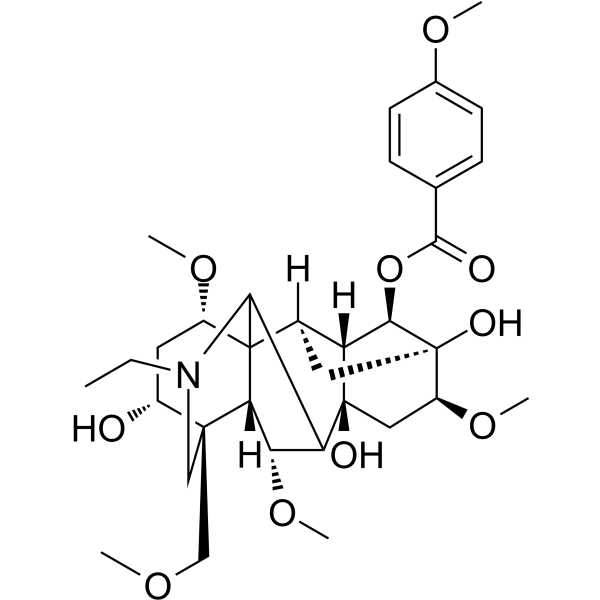
8-Deacetylyunaconitine
CAS No. 93460-55-0
8-Deacetylyunaconitine( —— )
Catalog No. M29278 CAS No. 93460-55-0
8-Deacetylyunaconitine is a a diterpenoid alkaloid derived from Aconitum Vilmorinian Radix.
Purity : >98% (HPLC)
 COA
Datasheet
HNMR
HPLC
MSDS
Handing Instructions
COA
Datasheet
HNMR
HPLC
MSDS
Handing Instructions
| Size | Price / USD | Stock | Quantity |
| 1 mL x 10 mM in DMSO | 134 | In Stock |


|
| 5MG | 98 | In Stock |
|
| 10MG | 147 | In Stock |
|
| 25MG | 250 | In Stock |
|
| 50MG | 354 | In Stock |
|
| 100MG | 498 | In Stock |
|
| 200MG | 658 | In Stock |
|
| 500MG | Get Quote | In Stock |
|
| 1G | Get Quote | In Stock |
|
Biological Information
-
Product Name8-Deacetylyunaconitine
-
NoteResearch use only, not for human use.
-
Brief Description8-Deacetylyunaconitine is a a diterpenoid alkaloid derived from Aconitum Vilmorinian Radix.
-
Description8-Deacetylyunaconitine is a a diterpenoid alkaloid derived from Aconitum Vilmorinian Radix.
-
In Vitro——
-
In Vivo——
-
Synonyms——
-
PathwayOthers
-
TargetOther Targets
-
Recptor——
-
Research Area——
-
Indication——
Chemical Information
-
CAS Number93460-55-0
-
Formula Weight617.73
-
Molecular FormulaC33H47NO10
-
Purity>98% (HPLC)
-
Solubility——
-
SMILESO(C)[C@@H]1C23[C@]4([C@](COC)(CN(CC)C2C([C@@H]4OC)[C@]5(O)[C@@H]6[C@]3(C[C@@](O)([C@]6(OC(=O)C7=CC=C(OC)C=C7)[H])[C@@H](OC)C5)[H])[C@H](O)C1)[H]
-
Chemical Name——
Shipping & Storage Information
-
Storage(-20℃)
-
ShippingWith Ice Pack
-
Stability≥ 2 years
Reference
molnova catalog



related products
-
Fibrinopeptide A, hu...
Fibrinopeptide A, human is a 16-residue short polypeptide cleaved from fibrinogen by thrombin. Fibrinopeptide A (FPA) is produced from the N-terminal Aα region of fibrinogen protein, on cleavage by thrombin.
-
1-(4-FLUORO-PHENYL)-...
1-(4-FLUORO-PHENYL)-BUTAN-1-ONE
-
(-)-Dihydroguaiareti...
Aristolone is a natural product from the leaf oil of Alpinia polyantha.
