


 Cart
Cart
 sales@molnova.com


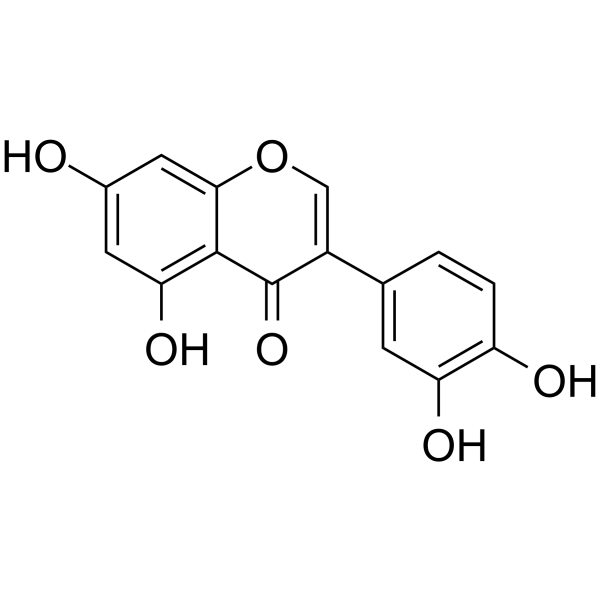
Orobol
CAS No. 480-23-9
Orobol( 3'-Hydroxygenistein | 3’,4’,5,7-tetrahydroxy-isoflavon )
Catalog No. M29205 CAS No. 480-23-9
Orobol is an inhibitor of tyrosine-specific protein kinase and phosphatidylinositol turnover. Orobol inhibits PI3K isoforms with IC50s of 3.46-5.27 μM for PI3K α/β/γ/K/δ. Orobol exhibits anti-skin-aging and anti-obesity effects.
Purity : >98% (HPLC)
 COA
Datasheet
HNMR
HPLC
MSDS
Handing Instructions
COA
Datasheet
HNMR
HPLC
MSDS
Handing Instructions
| Size | Price / USD | Stock | Quantity |
| 2MG | 258 | Get Quote |


|
| 100MG | Get Quote | Get Quote |
|
| 200MG | Get Quote | Get Quote |
|
| 500MG | Get Quote | Get Quote |
|
| 1G | Get Quote | Get Quote |
|
Biological Information
-
Product NameOrobol
-
NoteResearch use only, not for human use.
-
Brief DescriptionOrobol is an inhibitor of tyrosine-specific protein kinase and phosphatidylinositol turnover. Orobol inhibits PI3K isoforms with IC50s of 3.46-5.27 μM for PI3K α/β/γ/K/δ. Orobol exhibits anti-skin-aging and anti-obesity effects.
-
DescriptionOrobol is an inhibitor of tyrosine-specific protein kinase and phosphatidylinositol turnover. Orobol inhibits PI3K isoforms with IC50s of 3.46-5.27 μM for PI3K α/β/γ/K/δ. Orobol exhibits anti-skin-aging and anti-obesity effects.(In Vitro):Orobol inhibits CK1ε, VEGFR2, MAP4K5, MNK1, MUSK, TOPK, and TNIK with IC50s of 1.24-4.45 μM. Orobol (5-20 μM) effectively suppresses MDI (isobutylmethylxanthine, dexamethasone, and insulin (MDI))-induced phosphorylation of 4E-BP1. Orobol binds to CK1ε in an ATP-competitive manner.(In Vivo):In C57BL/6J mice, Orobol (10 mg/kg; intragastrically) attenuates high-fat diet-induced weight gain (17.3%) and lipid accumulation without affecting food intake.
-
In VitroOrobol binds to CK1ε in an ATP-competitive manner and exerts anti-obesity effects by targeting casein kinase 1 epsilon.Orobol (5-20 μM) effectively suppresses MDI (isobutylmethylxanthine, dexamethasone and insulin (MDI))-induced phosphorylation of 4E-BP1.
-
In VivoOrobol attenuates high fat diet-induced weight gain and lipid accumulation without affecting food intake in C57BL/6J mice. Animal Model:HFD-induced obesity in C57BL/6J mice Dosage:10?mg/kg Administration: Intragastrically; daily for 23 weeks Result:Significantly reduced body weight by 17.3% compared to the HFD group.
-
Synonyms3'-Hydroxygenistein | 3’,4’,5,7-tetrahydroxy-isoflavon
-
PathwayAngiogenesis
-
TargetBcl-2
-
RecptorBCL
-
Research Area——
-
Indication——
Chemical Information
-
CAS Number480-23-9
-
Formula Weight286.239
-
Molecular FormulaC15H10O6
-
Purity>98% (HPLC)
-
SolubilityIn Vitro:?DMSO : 50 mg/mL (174.68 mM)
-
SMILESOc1cc(O)c2c(c1)occ(-c1ccc(O)c(O)c1)c2=O
-
Chemical Name——
Shipping & Storage Information
-
Storage(-20℃)
-
ShippingWith Ice Pack
-
Stability≥ 2 years
Reference
molnova catalog



related products
-
A-1155463
A-1155463 is a highly potent and selective BCL-XL inhibitor (Ki=10 pM).
-
BCL6 inhibitor 7
A potent BCL6 protein-protein interaction inhibitor with Kd of 78 nM; exhibits an efficacy in cell-free and cellular PPI assays.
-
17-Hydroxy sprengeri...
17-Hydroxy sprengerinin C is a glycoside compound isolated from rhizomes of Polygonatum sibiricum with stronger anticancer activities.
