


 Cart
Cart
 sales@molnova.com


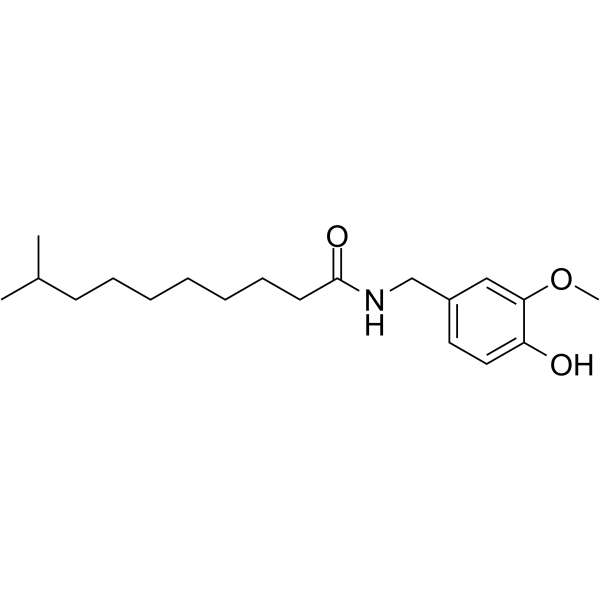
Homodihydrocapsaicin I
CAS No. 20279-06-5
Homodihydrocapsaicin I( —— )
Catalog No. M29165 CAS No. 20279-06-5
Homodihydrocapsaicin I is a natural product from Capsicum annuum L.
Purity : >98% (HPLC)
 COA
Datasheet
HNMR
HPLC
MSDS
Handing Instructions
COA
Datasheet
HNMR
HPLC
MSDS
Handing Instructions
| Size | Price / USD | Stock | Quantity |
| 1 mL x 10 mM in DMSO | 246 | In Stock |


|
| 5MG | 217 | In Stock |
|
| 10MG | 359 | In Stock |
|
| 100MG | Get Quote | In Stock |
|
| 200MG | Get Quote | In Stock |
|
| 500MG | Get Quote | In Stock |
|
| 1G | Get Quote | In Stock |
|
Biological Information
-
Product NameHomodihydrocapsaicin I
-
NoteResearch use only, not for human use.
-
Brief DescriptionHomodihydrocapsaicin I is a natural product from Capsicum annuum L.
-
DescriptionHomodihydrocapsaicin I is a natural product from Capsicum annuum L.
-
In VitroHomodihydrocapsaicin I has phytotoxic effects on seedling growth of lettuce and?reduces the radical length of?Lactuca sativa?seedling.
-
In Vivo——
-
Synonyms——
-
PathwayOthers
-
TargetOther Targets
-
Recptor——
-
Research Area——
-
Indication——
Chemical Information
-
CAS Number20279-06-5
-
Formula Weight321.461
-
Molecular FormulaC19H31NO3
-
Purity>98% (HPLC)
-
SolubilityIn Vitro:?DMSO : 100 mg/mL (311.09 mM)
-
SMILESCOc1cc(CNC(=O)CCCCCCCC(C)C)ccc1O
-
Chemical Name——
Shipping & Storage Information
-
Storage(-20℃)
-
ShippingWith Ice Pack
-
Stability≥ 2 years
Reference
molnova catalog



related products
-
Hosenkoside D
The aerial parts of Impatiens balsamina L.
-
R-G-D-S-P-A-S-S-K-P
RGDSPASSKP is a RGDS-containing fibronectin decapeptide.
-
Pseudobaptigenin
Pseudobaptigenin (Psi-baptigenin) is an isoflavone, a flavonoid lipid molecule that is a natural product found in Pterocarpus marsupium, Dalbergia spruceana.
