


 Cart
Cart
 sales@molnova.com


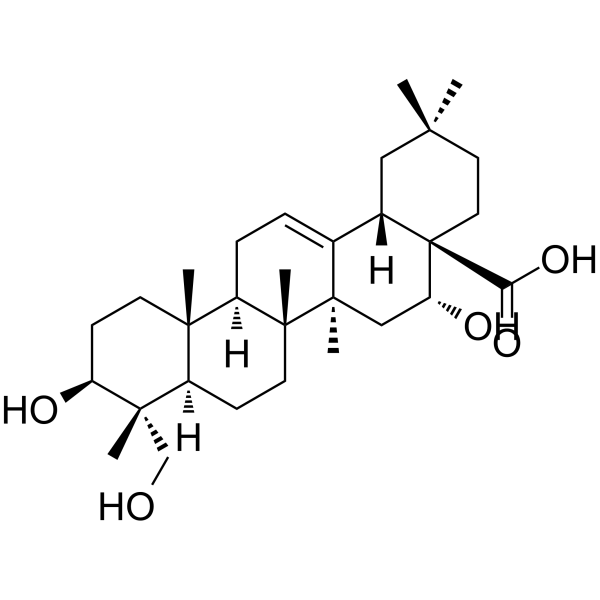
Caulophyllogenin
CAS No. 52936-64-8
Caulophyllogenin( Segetalic acid )
Catalog No. M29110 CAS No. 52936-64-8
Caulophyllogenin is a partial PPARγ agonist (EC50 = 12.6 μM) derived from the stem bark of Kalopanax pictus (Araliaceae).
Purity : >98% (HPLC)
 COA
Datasheet
HNMR
HPLC
MSDS
Handing Instructions
COA
Datasheet
HNMR
HPLC
MSDS
Handing Instructions
| Size | Price / USD | Stock | Quantity |
| 5MG | 254 | In Stock |


|
| 10MG | 372 | In Stock |
|
| 25MG | 623 | In Stock |
|
| 100MG | Get Quote | In Stock |
|
| 200MG | Get Quote | In Stock |
|
| 500MG | Get Quote | In Stock |
|
| 1G | Get Quote | In Stock |
|
Biological Information
-
Product NameCaulophyllogenin
-
NoteResearch use only, not for human use.
-
Brief DescriptionCaulophyllogenin is a partial PPARγ agonist (EC50 = 12.6 μM) derived from the stem bark of Kalopanax pictus (Araliaceae).
-
DescriptionCaulophyllogenin is a partial PPARγ agonist (EC50 = 12.6 μM) derived from the stem bark of Kalopanax pictus (Araliaceae). Caulophyllogenin inhibits pro-inflammatory cytokine secretion and can be used in studies about the prevention and treatment of inflammatory diseases, type-2 diabetes, obesity and metabolic syndrome.(In Vitro):Caulophyllogenin inhibits IL-12 p40, IL-6, and TNF-α with IC50s ranging from 3.3 to 20.0 μM.
-
In Vitro——
-
In Vivo——
-
SynonymsSegetalic acid
-
PathwayApoptosis
-
TargetIL Receptor
-
RecptorIL Receptor
-
Research Area——
-
Indication——
Chemical Information
-
CAS Number52936-64-8
-
Formula Weight488.709
-
Molecular FormulaC30H48O5
-
Purity>98% (HPLC)
-
Solubility——
-
SMILES[H][C@@]12CC(C)(C)CC[C@@]1([C@H](O)C[C@]1(C)C2=CC[C@]2([H])[C@@]3(C)CC[C@H](O)[C@@](C)(CO)[C@]3([H])CC[C@@]12C)C(O)=O
-
Chemical Name——
Shipping & Storage Information
-
Storage(-20℃)
-
ShippingWith Ice Pack
-
Stability≥ 2 years
Reference
molnova catalog



related products
-
Diallyl disulfide
Diallyl disulfide has antitumor effect, the effect can be enhanced by miR-200b and miR-22.
-
Suplatast tosilate
A Th2 cytokine inhibitor that attenuates IL-2, IL-5 and IL-13 production and has no effect on IFN-γ production.
-
Resiniferatoxin
Resiniferatoxin inhibits the production of Th1 cytokines, contributing to the defense against T. spiralis infection, and can be used in studies about the modulator of the immune response.
