


 Cart
Cart
 sales@molnova.com


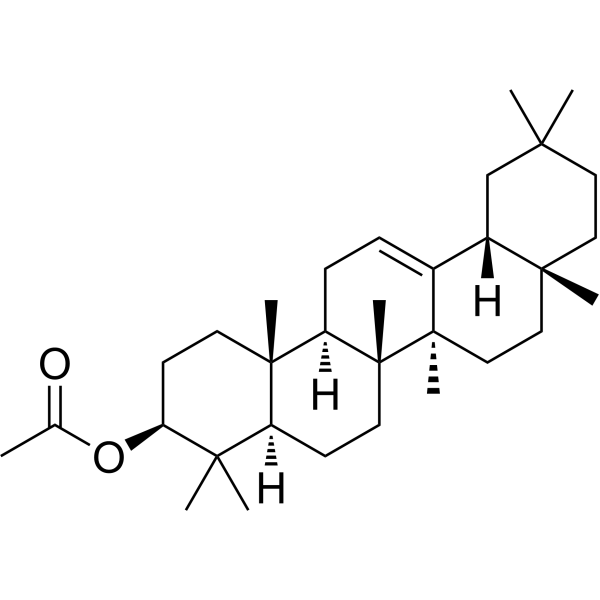
beta-Amyrin acetate
CAS No. 1616-93-9
beta-Amyrin acetate( —— )
Catalog No. M29101 CAS No. 1616-93-9
beta-Amyrin acetate inhibits HMG-CoA Reductase (HMGCR) and sEH activity with IC50 of 3.4 μM. beta-Amyrin acetate has anti-inflammatory, antifungal, antioxidant, and anti-hyperlipidemic activities.
Purity : >98% (HPLC)
 COA
Datasheet
HNMR
HPLC
MSDS
Handing Instructions
COA
Datasheet
HNMR
HPLC
MSDS
Handing Instructions
| Size | Price / USD | Stock | Quantity |
| 5MG | 138 | In Stock |


|
| 10MG | 183 | In Stock |
|
| 25MG | 330 | In Stock |
|
| 50MG | 479 | In Stock |
|
| 100MG | 695 | In Stock |
|
| 200MG | Get Quote | In Stock |
|
| 500MG | Get Quote | In Stock |
|
| 1G | Get Quote | In Stock |
|
Biological Information
-
Product Namebeta-Amyrin acetate
-
NoteResearch use only, not for human use.
-
Brief Descriptionbeta-Amyrin acetate inhibits HMG-CoA Reductase (HMGCR) and sEH activity with IC50 of 3.4 μM. beta-Amyrin acetate has anti-inflammatory, antifungal, antioxidant, and anti-hyperlipidemic activities.
-
Descriptionbeta-Amyrin acetate inhibits HMG-CoA Reductase (HMGCR) and sEH activity with IC50 of 3.4 μM. beta-Amyrin acetate has anti-inflammatory, antifungal, antioxidant, and anti-hyperlipidemic activities.(In Vitro):beta-Amyrin acetate (25 μM) decreases mEH activity to 61% of control activity. beta-Amyrin acetate (50 μg/mL) inhibits heat-induced hemolysis and hypotonicity-induced hemolysis of human erythrocytes. beta-Amyrin acetate (7.8-1000 μg/mL) inhibits all of the Candida fungal species tested (MIC: 30 - 250 μg/mL).(In Vivo):In Xylene-induced mouse ear topical edema model, beta-Amyrin acetate (100 μg/ear) significantly inhibits xylene-induced ear edema. In normal and arthritic rats, beta-Amyrin acetate (40 mg/kg; s.c.) increases the ATP-phosphohydrolase activity in liver homogenates. In adult albino rats, beta-Amyrin acetate (40 mg/kg; i.p.) shows significant anti-inflammatory activities to 43.6% with mean average weight of granulation tissue of 9.2 mg after 6 days.
-
In Vitroβ-Amyrin acetate (50 μg/mL) inhibits heat-induced hemolysis and hypotonicity-induced hemolysis of human erythrocytes.β-Amyrin acetate (5-100 μM) has HMG-CoA reductase inhibitory activity by locating in the hydrophobic binding cleft lined with residues Leu562, Gly560, Ala564, Gly569, Ser852, Leu853, Leu857, Met854, Ala856, Ser852 and Ala855 of human HMG CoA reductase.β-Amyrin acetate (7.8-1000 μg/mL, 48 h) inhibits all of the Candida fungal species tested with MIC values ranging from 30 to 250 μg/mL).
-
In Vivoβ-Amyrin acetate (applied on the anterior surface of the right ear, 100 μg/ear, a single dose) significantly inhibits xylene-induced ear edema in mice.β-Amyrin acetate (intraperitoneal injection, 4 mg/100 g, daily for 6 consecutive days) shows significant anti-inflammatory activities (43.6%) in adult albino rats.β-Amyrin acetate (subcutaneous injection, 4 mg/100 g, daily for 10 days ) increases the ATP-phosphohydrolase activity in liver homogenates both in normal and arthritic rats. Animal Model:Xylene-induced mouse ear topical edema model Dosage:50 and 100 μg/ear (5 μL) Administration:Applied on the anterior surface of the right ear Result:Inhibited Xylene-induced ear edema in miceAnimal Model:Adult albino rats Dosage:4 mg/100g, daily for 6 consecutive days Administration:Intraperitoneal injection Result:Showed significant anti-inflammatory activities with mean average weight of granulation tissue of 9.2 mg after 6 days.
-
Synonyms——
-
PathwayOthers
-
TargetAntioxidant
-
RecptorAntioxidant
-
Research Area——
-
Indication——
Chemical Information
-
CAS Number1616-93-9
-
Formula Weight468.766
-
Molecular FormulaC32H52O2
-
Purity>98% (HPLC)
-
Solubility——
-
SMILESCC(=O)O[C@H]1CC[C@@]2(C)[C@@H](CC[C@]3(C)[C@@H]2CC=C2[C@@H]4CC(C)(C)CC[C@]4(C)CC[C@@]32C)C1(C)C
-
Chemical Name——
Shipping & Storage Information
-
Storage(-20℃)
-
ShippingWith Ice Pack
-
Stability≥ 2 years
Reference
molnova catalog



related products
-
GB 1a
GB 1a is a natural product isolated from the leaves of Garcinia travancorica.
-
Neonuezhenide
Neonuezhenide is a phenolic compound isolated from Ligustrum officinale, which has strong antioxidant effects on free radical-induced hemolysis of red blood cells.
-
4-O-Methylpyridoxine
4'-O-Methylpyridoxine (MPN) is a vitamin-like compound discovered from Ginkgo biloba with antioxidant activity and cytotoxicity.
