


 Cart
Cart
 sales@molnova.com


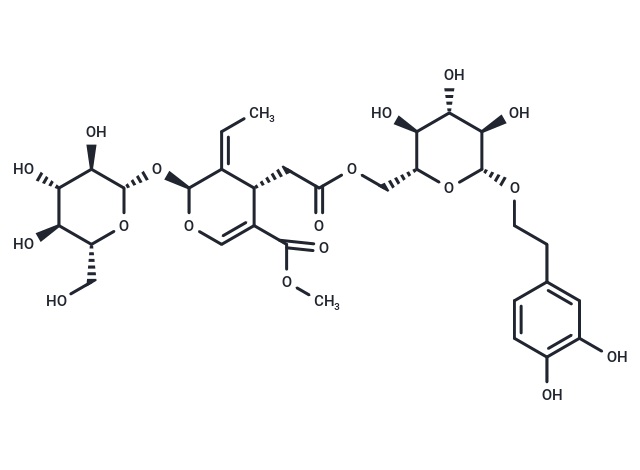
Neonuezhenide
CAS No. 96382-91-1
Neonuezhenide( —— )
Catalog No. M37725 CAS No. 96382-91-1
Neonuezhenide is a phenolic compound isolated from Ligustrum officinale, which has strong antioxidant effects on free radical-induced hemolysis of red blood cells.
Purity : >98% (HPLC)
 COA
Datasheet
HNMR
HPLC
MSDS
Handing Instructions
COA
Datasheet
HNMR
HPLC
MSDS
Handing Instructions
| Size | Price / USD | Stock | Quantity |
| 1 mL x 10 mM in DMSO | 87 | In Stock |


|
| 5MG | 69 | In Stock |
|
| 10MG | 116 | In Stock |
|
| 100MG | Get Quote | In Stock |
|
| 200MG | Get Quote | In Stock |
|
| 500MG | Get Quote | In Stock |
|
| 1G | Get Quote | In Stock |
|
Biological Information
-
Product NameNeonuezhenide
-
NoteResearch use only, not for human use.
-
Brief DescriptionNeonuezhenide is a phenolic compound isolated from Ligustrum officinale, which has strong antioxidant effects on free radical-induced hemolysis of red blood cells.
-
DescriptionNeonuezhenide exhibits strong antioxidant effect against hemolysis of red blood cells induced by free radicals.
-
In Vitro——
-
In Vivo——
-
Synonyms——
-
PathwayOthers
-
TargetAntioxidant
-
RecptorAntioxidant
-
Research Area——
-
Indication——
Chemical Information
-
CAS Number96382-91-1
-
Formula Weight702.65
-
Molecular FormulaC31H42O18
-
Purity>98% (HPLC)
-
Solubility——
-
SMILESC(\C)=C/1\[C@H](CC(OC[C@H]2O[C@@H](OCCC3=CC(O)=C(O)C=C3)[C@H](O)[C@@H](O)[C@@H]2O)=O)C(C(OC)=O)=CO[C@H]1O[C@@H]4O[C@H](CO)[C@@H](O)[C@H](O)[C@H]4O
-
Chemical Name——
Shipping & Storage Information
-
Storage(-20℃)
-
ShippingWith Ice Pack
-
Stability≥ 2 years
Reference
1. He ZD, et al. Antioxidative glucosides from the fruits of Ligustrum lucidum.?Chem Pharm Bull (Tokyo). 2001;49(6):780-784.?
molnova catalog



related products
-
2-Adamantanol
2-Adamantanol was used to synthesize antiallergic drug Mizolastine.
-
Trolox
It is an antioxidant like vitamin E and it is used in biological or biochemical applications to reduce oxidative stress or damage.
-
Dihydrolipoic acid
Dihydrolipoic acid, a dithiol-containing carboxylic acid, acts as a general antioxidant that is highly reactive against a variety of reactive oxygen species, including peroxynitirite, hydroxyl radicals, hydrogen peroxide, and hypochlorite, at concentrations ranging from 0.01-0.5 mM.
