


 Cart
Cart
 sales@molnova.com


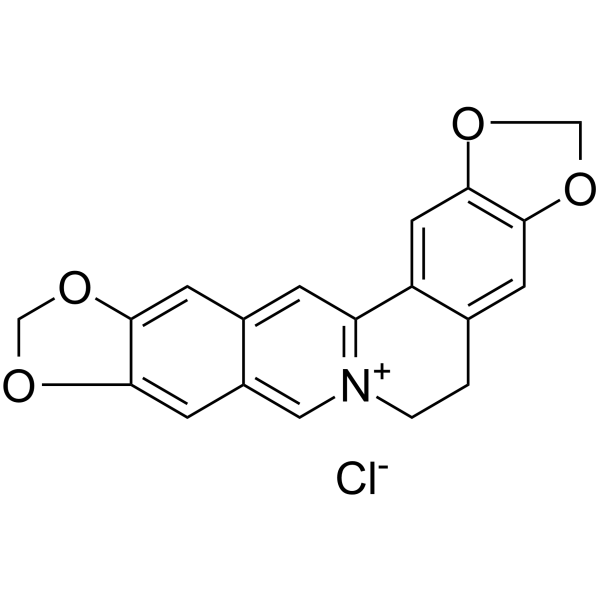
Pseudocoptisine chloride
CAS No. 30044-78-1
Pseudocoptisine chloride( Isocoptisine chloride )
Catalog No. M28939 CAS No. 30044-78-1
Pseudocoptisine chloride is isolated from Corydalis Tuber with anti-inflammatory and anti-amnestic properties. Pseudocoptisine chloride inhibits acetylcholinesterase (AChE) activity (IC50 = 12.8 μM).
Purity : >98% (HPLC)
 COA
Datasheet
HNMR
HPLC
MSDS
Handing Instructions
COA
Datasheet
HNMR
HPLC
MSDS
Handing Instructions
| Size | Price / USD | Stock | Quantity |
| 5MG | 155 | In Stock |


|
| 10MG | 235 | In Stock |
|
| 25MG | 440 | In Stock |
|
| 50MG | 635 | In Stock |
|
| 100MG | 899 | In Stock |
|
| 200MG | Get Quote | In Stock |
|
| 500MG | Get Quote | In Stock |
|
| 1G | Get Quote | In Stock |
|
Biological Information
-
Product NamePseudocoptisine chloride
-
NoteResearch use only, not for human use.
-
Brief DescriptionPseudocoptisine chloride is isolated from Corydalis Tuber with anti-inflammatory and anti-amnestic properties. Pseudocoptisine chloride inhibits acetylcholinesterase (AChE) activity (IC50 = 12.8 μM).
-
DescriptionPseudocoptisine chloride is isolated from Corydalis Tuber with anti-inflammatory and anti-amnestic properties. Pseudocoptisine chloride inhibits acetylcholinesterase (AChE) activity (IC50 = 12.8 μM).(In Vitro):In RAW264.7 cells, Pseudocoptisine chloride (0, 60, 90 μM; 1 hour) inhibited LPS-induced NO production in a dose-dependent manner. Pseudocoptisine chloride reduced levels of the pro-inflammatory mediators, such as, iNOS, COX-2, TNF-alpha, and IL-6 through the inhibition of NF-kappaB activation via the suppression of ERK and p38 phosphorylation. Pseudocoptisine chloride (30-90 μM; 1 hour) significantly reduced the LPS-induced TNF-α and IL-6 production and their mRNA expressions.(In Vivo):Pseudocoptisine chloride (2.0 mg/kg, p.o.) showed anti-amnesic activities on the learning and memory impairments induced by scopolamine (1.0 mg/kg, i.p.) and significantly reverses cognitive impairments in mice by passive avoidance test.
-
In VitroPseudocoptisine (0, 60, 90 μM; 1 hour) dose-dependently inhibited LPS-induced NO production in RAW264.7 cells.Pseudocoptisine (30-90 μM; 1 hour; RAW264.7 cells) significantly reduces the LPS-induced TNF-α and IL-6 production and their mRNA expressions.Pseudocoptisine acetate reduces levels of the pro-inflammatory mediators, such as, iNOS, COX-2, TNF-alpha, and IL-6 through the inhibition of NF-kappaB activation via the suppression of ERK and p38 phosphorylation in RAW 264.7 cells.
-
In VivoThe anti-amnesic activities of Pseudocoptisine in mice on the learning and memory impairments induced by scopolamine (1.0 mg/kg, i.p.) are examined. Pseudocoptisine (2.0 mg/kg, p.o.) significantly reverses cognitive impairments in mice by passive avoidance test.
-
SynonymsIsocoptisine chloride
-
PathwayMetabolic Enzyme/Protease
-
TargetAChE
-
RecptorVHL
-
Research Area——
-
Indication——
Chemical Information
-
CAS Number30044-78-1
-
Formula Weight355.77
-
Molecular FormulaC19H14ClNO4
-
Purity>98% (HPLC)
-
SolubilityIn Vitro:?DMSO : 1 mg/mL (2.81 mM)
-
SMILES[N+]12=CC3=CC4=C(OCO4)C=C3C=C1C5=CC6=C(OCO6)C=C5CC2.[Cl-]
-
Chemical Name——
Shipping & Storage Information
-
Storage(-20℃)
-
ShippingWith Ice Pack
-
Stability≥ 2 years
Reference
1.Buckley DL, et al. HaloPROTACS: Use of Small Molecule PROTACs to Induce Degradation of HaloTag Fusion Proteins. ACS Chem Biol. 2015 Aug 21;10(8):1831-7.
molnova catalog



related products
-
Clozapine N-oxide di...
Clozapine N-oxide dihydrochloride, a derivative of Clozapine and an agonist of human muscarinic design receptors (DREADDs), crosses the blood-brain barrier and activates DREADD receptors hM3Dq and hM4Di.
-
TAK-802 hydrochlorid...
A potent acetylcholinesterase (AChE) inhibitor with IC50 of 1.3 nM; exhibits high selectivity for acetylcholinesterase inhibition over butyrylcholinesterase inhibition.
-
Vincosamide
Vincosamide, an alkaloid from Psychotria leiocarpa extract, inhibits the acetylcholinesterase (AChE) activity with anti-inflammatory activity.
