


 Cart
Cart
 sales@molnova.com


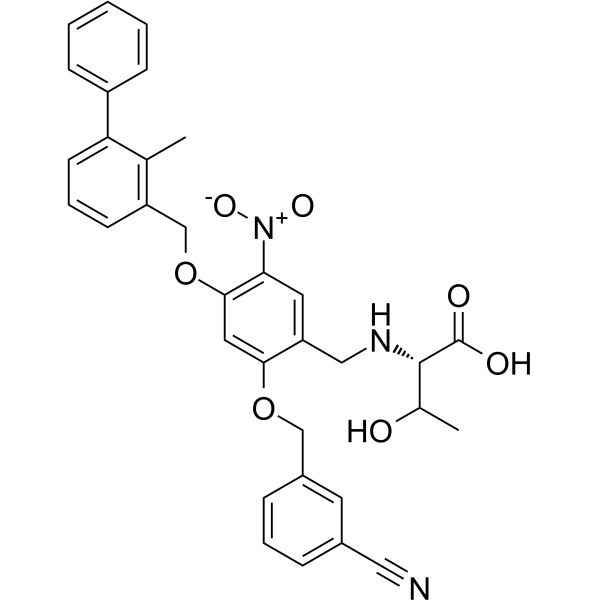
PD-1/PD-L1-IN-10
CAS No. 2487550-41-2
PD-1/PD-L1-IN-10( —— )
Catalog No. M28804 CAS No. 2487550-41-2
PD-1/PD-L1-IN-10 is an orally active PD-1/PD-L1 inhibitor (IC50 of 2.7 nM) with potent anticancer efficacy.
Purity : >98% (HPLC)
 COA
Datasheet
HNMR
HPLC
MSDS
Handing Instructions
COA
Datasheet
HNMR
HPLC
MSDS
Handing Instructions
| Size | Price / USD | Stock | Quantity |
| 1 mL x 10 mM in DMSO | 110 | In Stock |


|
| 5MG | 93 | In Stock |
|
| 10MG | 163 | In Stock |
|
| 25MG | 316 | In Stock |
|
| 50MG | 555 | In Stock |
|
| 100MG | 792 | In Stock |
|
| 200MG | Get Quote | In Stock |
|
| 500MG | Get Quote | In Stock |
|
| 1G | Get Quote | In Stock |
|
Biological Information
-
Product NamePD-1/PD-L1-IN-10
-
NoteResearch use only, not for human use.
-
Brief DescriptionPD-1/PD-L1-IN-10 is an orally active PD-1/PD-L1 inhibitor (IC50 of 2.7 nM) with potent anticancer efficacy.
-
DescriptionPD-1/PD-L1-IN-10 is an orally active PD-1/PD-L1 inhibitor (IC50 of 2.7 nM) with potent anticancer efficacy.(In Vitro):PD-1/PD-L1-IN-10 (compound B2) significantly promotes interferongamma secretion in a dose-dependent manner in vitro even at the low concentration of 1 nM.PD-1/PD-L1-IN-10 (compound B2) does not affect cell viability of LLC cells and lymph node T-cells.PD-1/PD-L1-IN-10 (compound B2, 0-100 nM) stabilizes the PD-L1 protein in mouse Lewis lung carcinoma (LLC) cells. In particular, PD-1/PD-L1-IN-10 (compound B2) maintains the PD-L1 stability in a dose-dependent manner at 58 °C. Suggesting that PD-1/PD-L1-IN-10 (compound B2) could enter LLC cells and then directly binds to the PD-L1 protein.(In Vivo):PD-1/PD-L1-IN-10 (compound B2, 5 mg/kg, intragastric gavage) exhibits potent in vivo anticancer efficacy in an LLC-bearing allograft mouse model. PD-1/PD-L1-IN-10 (compound B2) effectively blocks tumor cell proliferation and induces apoptosis in LLC tumor tissues..
-
In VitroPD-1/PD-L1-IN-10 (compound B2) significantly promotes interferongamma secretion in a dose-dependent manner in vitro even at the low concentration of 1 nM.PD-1/PD-L1-IN-10 (compound B2) does not affect cell viability of LLC cells and lymph node T-cells.PD-1/PD-L1-IN-10 (compound B2, 0-100 nM) stabilizes the PD-L1 protein in mouse Lewis lung carcinoma (LLC) cells. In particular, PD-1/PD-L1-IN-10 (compound B2) maintains the PD-L1 stability in a dose-dependent manner at 58 °C. Suggesting that PD-1/PD-L1-IN-10 (compound B2) could enter LLC cells and then directly binds to the PD-L1 protein.
-
In VivoPD-1/PD-L1-IN-10 (compound B2, 5 mg/kg, intragastric gavage) exhibits potent in vivo anticancer efficacy in an LLC-bearing allograft mouse model. PD-1/PD-L1-IN-10 (compound B2) effectively blocks tumor cell proliferation and induces apoptosis in LLC tumor tissues.. Animal Model:LLC tumor-bearing mice.Dosage:2, 5 mg/kg.Administration:i.g., qd., for 21 days Result:Significantly suppressed the growth of the tumor in a dose-dependent manner compared with the vehicle group.
-
Synonyms——
-
PathwayImmunology/Inflammation
-
TargetPD-1/PD-L1
-
Recptormonoamine oxidase
-
Research Area——
-
Indication——
Chemical Information
-
CAS Number2487550-41-2
-
Formula Weight581.62
-
Molecular FormulaC33H31N3O7
-
Purity>98% (HPLC)
-
SolubilityIn Vitro:?DMSO : 100 mg/mL (171.93 mM)
-
SMILESC[C@H]([C@@H](C(O)=O)NCc(c(OCc1cc(C#N)ccc1)c1)cc([N+]([O-])=O)c1OCc1c(C)c(-c2ccccc2)ccc1)O
-
Chemical Name——
Shipping & Storage Information
-
Storage(-20℃)
-
ShippingWith Ice Pack
-
Stability≥ 2 years
Reference
1.Zheng et al (2005) Novel potential neuroprotective agents with both iron chelating and amino acid-based derivatives targeting central nervous system neurons. Biochem.Pharmacol. 70 1642
molnova catalog



related products
-
CCC07-01
CCC07-01 (CCC 0701) is a novel alkylating compound that is capable of disrupting expression of PD-1, PD-L1 and CTLA-4 genes with IC50 of 15, 10 and 5 nM in cell-base assays.
-
BMS-202
BMS-202 is a small molecule inhibitor of the PD-1/PD-L1 interaction with IC50 of 18 nM in a homogenous time-resolved fluorescence binding assay.
-
PD-L1-IN-3
PD-L1-IN-3 (Compound 4a) functions as an inhibitor of the PD-1/PD-L1 axis, with an IC50 value of 4.97 nM for PD-L1 inhibition and an EC50 value of 2.70 μM for Jurkat T cell modulation.
