


 Cart
Cart
 sales@molnova.com


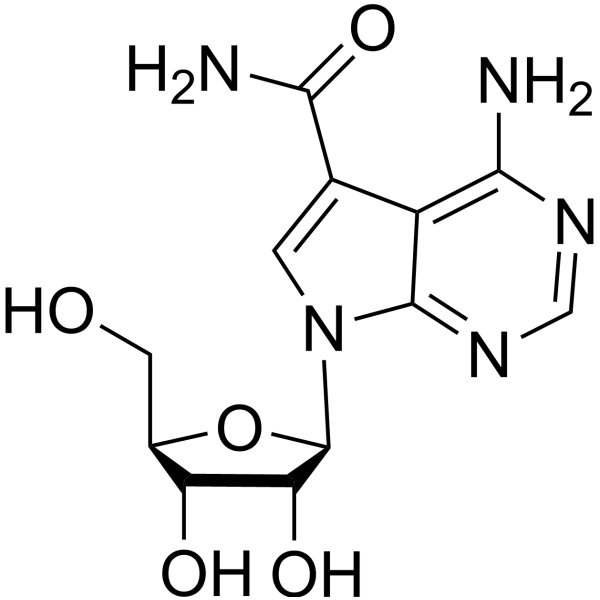
Sangivamycin
CAS No. 18417-89-5
Sangivamycin( NSC 65346 | BA-90912 )
Catalog No. M28797 CAS No. 18417-89-5
Sangivamycin is an effective inhibitor of protein kinase C (PKC, Ki = 10 μM). Sangivamycin exhibits antiproliferative activity against a variety of human cancers.
Purity : >98% (HPLC)
 COA
Datasheet
HNMR
HPLC
MSDS
Handing Instructions
COA
Datasheet
HNMR
HPLC
MSDS
Handing Instructions
| Size | Price / USD | Stock | Quantity |
| 1 mL x 10 mM in DMSO | 360 | In Stock |


|
| 5MG | 275 | In Stock |
|
| 10MG | 416 | In Stock |
|
| 25MG | 676 | In Stock |
|
| 50MG | 923 | In Stock |
|
| 100MG | 1237 | In Stock |
|
| 200MG | Get Quote | In Stock |
|
| 500MG | Get Quote | In Stock |
|
| 1G | Get Quote | In Stock |
|
Biological Information
-
Product NameSangivamycin
-
NoteResearch use only, not for human use.
-
Brief DescriptionSangivamycin is an effective inhibitor of protein kinase C (PKC, Ki = 10 μM). Sangivamycin exhibits antiproliferative activity against a variety of human cancers.
-
DescriptionSangivamycin is an effective inhibitor of protein kinase C (PKC, Ki = 10 μM). Sangivamycin exhibits antiproliferative activity against a variety of human cancers.(In Vitro):Sangivamycin (0.3 μM; 0-72 hours) exhibits almost maximal cytocidal for MCF7/ADR or cytostatic for MCF7/WT effects. Sangivamycin activates caspases in MCF7/ADR cells. Upon exposure of MCF7/ADR cells to Sangivamycin (0.3 μM), a vast amount of cleavage of lamin A to a 28-kDa fragment is detected within 48 hours. Sangivamycin has differential antitumor effects in drug-sensitive MCF7/wild type (WT) cells, causing growth arrest, and in multidrug-resistant MCF7/adriamycin-resistant (ADR) human breast carcinoma cells, causing massive apoptotic cell death.
-
In Vitro——
-
In Vivo——
-
SynonymsNSC 65346 | BA-90912
-
PathwayCell Cycle/DNA Damage
-
TargetNucleoside Antimetabolite/Analog
-
Recptor——
-
Research Area——
-
Indication——
Chemical Information
-
CAS Number18417-89-5
-
Formula Weight309.28
-
Molecular FormulaC12H15N5O5
-
Purity>98% (HPLC)
-
SolubilityIn Vitro:?DMSO : 100 mg/mL (323.33 mM)
-
SMILESNC(c1cn([C@@H]([C@@H]2O)O[C@H](CO)[C@H]2O)c2ncnc(N)c12)=O
-
Chemical Name——
Shipping & Storage Information
-
Storage(-20℃)
-
ShippingWith Ice Pack
-
Stability≥ 2 years
Reference
1.Virgolini I, et al. Current knowledge on the sensitivity of the (68)Ga-somatostatin receptor positron emission tomography and the SUV(max) reference range for management of pancreatic neuroendocrine tumours. Eur J Nucl Med Mol Imaging. 2016 May 13. [Epub ahead of print] Review.
molnova catalog



related products
-
RX-3117
RX-3117 (TV-1360, fluorocyclopentenylcytosine) is an orally available cytidine analog, nucleoside antimetabolite with potential antineoplastic activity.
-
Enocitabine
Enocitabine is a nucleoside analog. Enocitabine inhibits the replication of human cytomegalovirus(HCMV) and it also has antileukemic and antiviral activities.
-
2′-O-Methylcytidine
2′-O-Methylcytidine inhibits NS5B-catalyzed RNA synthesis in vitro, in a manner that is competitive with substrate nucleoside triphosphate. 2′-O-Methylcytidine inhibits HCV RNA replication.
