


 Cart
Cart
 sales@molnova.com


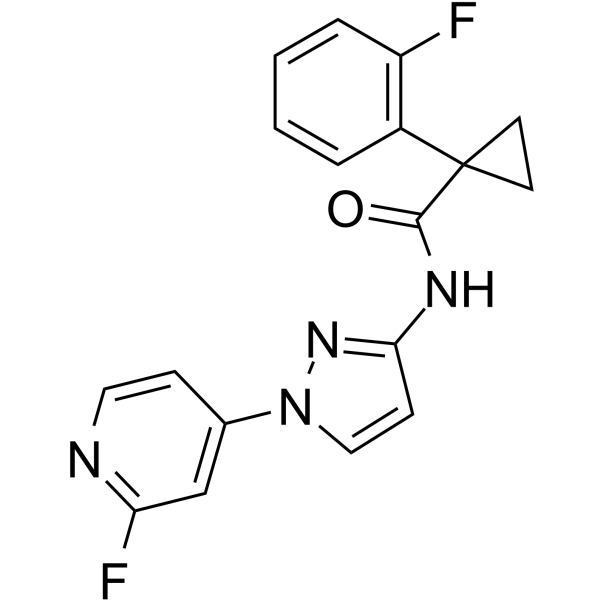
ELOVL1-IN-1
CAS No. 2227482-41-7
ELOVL1-IN-1( 1-(2-Fluorophenyl)-N-(1-(2-fluoropyridin-4-YL)-1H-pyrazol-3-YL)cyclopropane-1-carboxamide )
Catalog No. M28774 CAS No. 2227482-41-7
ELOVL1-IN-1 is an ELOVL1 inhibitor. ELOVL1-IN-1 can reduce the levels of very long chain fatty acids. ELOVL1-IN-1 can be used in the study of adrenoleukodystrophy (ALD).
Purity : >98% (HPLC)
 COA
Datasheet
HNMR
HPLC
MSDS
Handing Instructions
COA
Datasheet
HNMR
HPLC
MSDS
Handing Instructions
| Size | Price / USD | Stock | Quantity |
| 1 mL x 10 mM in DMSO | 353 | In Stock |


|
| 5MG | 321 | In Stock |
|
| 10MG | 472 | In Stock |
|
| 25MG | 846 | In Stock |
|
| 50MG | 1181 | In Stock |
|
| 100MG | 1535 | In Stock |
|
| 200MG | Get Quote | In Stock |
|
| 500MG | Get Quote | In Stock |
|
| 1G | Get Quote | In Stock |
|
Biological Information
-
Product NameELOVL1-IN-1
-
NoteResearch use only, not for human use.
-
Brief DescriptionELOVL1-IN-1 is an ELOVL1 inhibitor. ELOVL1-IN-1 can reduce the levels of very long chain fatty acids. ELOVL1-IN-1 can be used in the study of adrenoleukodystrophy (ALD).
-
DescriptionELOVL1-IN-1 is an ELOVL1 inhibitor. ELOVL1-IN-1 can reduce the levels of very long chain fatty acids. ELOVL1-IN-1 can be used in the study of adrenoleukodystrophy (ALD).(In Vitro):Administration of 1 nM-10 μM ELOVL1-IN-1 for 48 h reduces the level of VLCFA, lysophosphatidylcholine (LPC) in adrenoleukodystrophy (ALD) patient fibroblasts and healthy human fibroblasts, ALD patient B‐lymphocytes, and human microglia.(In Vivo):Oral dministration of ELOVL1-IN-1 reduces of a VLCFA level, specifically C26:0 LPC level in blood of ABCD1 knockout mice (0.5-64 mg/kg; 28 days), wild‐type (WT) rats (30-300 mg/kg; 7 days), and cynomolgous monkeys (30 mg/kg; 7 days).
-
In VitroELOVL1-IN-1 (compound 87) (1 nM-10 μM; 48 h) reduces the the level of VLCFA, lysophosphatidylcholine (LPC) in adrenoleukodystrophy (ALD) patient fibroblasts and healthy human fibroblasts, ALD patient B‐lymphocytes, and human microglia.
-
In VivoELOVL1-IN-1 (compound 87) reduces of a VLCFA level, specifically C26:0 LPC level in blood of ABCD1 knockout (KO) mice (0.5-64 mg/kg; p.o. once daily for 28 days), wild‐type (WT) rats (30-300 mg/kg; p.o. once daily for 7 days), and cynomolgous monkeys (30 mg/kg; p.o. once daily for 7 days).
-
Synonyms1-(2-Fluorophenyl)-N-(1-(2-fluoropyridin-4-YL)-1H-pyrazol-3-YL)cyclopropane-1-carboxamide
-
PathwayOthers
-
TargetOther Targets
-
RecptorAhR
-
Research Area——
-
Indication——
Chemical Information
-
CAS Number2227482-41-7
-
Formula Weight340.33
-
Molecular FormulaC18H14F2N4O
-
Purity>98% (HPLC)
-
SolubilityIn Vitro:?DMSO : 100 mg/mL (293.83 mM)
-
SMILESO=C(C1(CC1)c(cccc1)c1F)Nc(cc1)nn1-c1cc(F)ncc1
-
Chemical Name——
Shipping & Storage Information
-
Storage(-20℃)
-
ShippingWith Ice Pack
-
Stability≥ 2 years
Reference
1.Current Patent Assignee: MAGENTA THERAPEUTICS INC - WO2020/51207, 2020, A2
molnova catalog



related products
-
TriMetazidine EP IMp...
It is an organic compounds with molecular fomula C10H14O4.
-
Aleuritic Acid
Aleuritic acid, or α-aleuritic acid, is a major ingredient in shellac, constituting about 35% of it. It is used as a starting material in the perfume industry for the preparation of musk aroma.
-
Bocconoline
Bocconoline strongly perturbs various cellular components of human olfactory neurosphere-derived (hONS) cell lines.
