


 Cart
Cart
 sales@molnova.com


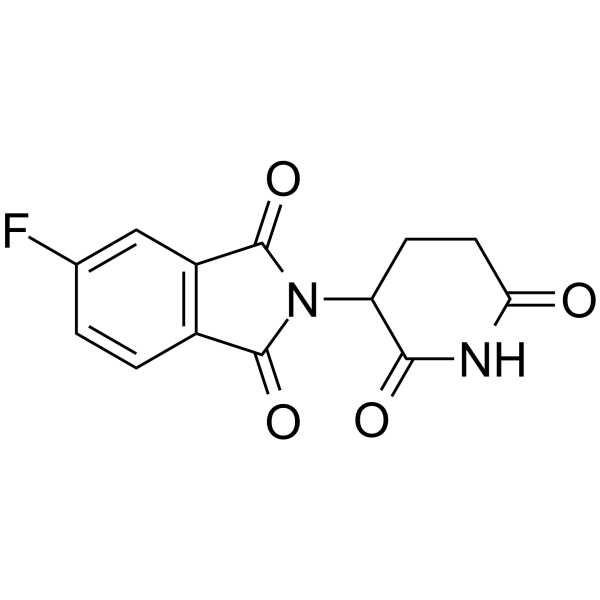
Thalidomide 5-fluoride
CAS No. 835616-61-0
Thalidomide 5-fluoride( H-Isoindole-1,3(2H)-dione, 2-(2,6-dioxo-3-piperidinyl)-5-fluoro- )
Catalog No. M28646 CAS No. 835616-61-0
Thalidomide 5-fluoride is a chemical compound.
Purity : >98% (HPLC)
 COA
Datasheet
HNMR
HPLC
MSDS
Handing Instructions
COA
Datasheet
HNMR
HPLC
MSDS
Handing Instructions
| Size | Price / USD | Stock | Quantity |
| 100MG | Get Quote | In Stock |


|
| 200MG | Get Quote | In Stock |
|
| 500MG | 27 | In Stock |
|
| 1G | Get Quote | In Stock |
|
Biological Information
-
Product NameThalidomide 5-fluoride
-
NoteResearch use only, not for human use.
-
Brief DescriptionThalidomide 5-fluoride is a chemical compound.
-
DescriptionThalidomide 5-fluoride is a chemical compound.
-
In Vitro——
-
In Vivo——
-
SynonymsH-Isoindole-1,3(2H)-dione, 2-(2,6-dioxo-3-piperidinyl)-5-fluoro-
-
PathwayOthers
-
TargetOther Targets
-
Recptor——
-
Research Area——
-
Indication——
Chemical Information
-
CAS Number835616-61-0
-
Formula Weight276.22
-
Molecular FormulaC13H9FN2O4
-
Purity>98% (HPLC)
-
SolubilityIn Vitro:?DMSO : 50 mg/mL (181.02 mM)
-
SMILESO=C(c(cc1)c2cc1F)N(C(CCC(N1)=O)C1=O)C2=O
-
Chemical Name——
Shipping & Storage Information
-
Storage(-20℃)
-
ShippingWith Ice Pack
-
Stability≥ 2 years
Reference
1.Waters LJ, Shahzad Y, Stephenson J. Modelling skin permeability with micellar liquid chromatography. Eur J Pharm Sci. 2013 Nov 20;50(3-4):335-40.
molnova catalog



related products
-
4,5-Dichlorocatechol
4,5-Dichlorocatechol is a substrate of the broad-spectrum chlorocatechol 1,2-dioxygenase of pseudomonas chlororaphis RW71.
-
Trimethylamine hydro...
Trimethylamine is a product of decomposition of plants and animals. It is the substance mainly responsible for the fishy odor often associated with fouling fish bacterial vagina infections and bad breath. It is also associated with taking large doses of choline.
-
Kaurenoic acid
Kaurenoic acid has anti-inflammatory potential in acetic acid-induced colitis, decreases in MDA level.
