


 Cart
Cart
 sales@molnova.com


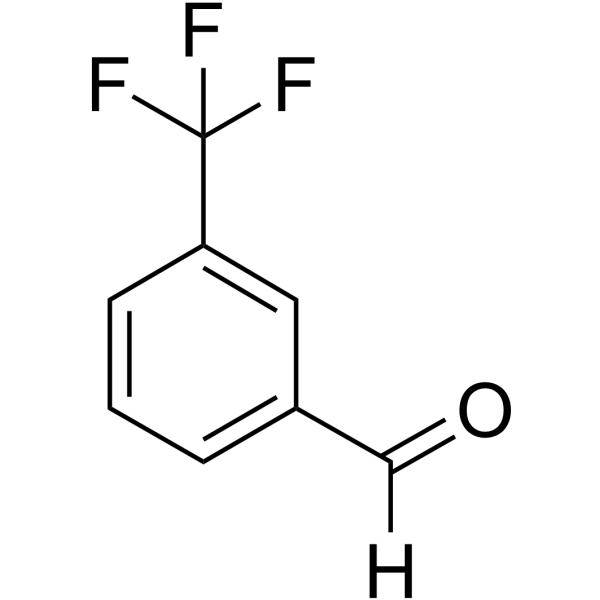
3-(Trifluoromethyl)benzaldehyde
CAS No. 454-89-7
3-(Trifluoromethyl)benzaldehyde( 3-Trifluoromethylbenzaldehyde )
Catalog No. M28634 CAS No. 454-89-7
3-(Trifluoromethyl)benzaldehyde is a chemical compound.
Purity : >98% (HPLC)
 COA
Datasheet
HNMR
HPLC
MSDS
Handing Instructions
COA
Datasheet
HNMR
HPLC
MSDS
Handing Instructions
| Size | Price / USD | Stock | Quantity |
| 1 mL x 10 mM in DMSO | 28 | In Stock |


|
| 100MG | Get Quote | In Stock |
|
| 200MG | Get Quote | In Stock |
|
| 500MG | Get Quote | In Stock |
|
| 1G | 27 | In Stock |
|
Biological Information
-
Product Name3-(Trifluoromethyl)benzaldehyde
-
NoteResearch use only, not for human use.
-
Brief Description3-(Trifluoromethyl)benzaldehyde is a chemical compound.
-
Description3-(Trifluoromethyl)benzaldehyde is a chemical compound.
-
In Vitro——
-
In Vivo——
-
Synonyms3-Trifluoromethylbenzaldehyde
-
PathwayOthers
-
TargetOther Targets
-
Recptorangiotensin II receptor
-
Research Area——
-
Indication——
Chemical Information
-
CAS Number454-89-7
-
Formula Weight174.12
-
Molecular FormulaC8H5F3O
-
Purity>98% (HPLC)
-
Solubility——
-
SMILESO=Cc1cccc(C(F)(F)F)c1
-
Chemical Name——
Shipping & Storage Information
-
Storage(-20℃)
-
ShippingWith Ice Pack
-
Stability≥ 2 years
Reference
1.Jin Q, et al. Allisartan isoproxil attenuates oxidative stress and inflammation through the SIRT1/Nrf2/NF?κB signalling pathway in diabetic cardiomyopathy rats. Mol Med Rep. 2021 Mar;23(3):215.
molnova catalog



related products
-
B I09
B I09, an IRE-1 RNase inhibitor with an IC50 of 1230 nM, inhibits splicing of XBP1 mRNA in human WaC3 cells and expression of xbp-1 in LPS-stimulated B cells. B I09 can be used to simulate the defects of XBP-1 in CLL cells.
-
(D-Thr6,D-Trp8·9,L-a...
(D-Thr6,D-Trp8·9,L-alaninol15)-Galanin (1-15)
-
Secretin, porcine
Secretin, porcine (Porcine secretin acetate) is a 27-amino acid peptide, acting on pancreatic acinar cells and ductal epithelial cells stimulating the production of bicarbonate rich fluid.Secretin porcine stimulates pancreatic and gastric secretions to aid in the diagnosis of pancreatic exocrine dysfunction and the diagnosis of gastrinoma.
