


 Cart
Cart
 sales@molnova.com


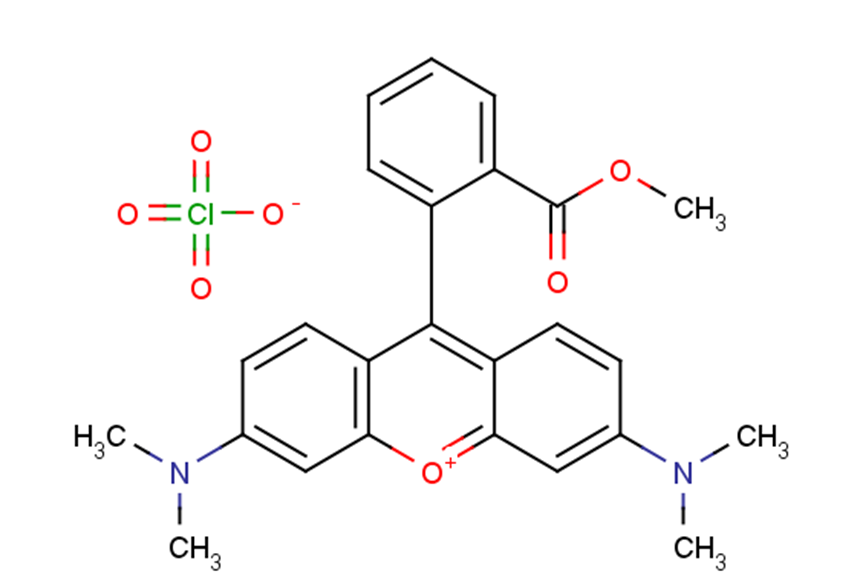
TMRM Perchlorate
CAS No. 115532-50-8
TMRM Perchlorate( T668 )
Catalog No. M22487 CAS No. 115532-50-8
TMRM Perchlorate is a cell-permeant cationic lipophilic red fluorescent dye (λex=530 nm, λem=592 nm). TMRM Perchlorate is a fluorescent probe (excitation, 530±21 nm; emission, 592±22 nm). In the presence of TMRM Perchlorate (2 μM) the coupled respiration with Complex I substrates or upon the addition of Complex II substrate is decreased by 27%.
Purity : >98% (HPLC)
 COA
Datasheet
HNMR
HPLC
MSDS
Handing Instructions
COA
Datasheet
HNMR
HPLC
MSDS
Handing Instructions
| Size | Price / USD | Stock | Quantity |
| 1 mL x 10 mM in DMSO | 41 | In Stock |


|
| 5MG | 37 | In Stock |
|
| 10MG | 61 | In Stock |
|
| 25MG | 117 | In Stock |
|
| 50MG | 212 | In Stock |
|
| 100MG | 346 | In Stock |
|
| 200MG | 481 | In Stock |
|
| 500MG | 779 | In Stock |
|
| 1G | Get Quote | In Stock |
|
Biological Information
-
Product NameTMRM Perchlorate
-
NoteResearch use only, not for human use.
-
Brief DescriptionTMRM Perchlorate is a cell-permeant cationic lipophilic red fluorescent dye (λex=530 nm, λem=592 nm). TMRM Perchlorate is a fluorescent probe (excitation, 530±21 nm; emission, 592±22 nm). In the presence of TMRM Perchlorate (2 μM) the coupled respiration with Complex I substrates or upon the addition of Complex II substrate is decreased by 27%.
-
DescriptionTMRM Perchlorate is a cell-permeant cationic lipophilic red fluorescent dye (λex=530 nm, λem=592 nm). TMRM Perchlorate is a fluorescent probe (excitation, 530±21 nm; emission, 592±22 nm). In the presence of TMRM Perchlorate (2 μM) the coupled respiration with Complex I substrates or upon the addition of Complex II substrate is decreased by 27%. The fluorescence signal in the presence of TMRM Perchlorate shows a slight decrease after the addition of glutamate, indicative of increased polarization of the mitochondrial inner membrane. Exposure of hippocampal cultures to high concentrations of TMRM Perchlorate (1 to 25 μM) stains mitochondria selectively and quickly, reaching a plateau after 5 to 10 min. Exposure of hippocampal cultures to low concentrations of TMRM Perchlorate (50 to 500 nM) for 1 to 3 hours results in selective staining of mitochondria in both neurons and the underlying glial cells. Low concentrations of TMRM Perchlorate (50 to 200 nM) do not induce apoptosis, whereas higher concentrations (0.5 and 2.5 μM) enhance apoptosis (KD = 500 nM).
-
In Vitro——
-
In Vivo——
-
SynonymsT668
-
PathwayOthers
-
TargetOther Targets
-
RecptorOthers
-
Research Area——
-
Indication——
Chemical Information
-
CAS Number115532-50-8
-
Formula Weight500.93
-
Molecular FormulaC25H25ClN2O7
-
Purity>98% (HPLC)
-
SolubilityDMSO:41.67 mg/mL (83.19 mM; Need ultrasonic)
-
SMILES[O-]Cl(=O)(=O)=O.COC(=O)c1ccccc1-c1c2ccc(cc2[o+]c2cc(ccc12)N(C)C)N(C)C
-
Chemical Name——
Shipping & Storage Information
-
Storage(-20℃)
-
ShippingWith Ice Pack
-
Stability≥ 2 years
Reference
1. Chowdhury SR, et al. Simultaneous evaluation of substrate-dependent oxygen consumption rates and mitochondrial membrane potential by TMRM and safranin in cortical mitochondria. Biosci Rep. 2015 Dec 8;36(1):e00286.
molnova catalog



related products
-
(Rac)-Acolbifene
(Rac)-Acolbifene is the racemic form of EM652 (estrogen receptor antagonist), has anti-estrogenic and estrogenic activities.
-
Dinoprost Tromethami...
Dinoprost(Prostaglandin F2α) tromethamine salt is a naturally occurring prostaglandin used in medicine to induce labor and as an abortifacient.
-
Debilon
Debilon shows cytotoxic activity against P-388 cells.
