


 Cart
Cart
 sales@molnova.com


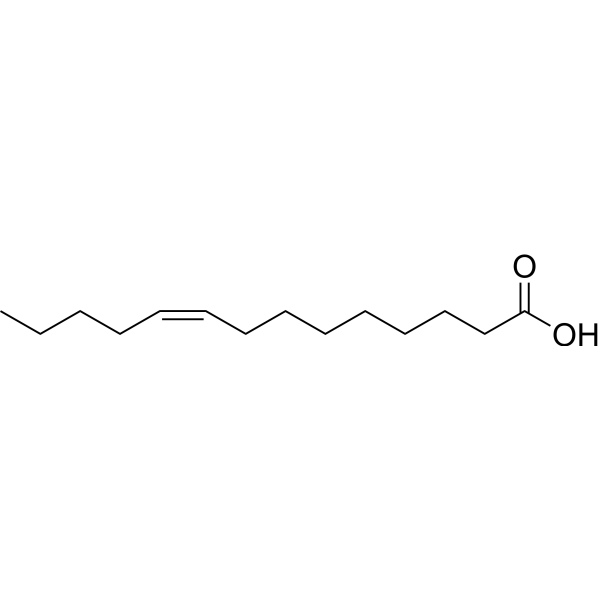
Myristoleic acid
CAS No. 544-64-9
Myristoleic acid( (Z)-Tetradec-9-enoic acid | cis-9-tetradecenoic acid | 9-Tetradecenoic acid )
Catalog No. M28356 CAS No. 544-64-9
Myristoleic acid is a cytotoxic component in the extract from Serenoa repens. Myristoleic acid induces apoptosis and necrosis in human prostatic LNCaP cells.
Purity : >98% (HPLC)
 COA
Datasheet
HNMR
HPLC
MSDS
Handing Instructions
COA
Datasheet
HNMR
HPLC
MSDS
Handing Instructions
| Size | Price / USD | Stock | Quantity |
| 10MG | 34 | In Stock |


|
| 25MG | 55 | In Stock |
|
| 100MG | Get Quote | In Stock |
|
| 200MG | Get Quote | In Stock |
|
| 500MG | Get Quote | In Stock |
|
| 1G | Get Quote | In Stock |
|
Biological Information
-
Product NameMyristoleic acid
-
NoteResearch use only, not for human use.
-
Brief DescriptionMyristoleic acid is a cytotoxic component in the extract from Serenoa repens. Myristoleic acid induces apoptosis and necrosis in human prostatic LNCaP cells.
-
DescriptionMyristoleic acid is a cytotoxic component in the extract from Serenoa repens. Myristoleic acid induces apoptosis and necrosis in human prostatic LNCaP cells.(In Vitro):Myristoleic acid induces both necrosis (100 μg/mL, 81.8%) and apoptosis (100 μg/mL, 89.5%) in LNCaP cells . Myristoleic acid inhibited RANKL-induced osteoclast formation in vitro, especially, at later stages of differentiation. (In Vivo):Myristoleic acid (2 mg/kg, IP every 24 h for 4 days) prevents RANKL-induced bone loss and osteoclast formation in mice .
-
In VitroMyristoleic acid induces both apoptosis (100 μg/mL, 89.5%) and necrosis (100 μg/mL, 81.8%) in LNCaP cells. Myristoleic acid inhibited RANKL-induced osteoclast formation in vitro, especially, at later stages of differentiation. Cell Proliferation Assay Cell Line:Human prostatic carcinoma LNCaP cells.Concentration:0, 50, 100, 150, 200, 250 μg/mL.Incubation Time:24 h.Result:When LNCaP cells were treated with 130 μg/mL extract or 100 μg/mL myristoleic acid for 24 hr, the proportion of apoptotic cells was 16.5 and 8.8%, and that of necrotic one was 46.8 and 81.8%, respectively.
-
In VivoMyristoleic acid (2 mg/kg, IP every 24 h for 4 days) prevents RANKL-induced bone loss and osteoclast formation in mice. Animal Model:C57BL/6 mice at 5 weeks. Dosage:0.2, 2 mg/kg Administration:IP every 24 h for 4 days.Result:Co-administration of myristoleic acid suppressed generation of TRAP-positive osteoclasts induced by sRANKL and attenuated the increases in osteoclastic indices of Oc.S/BS, N.Oc/B. Pm and ES/BS in a dose-dependent manner.
-
Synonyms(Z)-Tetradec-9-enoic acid | cis-9-tetradecenoic acid | 9-Tetradecenoic acid
-
PathwayApoptosis
-
TargetApoptosis
-
RecptorSARS-CoV-2
-
Research Area——
-
Indication——
Chemical Information
-
CAS Number544-64-9
-
Formula Weight226.36
-
Molecular FormulaC14H26O2
-
Purity>98% (HPLC)
-
SolubilityIn Vitro:?DMSO : ≥ 100 mg/mL (441.77 mM)
-
SMILESCCCC\C=C/CCCCCCCC(O)=O
-
Chemical Name——
Shipping & Storage Information
-
Storage(-20℃)
-
ShippingWith Ice Pack
-
Stability≥ 2 years
Reference
1.Han SH, et al. Structure-Based Optimization of ML300-Derived, Noncovalent Inhibitors Targeting the Severe Acute Respiratory Syndrome Coronavirus 3CL Protease (SARS-CoV-2 3CLpro). J Med Chem. 2022 Feb 24;65(4):2880-2904.
molnova catalog



related products
-
M3541
M3541 is a selectively potent and orally active ATM inhibitor with potential antitumor activity.M-3541 inhibits ATM kinase activity and ATM-mediated signaling by binding to ATM.
-
Pyrazoloacridine
Pyrazoloacridine is a nucleic acid binding agent that inhibits the activity of topo I and II with an IC50 of 1.25 μM in K562 cells. Pyrazoloacridine shows anti-cancer activity.
-
BTZO-1
BTZO-1 is an antioxidant response element (ARE) activator with cardioprotective activity.
