


 Cart
Cart
 sales@molnova.com


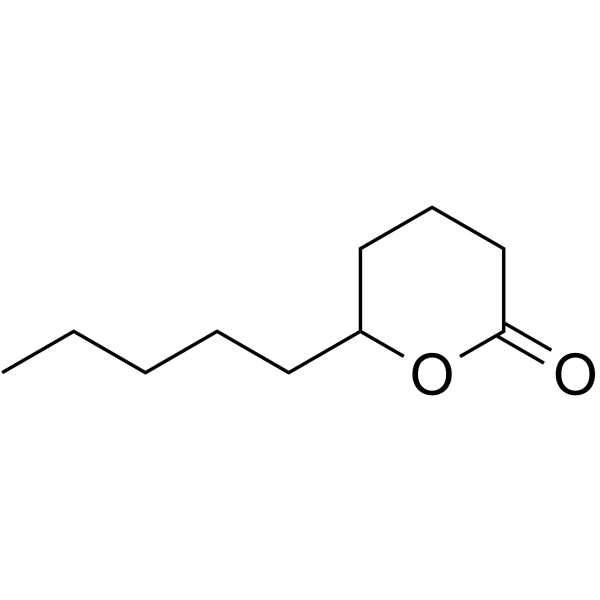
δ-Decalactone
CAS No. 705-86-2
δ-Decalactone( —— )
Catalog No. M28334 CAS No. 705-86-2
δ-Decalactone is found in nonfat dry milks and fruits and with a sweet taste.
Purity : >98% (HPLC)
 COA
Datasheet
HNMR
HPLC
MSDS
Handing Instructions
COA
Datasheet
HNMR
HPLC
MSDS
Handing Instructions
| Size | Price / USD | Stock | Quantity |
| 1 mL x 10 mM in DMSO | 29 | In Stock |


|
| 100MG | Get Quote | In Stock |
|
| 200MG | Get Quote | In Stock |
|
| 500MG | Get Quote | In Stock |
|
| 1G | 37 | In Stock |
|
Biological Information
-
Product Nameδ-Decalactone
-
NoteResearch use only, not for human use.
-
Brief Descriptionδ-Decalactone is found in nonfat dry milks and fruits and with a sweet taste.
-
Descriptionδ-Decalactone is found in nonfat dry milks and fruits and with a sweet taste.
-
In Vitro——
-
In Vivo——
-
Synonyms——
-
PathwayOthers
-
TargetOther Targets
-
RecptorCRF1|Adrenocorticotropic hormone (ACTH)
-
Research Area——
-
Indication——
Chemical Information
-
CAS Number705-86-2
-
Formula Weight170.252
-
Molecular FormulaC10H18O2
-
Purity>98% (HPLC)
-
SolubilityIn Vitro:?DMSO : 100 mg/mL (587.37 mM)
-
SMILESCCCCCC1CCCC(=O)O1
-
Chemical Name——
Shipping & Storage Information
-
Storage(-20℃)
-
ShippingWith Ice Pack
-
Stability≥ 2 years
Reference
1.Zorrilla EP, Logrip ML, Koob GF. Corticotropin releasing factor: a key role in the neurobiology of addiction. Front Neuroendocrinol. 2014 Apr;35(2):234-44.
molnova catalog



related products
-
Uracil
Uracil is one of the four nucleobases in the nucleic acid of RNA can be used for drug delivery and as a pharmaceutical.
-
PF-06446846 hydrochl...
PF-06446846 hydrochloride, an orally active and highly selective inhibitor, targets Proprotein Convertase Subtilisin/Kexin type 9 (PCSK9) translation by inducing ribosomal stalling at approximately codon 34, effectively suppressing PCSK9 expression.
-
Gentiiridosides A
Gentiiridosides A
