


 Cart
Cart
 sales@molnova.com


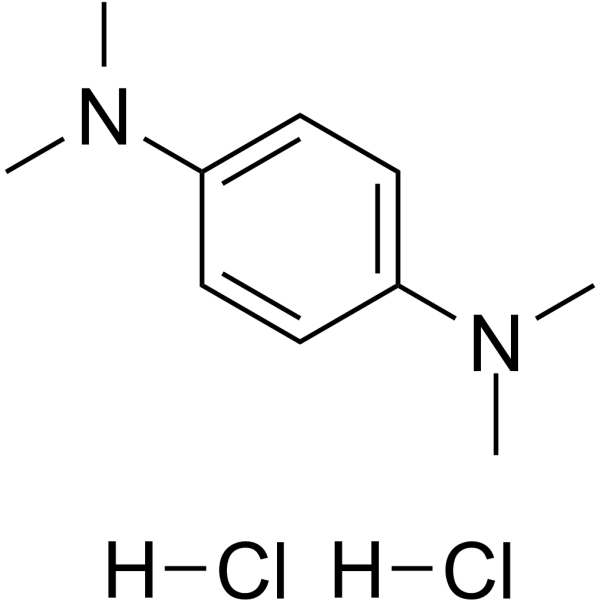
TMPD dihydrochloride
CAS No. 637-01-4
TMPD dihydrochloride( —— )
Catalog No. M28331 CAS No. 637-01-4
TMPD dihydrochloride is an active substrate of enzymatically convert redox and an electron donor for the reduction of heme peroxidases.
Purity : >98% (HPLC)
 COA
Datasheet
HNMR
HPLC
MSDS
Handing Instructions
COA
Datasheet
HNMR
HPLC
MSDS
Handing Instructions
| Size | Price / USD | Stock | Quantity |
| 100MG | Get Quote | In Stock |


|
| 200MG | Get Quote | In Stock |
|
| 500MG | Get Quote | In Stock |
|
| 1G | 27 | In Stock |
|
Biological Information
-
Product NameTMPD dihydrochloride
-
NoteResearch use only, not for human use.
-
Brief DescriptionTMPD dihydrochloride is an active substrate of enzymatically convert redox and an electron donor for the reduction of heme peroxidases.
-
DescriptionTMPD dihydrochloride is an active substrate of enzymatically convert redox and an electron donor for the reduction of heme peroxidases.(In Vitro):TMPD dihydrochloride differentiates organisms that exhibit CYP C oxidase activity and distinguishes between Gram-negative and Gram-positive pathogenic and non-pathogenic bacteria. TMPD dihydrochloride can be used as a colorimetric indicator.
-
In VitroTMPD (N,N,N′,N′-tetramethyl-para-phenylene-diamine) is used in cell culture and microbiology to differentiate organisms that exhibit cytochrome c oxidase activity and to distinguish between Gram-negative and Gram-positive pathogenic and non-pathogenic bacteria.The concept of TMPD oxidation by microorganisms is widely used and is known as a successful colorimetric indicator for bacterial oxidases, as the radical cation TMPD+˙, formed by oxidation, shows a characteristic deep blue colour. The electrochemical recognition of the TMPD oxidation by bacterial oxidases can be applied to a variety of pathogens.
-
In Vivo——
-
Synonyms——
-
PathwayOthers
-
TargetOther Targets
-
Recptor——
-
Research Area——
-
Indication——
Chemical Information
-
CAS Number637-01-4
-
Formula Weight237.17
-
Molecular FormulaC10H18Cl2N2
-
Purity>98% (HPLC)
-
SolubilityIn Vitro:?H2O : 100 mg/mL (421.64 mM)
-
SMILESCN(C)C1=CC=C(N(C)C)C=C1.Cl.Cl
-
Chemical Name——
Shipping & Storage Information
-
Storage(-20℃)
-
ShippingWith Ice Pack
-
Stability≥ 2 years
Reference
1.Weber U, Schmid H. Synthese und biologische Aktivit?t des Dekapeptids Gly-Pro-Cys-Lys-Ala-Arg-Phe-Gly-Gly-Cys als Modell für das aktive Zentrum des basischen Trypsininhibitors aus Rinderorganen (Kunitz-Inhibitor [Synthesis and biological activity of the decapeptide Gly-Pro-Cys-Lys-Ala-Arg-Phe-Gly-Gly-Cys as a model for the active center of the basic trypsin inhibitor from bovine organs (Kunitz inhibitor) (author's transl)]. Hoppe Seylers Z Physiol Chem. 1976 Dec;357(10):1359-63. German.
molnova catalog



related products
-
Antibacterial agent ...
(2S)-4-biphenyl-4-yl-N-hydroxy-2-methyl-2-(methylsulfonyl)butanamide is a LpxC inhibitor with IC50 >95.2 nM.
-
Endothelin-1 (human,...
Endothelin 1 (swine, human) is a synthetic peptide with the sequence of human and swine Endothelin 1, which is a potent endogenous vasoconstrictor. Endothelin 1 acts through two types of receptors ETA and ETB.
-
BAY1217389
BAY 1217389 is an effective and selective inhibitor of the monopolar spindle 1 (MPS1) kinase (IC50<10 nM).
