


 Cart
Cart
 sales@molnova.com


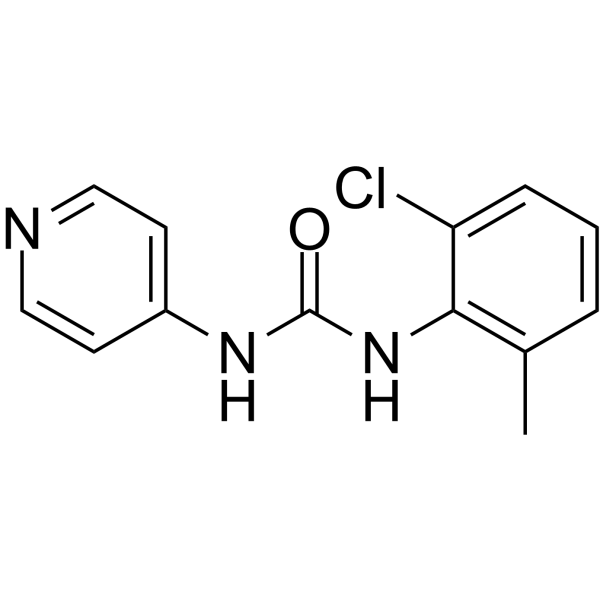
N-(2-Chloro-6-methylphenyl)-N-4-pyridinylurea
CAS No. 97627-24-2
N-(2-Chloro-6-methylphenyl)-N-4-pyridinylurea( —— )
Catalog No. M26317 CAS No. 97627-24-2
N-(2-Chloro-6-methylphenyl)-N'-4-pyridinylurea is an anticonvulsant agent, treatment of generalized tonic-clonic and partial seizures.
Purity : >98% (HPLC)
 COA
Datasheet
HNMR
HPLC
MSDS
Handing Instructions
COA
Datasheet
HNMR
HPLC
MSDS
Handing Instructions
| Size | Price / USD | Stock | Quantity |
| 1 mL x 10 mM in DMSO | 53 | In Stock |


|
| 2MG | 29 | In Stock |
|
| 5MG | 48 | In Stock |
|
| 10MG | 82 | In Stock |
|
| 25MG | 164 | In Stock |
|
| 50MG | 259 | In Stock |
|
| 100MG | 416 | In Stock |
|
| 200MG | 576 | In Stock |
|
| 500MG | Get Quote | In Stock |
|
| 1G | Get Quote | In Stock |
|
Biological Information
-
Product NameN-(2-Chloro-6-methylphenyl)-N-4-pyridinylurea
-
NoteResearch use only, not for human use.
-
Brief DescriptionN-(2-Chloro-6-methylphenyl)-N'-4-pyridinylurea is an anticonvulsant agent, treatment of generalized tonic-clonic and partial seizures.
-
DescriptionN-(2-Chloro-6-methylphenyl)-N'-4-pyridinylurea is an anticonvulsant agent, treatment of generalized tonic-clonic and partial seizures.(In Vivo):N-(2-Chloro-6-methylphenyl)-N'-4-pyridinylurea shows anticonvulsant activity at 30 mg/kg in the initial tests with no signs of ataxia until 300 mg/kg. The activity seen with 30 mg/kg 37 is still present 4 h postdose. Compound is effective against seizures induced by maximal electroshock but does not protect mice from clonic seizures produced by the convulsant pentylenetetrazol. The overall pharmacological profile suggests that Compound would be of therapeutic use in the treatment of generalized tonic-clonic and partial seizures.
-
In Vitro——
-
In VivoCompound shows anticonvulsant activity at 30 mg/kg in the initial tests with no signs of ataxia until 300 mg/kg. The activity seen with 30 mg/kg 37 is still present 4 h postdose. Compound is effective against seizures induced by maximal electroshock but does not protect mice from clonic seizures produced by the convulsant pentylenetetrazol. The overall pharmacological profile suggests that Compound would be of therapeutic use in the treatment of generalized tonic-clonic and partial seizures. Compound is selected for clinical trials.
-
Synonyms——
-
PathwayOthers
-
TargetOther Targets
-
RecptornAChR| PAFR
-
Research Area——
-
Indication——
Chemical Information
-
CAS Number97627-24-2
-
Formula Weight261.71
-
Molecular FormulaC13H12ClN3O
-
Purity>98% (HPLC)
-
SolubilityIn Vitro:?DMSO : 125 mg/mL (477.63 mM)
-
SMILESCc1cccc(Cl)c1NC(=O)Nc1ccncc1
-
Chemical Name——
Shipping & Storage Information
-
Storage(-20℃)
-
ShippingWith Ice Pack
-
Stability≥ 2 years
Reference
1.Synthesis and anti-platelet activity of ferulamide derivativesJournal of Chinese Pharmaceutical Sciences, 2002, 54(1):41-52.
molnova catalog



related products
-
1-O-p-coumaroyl-β-D-...
1-O-p-Coumaroyl-β-D-glucose can promote glucose uptake in HuH7 cells, and be be extracted from Luffa cylindrica (L.) Roem (sponge gourds).
-
Schnurri-3 inhibitor...
Schnurri-3 inhibitor-1, a potent inhibitor of schnurri-3, is an essential regulator of bone formation in adults that can be used in osteoporosis research. Schnurri-3 inhibitor-1 can inhibit Shn3 with EF1alpha promoter in osteoblast cell line Shn3FFL (AC50 = 2.09 μM) .
-
Cyclosporin H
Cyclosporin H (CsH), a specific inhibitor of FPR1, inhibited lung inflammation in the ALI models.
