


 Cart
Cart
 sales@molnova.com


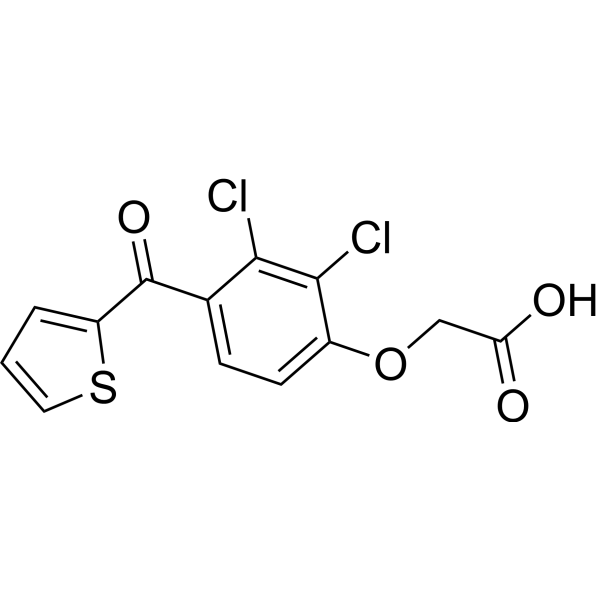
Tienilic Acid
CAS No. 40180-04-9
Tienilic Acid( Ticrynafen | ANP 3624 )
Catalog No. M28066 CAS No. 40180-04-9
Tienilic Acid is a uricosuric diuretic with certain hepatotoxicity.
Purity : >98% (HPLC)
 COA
Datasheet
HNMR
HPLC
MSDS
Handing Instructions
COA
Datasheet
HNMR
HPLC
MSDS
Handing Instructions
| Size | Price / USD | Stock | Quantity |
| 1 mL x 10 mM in DMSO | 44 | In Stock |


|
| 5MG | 37 | In Stock |
|
| 10MG | 68 | In Stock |
|
| 25MG | 140 | In Stock |
|
| 50MG | 203 | In Stock |
|
| 100MG | 300 | In Stock |
|
| 200MG | 449 | In Stock |
|
| 500MG | Get Quote | In Stock |
|
| 1G | Get Quote | In Stock |
|
Biological Information
-
Product NameTienilic Acid
-
NoteResearch use only, not for human use.
-
Brief DescriptionTienilic Acid is a uricosuric diuretic with certain hepatotoxicity.
-
DescriptionTienilic Acid is a uricosuric diuretic with certain hepatotoxicity.(In Vivo):In female and male Sprague-Dawley rats, Tienilic Acid decreased blood pressure and serum uric acid at 30 mg/kg. Tienilic acid decreased slightly hemoglobin and increased S-GPT at 120 and 480 mg/kg. Tienilic Acid significantly increase the liver weight and serum magnesium concentration in male rats, while the liver weight of female rats increased only slightly. Tienilic Acid also induced unicellular necrosis of small groups of liver cells.
-
In Vitro——
-
In VivoTienilic acid (100 mg/lg in rats and mice, 5 mg/kg in pigs and dog; PO and IV; single dosage) is only found in plasma, eliminates by the biliary and the urinary fast, and exhibits small differences in the different species.Tienilic acid (0-480 mg/kg; PO; for 28 days) decreases blood pressure, serum, uric acidhemoglobin, and increased S-GPT; induces unicellular necrosis of small groups of liver cells. Animal Model:Rats, mice, pigs and dogs Dosage:100 mg/lg in rats and mice, 5 mg/kg in pigs and dogs Administration:PO and IV; single dosageResult:Only found in plasma with important bindings to the plasma proteins at the blood level; pharmacological action for several hours; eliminated by the biliary and particularly the urinary fast, practically total in the first 48 hours after administration; only small differences were observed for the parameters measured in the different species.Animal Model:Female and male Sprague-Dawley rats Dosage:0, 30, 120 and 480 mg/kg Administration:PO; for 28 days Result:Decreased blood pressure and serum uric acid at 30 mg/kg; decreased slightly hemoglobin and increased S-GPT at 120 and 480 mg/kg; significantly increase the liver weight and serum magnesium concentration in male rats, while the liver weight of female rats increased only slightly; besides, induced unicellular necrosis of small groups of liver cells.
-
SynonymsTicrynafen | ANP 3624
-
PathwayMetabolic Enzyme/Protease
-
TargetP450
-
Recptor——
-
Research Area——
-
Indication——
Chemical Information
-
CAS Number40180-04-9
-
Formula Weight331.16
-
Molecular FormulaC13H8Cl2O4S
-
Purity>98% (HPLC)
-
SolubilityIn Vitro:?DMSO : 100 mg/mL (301.96 mM)
-
SMILESOC(=O)COc1ccc(C(=O)c2cccs2)c(Cl)c1Cl
-
Chemical Name——
Shipping & Storage Information
-
Storage(-20℃)
-
ShippingWith Ice Pack
-
Stability≥ 2 years
Reference
1.Chan FC, et al. 3- and 4-pyridylalkyl adamantanecarboxylates: inhibitors of human cytochrome P450(17 alpha) (17 alpha-hydroxylase/C17,20-lyase). Potential nonsteroidal agents for the treatment of prostatic cancer. J Med Chem. 1996 Aug 16;39(17):3319-23.
molnova catalog



related products
-
Tyrosol
Tyrosol is a phenolic antioxidant that is naturally present in several foods such as wines and green tea and is present most abundantly in olives.
-
Beta-Tetralone
2-Tetralone is an organic chemical compound with the molecular formula C10H10O.
-
Proadifen hydrochlor...
Proadifen hydrochloride is a Cytochrome P450 inhibitor (IC50 = 19μM).
