


 Cart
Cart
 sales@molnova.com


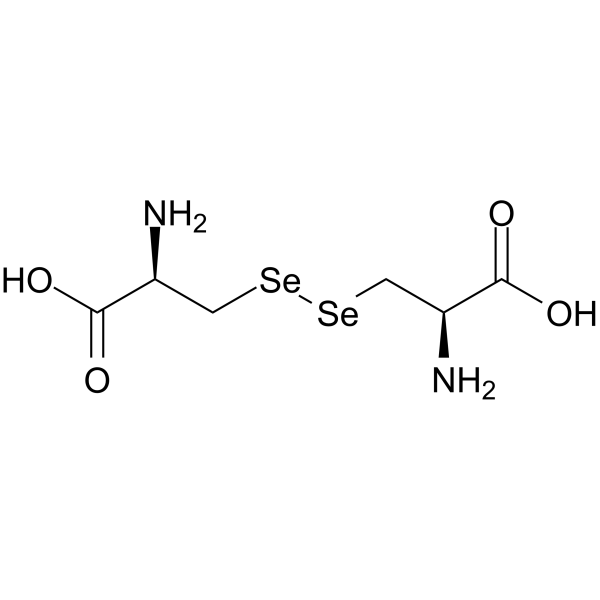
L-Selenocystine
CAS No. 29621-88-3
L-Selenocystine( —— )
Catalog No. M28015 CAS No. 29621-88-3
L-Selenocystine can be used as a building block in biologically active selenol compounds.
Purity : >98% (HPLC)
 COA
Datasheet
HNMR
HPLC
MSDS
Handing Instructions
COA
Datasheet
HNMR
HPLC
MSDS
Handing Instructions
| Size | Price / USD | Stock | Quantity |
| 1 mL x 10 mM in DMSO | 48 | In Stock |


|
| 25MG | 29 | In Stock |
|
| 50MG | 35 | In Stock |
|
| 100MG | 50 | In Stock |
|
| 200MG | Get Quote | In Stock |
|
| 500MG | Get Quote | In Stock |
|
| 1G | Get Quote | In Stock |
|
Biological Information
-
Product NameL-Selenocystine
-
NoteResearch use only, not for human use.
-
Brief DescriptionL-Selenocystine can be used as a building block in biologically active selenol compounds.
-
DescriptionL-Selenocystine can be used as a building block in biologically active selenol compounds.
-
In Vitro——
-
In Vivo——
-
Synonyms——
-
PathwayOthers
-
TargetOther Targets
-
RecptorAntiviral
-
Research Area——
-
Indication——
Chemical Information
-
CAS Number29621-88-3
-
Formula Weight334.114
-
Molecular FormulaC6H12N2O4Se2
-
Purity>98% (HPLC)
-
SolubilityIn Vitro:?H2O : 5.88 mg/mL (17.60 mMu)
-
SMILESN[C@@H](C[Se][Se]C[C@H](N)C(O)=O)C(O)=O
-
Chemical Name——
Shipping & Storage Information
-
Storage(-20℃)
-
ShippingWith Ice Pack
-
Stability≥ 2 years
Reference



-
[Pro3]-GIP (Rat)
High affinity rat GIP receptor partial agonist (Kd = 13 nM). Increases cAMP accumulation in COS-7 cells transfected with rat GIP receptor, while also acting as a competitive antagonist of GIP.
-
MC1742
MC1742 is an inhibitor of class I histone deacetylases (HDACs; IC50s = 0.1, 0.11, 0.02, and 0.61 μM for HDAC1, -2, -3, and -8, respectively) and class IIb HDACs (IC50s = 7 and 40 nM for HDAC6 and HDAC10, respectively).
-
FG 7142
FG 7142?also modulates GABA-induced chloride flux at GABAA receptors expressing the α1 subunit (EC50= 137 nM).?FG 7142?can increase tyrosine hydroxylation and cause upregulation of β-adrenoceptors in mouse cerebral cortex.?FG 7142 , a non-selectively benzodiazepine inverse agonist, has high affinity for the α1 subunit-containing GABAA receptor (Ki=91 nM).?
