


 Cart
Cart
 sales@molnova.com


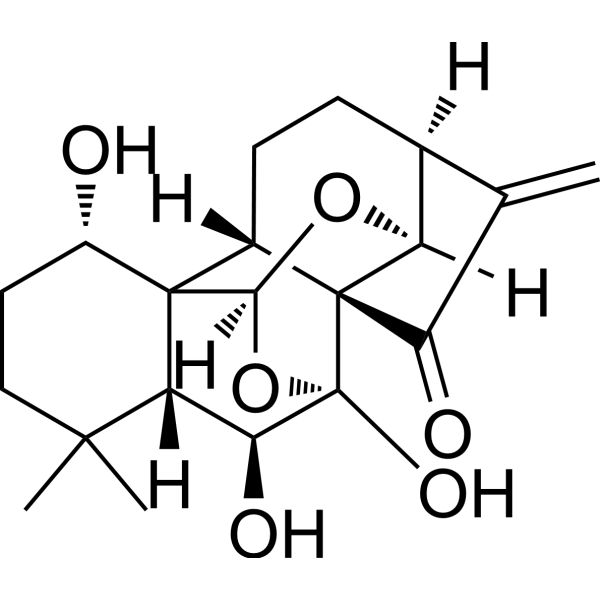
Ponicidin
CAS No. 52617-37-5
Ponicidin( Rubescensine B )
Catalog No. M27958 CAS No. 52617-37-5
Ponicidin is a diterpenoid derived from Rabdosia rubescens. Ponicidin exhibits immunoregulatory, anti-inflammatory, anti-viral, and anti-cancer activity.
Purity : >98% (HPLC)
 COA
Datasheet
HNMR
HPLC
MSDS
Handing Instructions
COA
Datasheet
HNMR
HPLC
MSDS
Handing Instructions
| Size | Price / USD | Stock | Quantity |
| 1 mL x 10 mM in DMSO | 111 | In Stock |


|
| 5MG | 123 | In Stock |
|
| 10MG | 187 | In Stock |
|
| 25MG | 315 | In Stock |
|
| 50MG | 461 | In Stock |
|
| 100MG | Get Quote | In Stock |
|
| 200MG | Get Quote | In Stock |
|
| 500MG | Get Quote | In Stock |
|
| 1G | Get Quote | In Stock |
|
Biological Information
-
Product NamePonicidin
-
NoteResearch use only, not for human use.
-
Brief DescriptionPonicidin is a diterpenoid derived from Rabdosia rubescens. Ponicidin exhibits immunoregulatory, anti-inflammatory, anti-viral, and anti-cancer activity.
-
DescriptionPonicidin is a diterpenoid derived from Rabdosia rubescens. Ponicidin exhibits immunoregulatory, anti-inflammatory, anti-viral, and anti-cancer activity. Ponicidin induces apoptosis of gastric carcinoma cells, decreases the phosphorylation of JAK2 and STAT3, and shows no effect on protein levels of JAK2 and STAT3.(In Vitro):K562 cells in culture medium in vitro were given different concentrations of Ponicidin (10-50 micromol x L(-1)) for 24, 48, and 72 h. The inhibitory rate of the cells was measured by MTT assay, cell apoptotic rates were detected by flow cytometry (FCM) using Annexin V staining after K562 cells were treated with different concentrations of Ponicidin for 72 hours, and cell morphology was observed by Wright-Giemsa staining. Ponicidin (over 30 micromol x L(-1)) could inhibit the growth of K562 cells in both time- and dose-dependent manner. FCM analysis revealed that apoptotic cells were gradually increased in a dose-dependent manner after treatment for 72 hours, and that marked morphological changes of cell apoptosis such as condensation of chromatin was clearly observed by Wright-Giemsa staining after treatment by 50 micromol x L(-1) Ponicidin. Furthermore, Western blotting also showed that expression of p-AKT and p-P85 in PI3K/AKT signaling pathways was downregulated dramatically whereas the expression of p-P38, as well as p-ERK and p-JNK, remained unchanged after the cells were treated by PON for 48 h.
-
In Vitro——
-
In Vivo——
-
SynonymsRubescensine B
-
PathwayApoptosis
-
TargetApoptosis
-
RecptorEGFR|HER2
-
Research Area——
-
Indication——
Chemical Information
-
CAS Number52617-37-5
-
Formula Weight362.42
-
Molecular FormulaC20H26O6
-
Purity>98% (HPLC)
-
SolubilityIn Vitro:?DMSO : 125 mg/mL (344.90 mM)
-
SMILESC=C1C([C@@]23[C@](O)(O4)[C@@H](O)[C@]5([H])C(C)(C)CC[C@H](O)[C@@]5([C@@]4([H])O[C@@]3([H])[C@H]1CC6)[C@@]26[H])=O
-
Chemical Name——
Shipping & Storage Information
-
Storage(-20℃)
-
ShippingWith Ice Pack
-
Stability≥ 2 years
Reference
1.Adam V Patterson, et al. Abstract 5358: The hypoxia-activated EGFR-TKI TH-4000 overcomes erlotinib-resistance in preclinical NSCLC models at plasma levels achieved in a Phase 1 clinical trial. AACR 106th Annual Meeting 2015; April 18-22, 2015; Philadelphia, PA.
molnova catalog



related products
-
ASK1-IN-2
ASK1-IN-2 is a potent and orally active inhibitor of apoptosis signal-regulating kinase 1 (ASK1), with an IC50 of 32.8 nM. ASK1-IN-2 can potentially be used as a therapeutic strategy for ulcerative colitis.
-
BiP inducer X
BiP inducer X is a selective inducer of immunoglobulin heavy chain binding protein (BiP)/GRP78 and an ER chaperone inducer. BiP inducer X prevents cell death in neurons and retinal cell lines.
-
Lexatumumab
Lexatumumab (GHS-ETR 2) is a human excitatory monoclonal antibody targeting TRAIL receptor 2 that has anticancer activity and induces apoptosis in malignant mesothelioma.
