


 Cart
Cart
 sales@molnova.com


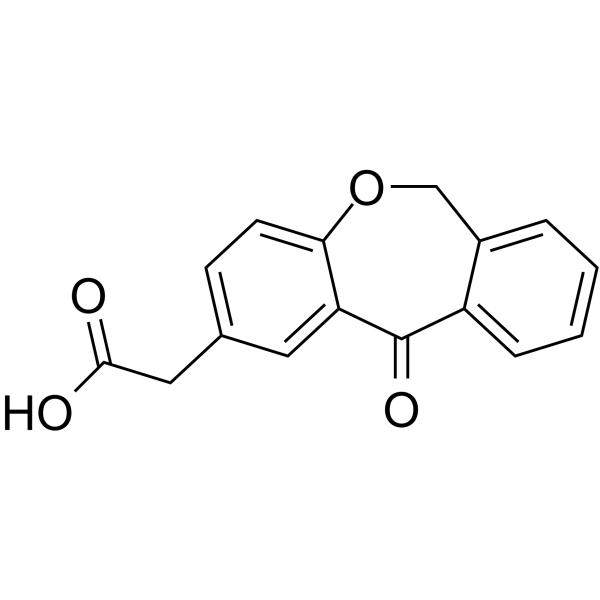
Isoxepac
CAS No. 55453-87-7
Isoxepac( Olopatadine USP Related Compound C | HP 549 )
Catalog No. M27889 CAS No. 55453-87-7
Isoxepac is a non-steroidal anti-antiphlogistic agent and analgesic.
Purity : >98% (HPLC)
 COA
Datasheet
HNMR
HPLC
MSDS
Handing Instructions
COA
Datasheet
HNMR
HPLC
MSDS
Handing Instructions
| Size | Price / USD | Stock | Quantity |
| 1 mL x 10 mM in DMSO | 42 | In Stock |


|
| 100MG | Get Quote | In Stock |
|
| 200MG | Get Quote | In Stock |
|
| 500MG | 37 | In Stock |
|
| 1G | 52 | In Stock |
|
Biological Information
-
Product NameIsoxepac
-
NoteResearch use only, not for human use.
-
Brief DescriptionIsoxepac is a non-steroidal anti-antiphlogistic agent and analgesic.
-
DescriptionIsoxepac is a non-steroidal anti-antiphlogistic agent and analgesic.
-
In Vitro——
-
In Vivo——
-
SynonymsOlopatadine USP Related Compound C | HP 549
-
PathwayOthers
-
TargetOther Targets
-
RecptorAkt|ERK|JNK|mTOR|NF-κB|p38 MAPK
-
Research Area——
-
Indication——
Chemical Information
-
CAS Number55453-87-7
-
Formula Weight268.268
-
Molecular FormulaC16H12O4
-
Purity>98% (HPLC)
-
SolubilityIn Vitro:?DMSO : 100 mg/mL (372.77 mM)
-
SMILESOC(=O)Cc1ccc2OCc3ccccc3C(=O)c2c1
-
Chemical Name——
Shipping & Storage Information
-
Storage(-20℃)
-
ShippingWith Ice Pack
-
Stability≥ 2 years
Reference
1.Beaver C, et al. Vincristine Minibag Administration: A Quality Improvement Project to Minimize Medical Errors. Clin J Oncol Nurs. 2018 Dec 1;22(6):669-672.
molnova catalog



related products
-
Orexin A (human, rat...
Endogenous agonist at orexin receptors (Ki values are 20 and 38 nM for OX1 and OX2 receptors respectively). Stimulates feeding following central administration and may be involved in the control of sleep-wake cycle and other hypothalamic functions.
-
Emixustat
Emixustat (ACU-4429) is a first in class small-molecule inhibitor of the visual cycle isomerase (RPE65) with IC50 of 4.4 nM.
-
2B/3, Dengue Proteas...
2B/3, Dengue Protease Substrate
