


 Cart
 sales@molnova.com


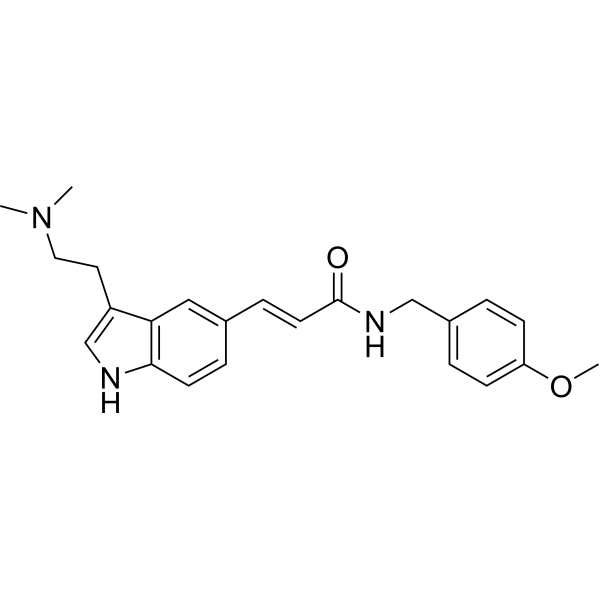
GR 46611
CAS No. 185259-85-2
GR 46611( —— )
Catalog No. M27631 CAS No. 185259-85-2
GR 46611 is a selective 5-HT1B and 5-HT1D receptor agonist and can be used in studies about the treatment of epilepsy.
Purity : >98% (HPLC)
 COA
Datasheet
HNMR
HPLC
MSDS
Handing Instructions
| Size | Price / USD | Stock | Quantity |
| 5MG | 80 | In Stock |


|
| 10MG | 130 | In Stock |
|
| 25MG | 264 | In Stock |
|
| 50MG | 412 | In Stock |
|
| 100MG | 601 | In Stock |
|
| 200MG | Get Quote | In Stock |
|
| 500MG | Get Quote | In Stock |
|
| 1G | Get Quote | In Stock |
|
Biological Information
-
Product NameGR 46611
-
NoteResearch use only, not for human use.
-
Brief DescriptionGR 46611 is a selective 5-HT1B and 5-HT1D receptor agonist and can be used in studies about the treatment of epilepsy.
-
DescriptionGR 46611 is a selective 5-HT1B and 5-HT1D receptor agonist and can be used in studies about the treatment of epilepsy.(In Vivo):GR 46611 (0.6 and 6 nmol; paraventricular hypothalamic nucleus (PVN)) promptly and reliably elicited feeding at their higher doses, without affecting drinking or non-ingestive behaviors. GR 46611 (6 nmol) elicited intense feeding responses in the n. medialis hypothalami posterioris and in the adjacent n. lateralis hypothalami posterioris (PMH/PLH complex, in the caudoventral hypothalamus) and in the n. magnocellularis preopticus (PPM, in the caudal preoptic region). GR 46611 (1 mg/kg) significantly increased the threshold of hyperthermia-induced seizure and lowered seizure severity thereby improving the survival of DS mice.
-
In VitroGR-46611 (1 μM, 48 h) induces CEM cell proliferation. Cell Proliferation Assay Cell Line:CEM cells (human T lymphoblastic leukemia cell line)Concentration:1 μM Incubation Time:48 h Result:Induced a significant increase in cell proliferation by 37.0%.
-
In VivoGR-46611 (1 mg/kg, i.p. ) significantly improves survival of Dravet syndrome (DS) mice.GR-46611 (0.03-300 μg/kg, i.v.) increases threshold volume, bladder capacity, and residual volume in chronic spinal cord injury (SCI) cats.GR46611 (3-30 mg/kg, s.c.) causes a dose-related decrease in rectal temperature in the adult guinea-pig. Animal Model:Dravet syndrome (DS) mice Dosage:0.01, 0.1 and 1 mg/kg Administration:Intraperitoneal injection (i.p.)Result:Improved survival relative to vehicle treated controls with 89% surviving rate.
-
Synonyms——
-
PathwayEndocrinology/Hormones
-
Target5-HT Receptor
-
Recptor——
-
Research Area——
-
Indication——
Chemical Information
-
CAS Number185259-85-2
-
Formula Weight377.488
-
Molecular FormulaC23H27N3O2
-
Purity>98% (HPLC)
-
SolubilityIn Vitro:?DMSO : 100 mg/mL (264.91 mM)
-
SMILESCOc1ccc(CNC(=O)\C=C/c2ccc3[nH]cc(CCN(C)C)c3c2)cc1
-
Chemical Name——
Shipping & Storage Information
-
Storage(-20℃)
-
ShippingWith Ice Pack
-
Stability≥ 2 years
Reference
1.Moisés Laparra J, et al. Kojibiose ameliorates arachidic acid-induced metabolic alterations in hyperglycaemic rats. Br J Nutr. 2015 Nov 14;114(9):1395-402.
molnova catalog


related products
-
Peptide 401
Peptide 401 is an antimicrobial peptide (AMP) derived from the venom of bees and wasps. Peptide 401 induces mast cell degranulation, activating histamine release from peritoneal mast cells. Additionally, peptide 401 exhibits some anti-inflammatory activity, decreasing paw edema in animal models.
-
Metadoxine
It is neurotransmitter stimulants.
-
Amisulpride
Amisulpride(DAN 2163) is an antipsychotic drug, which is a selective dopamine antagonist.
