


 Cart
Cart
 sales@molnova.com


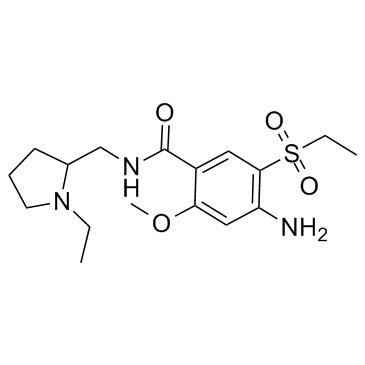
Amisulpride
CAS No. 71675-85-9
Amisulpride( DAN 2163 | Solian )
Catalog No. M15741 CAS No. 71675-85-9
Amisulpride(DAN 2163) is an antipsychotic drug, which is a selective dopamine antagonist.
Purity : >98% (HPLC)
 COA
Datasheet
HNMR
HPLC
MSDS
Handing Instructions
COA
Datasheet
HNMR
HPLC
MSDS
Handing Instructions
| Size | Price / USD | Stock | Quantity |
| 1 mL x 10 mM in DMSO | 37 | In Stock |


|
| 25MG | 40 | In Stock |
|
| 50MG | 54 | In Stock |
|
| 100MG | 73 | In Stock |
|
| 200MG | 128 | In Stock |
|
| 500MG | 233 | In Stock |
|
| 1G | 346 | In Stock |
|
Biological Information
-
Product NameAmisulpride
-
NoteResearch use only, not for human use.
-
Brief DescriptionAmisulpride(DAN 2163) is an antipsychotic drug, which is a selective dopamine antagonist.
-
DescriptionAmisulpride(DAN 2163) is an antipsychotic drug, which is a selective dopamine antagonist (Ki=2.8 nM D2 receptor; Ki=3.2 nM D3 receptor).(In Vitro):Amisulpride is an atypical dopamine D2/D3 receptor antagonist with Kis of 2.8 and 3.2 nM for human dopamine D2 and D3, respectively. Amisulpride (100 nM) inhibits quinpirole-elicited [3H]thymidine incorporation with an IC50 value of 22±3 nM (n=3). Amisulpride slightly but significantly increases [3H]dopamine release from slices of the rat striatum (S2/S1=0.88±0.04 under control conditions, n=6; 1.04±0.08 in the presence of 100 nM Amisulpride,n=4; P<0.05) and opposes the inhibitory effects of 7-OH-DPAT in both brain areas.(In Vivo):Only the highest dose of Amisulpride (100 mg/kg) significantly reduces dopamine levels in the striatum or limbic system. Amisulpride significantly increases the synthesis of dopamine in the rat striatum and limbic system at doses of 20 and 100 mg/kg. Amisulpride (0.5 to 75 mg/kg) fails to provoke an additional increase in dopa accumulation in the striatum but slightly accelerates, at 75 mg/kg, dopamine synthesis in the limbic system. In comparison with vehicle-treated controls, Amisulpride (10 mg/kg) increases extracellular dopamine levels. The administration of Amisulpride (0.5 to 15 mg/kg s.c.) provokes a time- and dose-dependent increase in the stimulation-evoked dopamine release. Amisulpride decreases striatal ACh levels significantly at 30 and 100 mg/kg (87.5% and 56.3% of control levels, respectively). In both acute study, Amisulpride (70 mg/kg, p.o.) significantly increases the duration of swimming behavior [F(3,28)=45.90, p<0.01].
-
In VitroAmisulpride is an atypical dopamine D2/D3 receptor antagonist with Kis of 2.8 and 3.2 nM for human dopamine D2 and D3, respectively. Amisulpride (100 nM) inhibits quinpirole-elicited [3H]thymidine incorporation with an IC50 value of 22±3 nM (n=3). Amisulpride slightly but significantly increases [3H]dopamine release from slices of the rat striatum (S2/S1=0.88±0.04 under control conditions, n=6; 1.04±0.08 in the presence of 100 nM Amisulpride,n=4; P<0.05) and opposes the inhibitory effects of 7-OH-DPAT in both brain areas.
-
In VivoOnly the highest dose of Amisulpride (100 mg/kg) significantly reduces dopamine levels in the striatum or limbic system. Amisulpride significantly increases the synthesis of dopamine in the rat striatum and limbic system at doses of 20 and 100 mg/kg. Amisulpride (0.5 to 75 mg/kg) fails to provoke an additional increase in dopa accumulation in the striatum but slightly accelerates, at 75 mg/kg, dopamine synthesis in the limbic system. In comparison with vehicle-treated controls, Amisulpride (10 mg/kg) increases extracellular dopamine levels. The administration of Amisulpride (0.5 to 15 mg/kg s.c.) provokes a time- and dose-dependent increase in the stimulation-evoked dopamine release. Amisulpride decreases striatal ACh levels significantly at 30 and 100 mg/kg (87.5% and 56.3% of control levels, respectively). In both acute study, Amisulpride (70 mg/kg, p.o.) significantly increases the duration of swimming behavior [F(3,28)=45.90, p<0.01].
-
SynonymsDAN 2163 | Solian
-
PathwayEndocrinology/Hormones
-
Target5-HT Receptor
-
Recptor5-HT| Dopamine
-
Research AreaCancer
-
Indication——
Chemical Information
-
CAS Number71675-85-9
-
Formula Weight369.49
-
Molecular FormulaC17H27N3O4S
-
Purity>98% (HPLC)
-
SolubilityEthanol: 74 mg/mL (200.28 mM); DMSO: 74 mg/mL (200.28 mM)
-
SMILESCCN1CCCC1CNC(=O)C1=CC(=C(N)C=C1OC)S(=O)(=O)CC
-
Chemical Name——
Shipping & Storage Information
-
Storage(-20℃)
-
ShippingWith Ice Pack
-
Stability≥ 2 years
Reference
1.Rosenzweig P, et al. Hum Psychopharmacol. 2002 Jan;17(1):1-13.
molnova catalog



related products
-
5-Methoxytryptamine
5-Methoxytryptamine is a tryptamine derivative that acts as a full agonist at the 5-HT1 5-HT2 5-HT4 5-HT6 and 5-HT7 receptors.
-
Espindolol
Espindolol is a novel non-selective β blocker with central 5-HT1a and partial β2 receptor agonist effects.
-
EMDT oxalate
EMDT oxalate is a selective 5-HT6 agonist, and has antidepressant effects.
