


 Cart
Cart
 sales@molnova.com


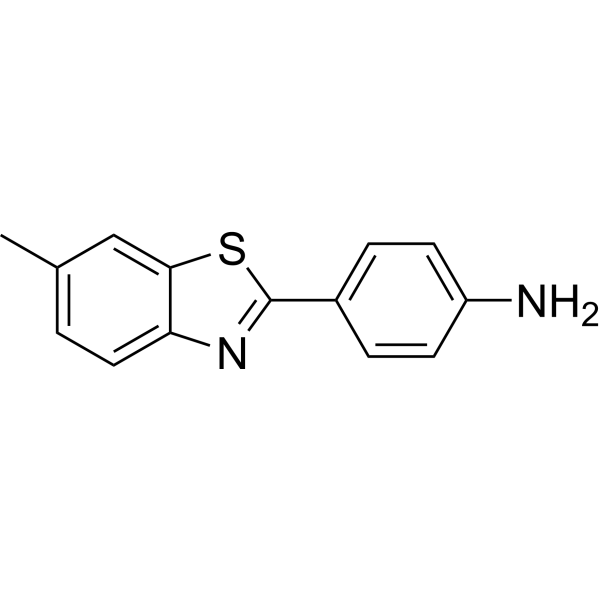
Phenyl-benzothiazole
CAS No. 92-36-4
Phenyl-benzothiazole( 2-(4-Aminophenyl)-6-methylbenzothiazole | 4-(6-methyl-1,3-benzothiazol-2-yl)aniline | Dehydrothio-p-toluidine | 2-(p-Aminophenyl)-6-methylbenzothiazole )
Catalog No. M27610 CAS No. 92-36-4
Phenyl-benzothiazole is an azole for proteomics research.
Purity : >98% (HPLC)
 COA
Datasheet
HNMR
HPLC
MSDS
Handing Instructions
COA
Datasheet
HNMR
HPLC
MSDS
Handing Instructions
| Size | Price / USD | Stock | Quantity |
| 1 mL x 10 mM in DMSO | 28 | In Stock |


|
| 100MG | Get Quote | In Stock |
|
| 200MG | Get Quote | In Stock |
|
| 500MG | Get Quote | In Stock |
|
| 1G | 27 | In Stock |
|
Biological Information
-
Product NamePhenyl-benzothiazole
-
NoteResearch use only, not for human use.
-
Brief DescriptionPhenyl-benzothiazole is an azole for proteomics research.
-
DescriptionPhenyl-benzothiazole is an azole for proteomics research.
-
In Vitro——
-
In VivoDehydrothio-p-toluidine (4 h) induces salivation, pawing and chewing motions, lachrymation, sporadic fasciculations, rapid respiration and slight weight loss of mice under an average of 0.64 mg DHPT/L condition. Dehydrothio-p-toluidine (4 h) induces sporadic nasal discharge and lethargy of mice under an average of 2.41 mg DHPT/L condition.Dehydrothio-p-toluidine (6 h/day on 5 days followed by two rest days and then by five additional days of exposures; 0.6 mg DHPT/L) decreases the erythrocyte count, haemoglobin level and relative number of lymphocytes than in the controls, excrets a larger volume of less-concentratedurine, produces liver changes characterized by hepatocyte hyper trophy and proliferation of bile-duct epithelial cells and induxes thymic necrosis and depletion of lymphocytes after the tenth exposure.
-
Synonyms2-(4-Aminophenyl)-6-methylbenzothiazole | 4-(6-methyl-1,3-benzothiazol-2-yl)aniline | Dehydrothio-p-toluidine | 2-(p-Aminophenyl)-6-methylbenzothiazole
-
PathwayOthers
-
TargetOther Targets
-
RecptorNADPH oxidase|ROS
-
Research Area——
-
Indication——
Chemical Information
-
CAS Number92-36-4
-
Formula Weight240.32
-
Molecular FormulaC14H12N2S
-
Purity>98% (HPLC)
-
Solubility——
-
SMILESCc1ccc2nc(sc2c1)-c1ccc(N)cc1
-
Chemical Name——
Shipping & Storage Information
-
Storage(-20℃)
-
ShippingWith Ice Pack
-
Stability≥ 2 years
Reference
1.Kim GN, Jang HD. Flavonol content in the water extract of the mulberry (Morus alba L.) leaf and their antioxidant capacities. J Food Sci. 2011 Aug;76(6):C869-73.
molnova catalog



related products
-
FMRF - related pepti...
FMRF - related peptide, SDPFLRF - NH2
-
Methylnonylketone
Methylnonylketone is a natural non-toxic insect repellant compound.
-
Enterobactin
Enterobactin is a high-affinity siderophore that acquires iron for microbial systems.
