


 Cart
Cart
 sales@molnova.com


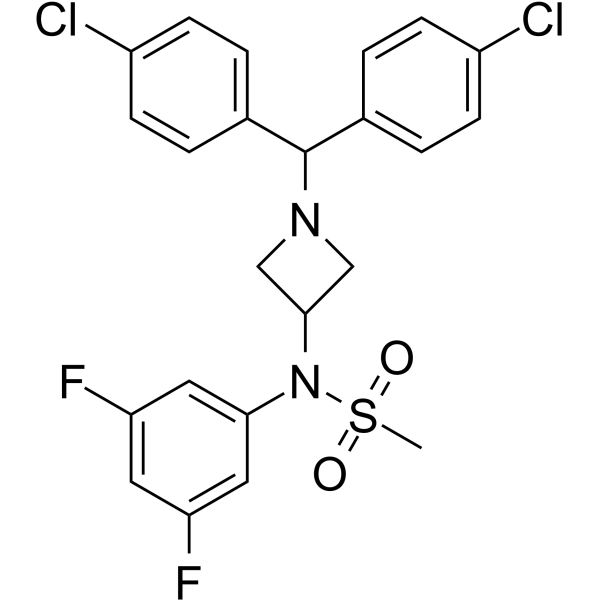
Drinabant
CAS No. 358970-97-5
Drinabant( AVE-1625 )
Catalog No. M27478 CAS No. 358970-97-5
Drinabant is an orally active CB1 receptor antagonist. Drinabant inhibits the agonist-stimulated calcium signal with IC50 values of 25 nM and 10 nM for the hCB1-R and rCB1-R, respectively, and is ineffective for the hCB2-R.
Purity : >98% (HPLC)
 COA
Datasheet
HNMR
HPLC
MSDS
Handing Instructions
COA
Datasheet
HNMR
HPLC
MSDS
Handing Instructions
| Size | Price / USD | Stock | Quantity |
| 5MG | 152 | In Stock |


|
| 10MG | 235 | In Stock |
|
| 25MG | 389 | In Stock |
|
| 50MG | 554 | In Stock |
|
| 100MG | 789 | In Stock |
|
| 200MG | 1051 | In Stock |
|
| 500MG | Get Quote | In Stock |
|
| 1G | Get Quote | In Stock |
|
Biological Information
-
Product NameDrinabant
-
NoteResearch use only, not for human use.
-
Brief DescriptionDrinabant is an orally active CB1 receptor antagonist. Drinabant inhibits the agonist-stimulated calcium signal with IC50 values of 25 nM and 10 nM for the hCB1-R and rCB1-R, respectively, and is ineffective for the hCB2-R.
-
DescriptionDrinabant is an orally active CB1 receptor antagonist. Drinabant inhibits the agonist-stimulated calcium signal with IC50 values of 25 nM and 10 nM for the hCB1-R and rCB1-R, respectively, and is ineffective for the hCB2-R.(In Vivo):Drinabant (10 mg/kg orally once daily), combined with Olanzapine attenuates body weight gain, diminishing the enhanced food intake while maintaining increased energy expenditure and decreased motility. Drinabant (1, 3, and 10 mg/kg ip), reverses abnormally persistent LI induced by MK-801 or neonatal nitric oxide synthase inhibition in rodents, and improves both working and episodic memory.
-
In Vitro——
-
In VivoAVE1625 (10 mg/kg orally once daily), combined with Olanzapine (HY-14541) attenuates body weight gain, diminishing the enhanced food intake while maintaining increased energy expenditure and decreased motility. AVE1625 (1, 3, and 10 mg/kg ip), reverses abnormally persistent LI induced by MK-801 (HY-15084B) or neonatal nitric oxide synthase inhibition in rodents, and improves both working and episodic memory. Animal Model:Rats.Dosage:30 mg/kg.Administration:Oral gavage, single dose.Result:Had free access to food during the preceding night (postprandial state) caused a pronounced reduction of food intake during the subsequent 10-12 h without differences intheir locomotor activity relative to that of the control group.Caused an increase in FFA and glycerol, indicating increased lipolysis from fat tissue.Immediately resulted in a pronounced increase in VCO2 and VO2, indicating increased oxidation of energetic substrates and increased TEE.Animal Model:Female Hanover Wistar rats weighing 225 ± 8.6 g.Dosage:10 mg/kg.Administration:Orally once daily.Result:Reduced their weight markedly within the first 3 days of treatment where upon animals maintained lower body weight, although they lost about 7.3 ± 1.3 g fat during the 12 days of treatment.
-
SynonymsAVE-1625
-
PathwayGPCR/G Protein
-
TargetCannabinoid Receptor
-
RecptorTRPV1
-
Research Area——
-
Indication——
Chemical Information
-
CAS Number358970-97-5
-
Formula Weight497.39
-
Molecular FormulaC23H20Cl2F2N2O2S
-
Purity>98% (HPLC)
-
Solubility——
-
SMILESCS(N(C(C1)CN1C(c(cc1)ccc1Cl)c(cc1)ccc1Cl)c1cc(F)cc(F)c1)(=O)=OCS(N(C(C1)CN1C(c(cc1)ccc1Cl)c(cc1)ccc1Cl)c1cc(F)cc(F)c1)(=O)=O
-
Chemical Name——
Shipping & Storage Information
-
Storage(-20℃)
-
ShippingWith Ice Pack
-
Stability≥ 2 years
Reference
1.Kym PR, Kort ME, Hutchins CW. Analgesic potential of TRPV1 antagonists. Biochem Pharmacol. 2009 Aug 1;78(3):211-6.
molnova catalog



related products
-
CB1R antagonist 1
CB1R antagonist 1 is a potent CB1R antagonist that can be used to study diseases related to the nervous system.
-
2-Arachidonoylglycer...
2-Arachidonoylglycerol activates neuronal cannabinoid receptors as a full agonist, and prevents the induction of long-term potentiation at CA3–CA1 synapses.
-
CB2R PAM
CB2R PAM is an orally active cannabinoid type 2 receptor (CB2Rs) positive allosteric modulator that enhances CP 55940 and 2-Arachidonylglycerol-stimulated [35S]GTPγS binding to CB2 receptors without affecting receptor activity in the absence of agonists.
