


 Cart
Cart
 sales@molnova.com


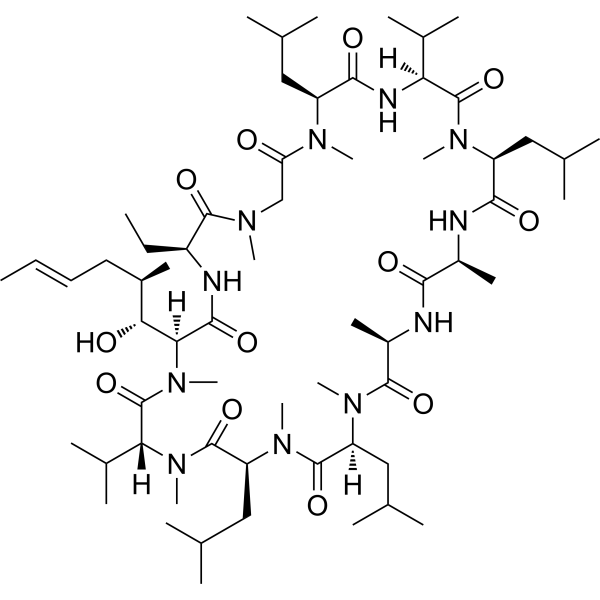
Cyclosporin H
CAS No. 83602-39-5
Cyclosporin H( —— )
Catalog No. M27415 CAS No. 83602-39-5
Cyclosporin H (CsH), a specific inhibitor of FPR1, inhibited lung inflammation in the ALI models.
Purity : >98% (HPLC)
 COA
Datasheet
HNMR
HPLC
MSDS
Handing Instructions
COA
Datasheet
HNMR
HPLC
MSDS
Handing Instructions
| Size | Price / USD | Stock | Quantity |
| 5MG | 264 | In Stock |


|
| 10MG | 372 | In Stock |
|
| 25MG | 652 | In Stock |
|
| 50MG | 909 | In Stock |
|
| 100MG | Get Quote | In Stock |
|
| 200MG | Get Quote | In Stock |
|
| 500MG | Get Quote | In Stock |
|
| 1G | Get Quote | In Stock |
|
Biological Information
-
Product NameCyclosporin H
-
NoteResearch use only, not for human use.
-
Brief DescriptionCyclosporin H (CsH), a specific inhibitor of FPR1, inhibited lung inflammation in the ALI models.
-
DescriptionCyclosporin H (CsH), a specific inhibitor of FPR1, inhibited lung inflammation in the ALI models. CsH significantly attenuated MTDs or NFP-induced inflammatory lung injury and activation of MAPK and AKT pathways. Cyclosporin H is a viral transduction enhancer which increases lentiviral transduction up to 10-fold in human cord blood-derived hematopoietic stem and progenitor cells (HSPCs). When combined with Rapamycin or Prostaglandin E2 Cyclosporin H displays an additive effect. Cyclosporin H lacks immunosuppressant activity of Cyclosporin A.(In Vitro):Cyclosporin H is a potent inhibitor of FMLP-induced superoxide anion (O2-) formation in human neutrophils. Cyclosporin H inhibited FMLP binding in HL-60 membranes with a Ki (inhibition constant) of 0.10 μM. Cyclosporin H inhibited activation by FMLP of high affinity GTPase (the enzymatic activity of alpha-subunits of heterotrimeric regulatory guanine nucleotide-binding proteins) in HL-60 membranes with a Ki of 0.79 μM. Cyclosporin H inhibited the stimulatory effects of FMLP on cytosolic Ca2+ concentration ([Ca2+]i), O2- formation, and beta-glucuronidase release with Ki values of 0.08, 0.24, and 0.45 μM, respectively.(In Vivo):Cyclosporin H (5 mg/kg; i.p.; before LPS or HCl challenge) attenuats lung injury induced by LPS or HCl (a lung injurymodel).
-
In Vitro——
-
In Vivo——
-
Synonyms——
-
PathwayOthers
-
TargetOther Targets
-
RecptorAXL
-
Research Area——
-
Indication——
Chemical Information
-
CAS Number83602-39-5
-
Formula Weight1202.61
-
Molecular FormulaC62H111N11O12
-
Purity>98% (HPLC)
-
SolubilityIn Vitro:?DMSO : 100 mg/mL (83.15 mM)
-
SMILESCN(C(C(CC(C)C)N(C)C(C(C)NC(C(C)NC(C(CC(C)C)N(C)C(C(C(C)C)NC(C(N1C)CC(C)C)=O)=O)=O)=O)=O)=O)C(CC(C)C)C(N(C)C(C(C)C)C(N(C)C(C(O)C(C)C/C=C/C)C(NC(CC)C(N(C)CC1=O)=O)=O)=O)=O
-
Chemical Name——
Shipping & Storage Information
-
Storage(-20℃)
-
ShippingWith Ice Pack
-
Stability≥ 2 years
Reference
1.Jimbo T, et, al. DS-1205b, a novel selective inhibitor of AXL kinase, blocks resistance to EGFR-tyrosine kinase inhibitors in a non-small cell lung cancer xenograft model. Oncotarget. 2019 Aug 27;10(50):5152-5167.
molnova catalog



related products
-
Letolizumab
Letolizumab (BMS-986004) is a dimeric antibody targeting CD40L for the expression of mutant IgG1 that lacks effector functions including Fc binding and complement binding.
-
Tetrahydropalmatine
Tetrahydropalmatine, an active component isolated from corydalis (a Chinese herbal medicine), possesses analgesic effects.
-
Decyl-TPP bromide
Decyl-TPP bromide may be used as an intermediate for chemical synthesis and an inactive control or as a reference to mitoquinone (MitoQ).
