


 Cart
Cart
 sales@molnova.com


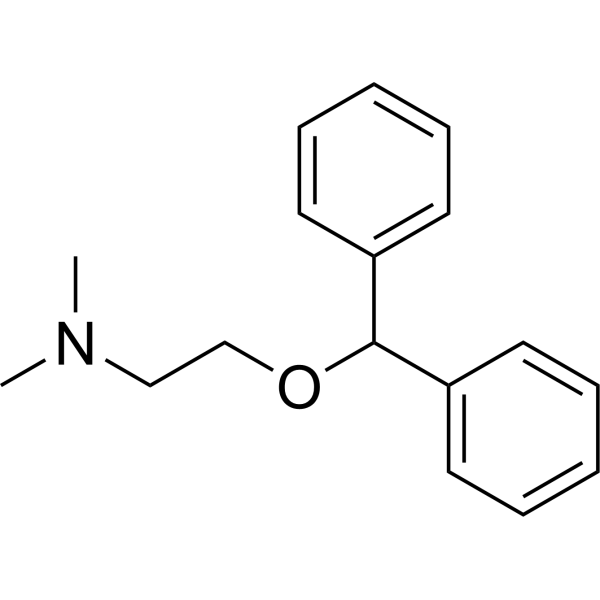
Diphenhydramine
CAS No. 58-73-1
Diphenhydramine( Syntedril | PM255 | PM-255 | Diphenhydramine | Dabylen | Debendrin )
Catalog No. M27401 CAS No. 58-73-1
Diphenhydramine, a first-generation antihistamine possessing antiemetic, antitussive, anticholinergic, and sedative properties, is mainly used in the treatment of allergies.
Purity : >98% (HPLC)
 COA
Datasheet
HNMR
HPLC
MSDS
Handing Instructions
COA
Datasheet
HNMR
HPLC
MSDS
Handing Instructions
| Size | Price / USD | Stock | Quantity |
| 1 mL x 10 mM in DMSO | 37 | In Stock |


|
| 100MG | Get Quote | In Stock |
|
| 200MG | 32 | In Stock |
|
| 500MG | 51 | In Stock |
|
| 1G | Get Quote | In Stock |
|
Biological Information
-
Product NameDiphenhydramine
-
NoteResearch use only, not for human use.
-
Brief DescriptionDiphenhydramine, a first-generation antihistamine possessing antiemetic, antitussive, anticholinergic, and sedative properties, is mainly used in the treatment of allergies.
-
DescriptionDiphenhydramine, a first-generation antihistamine possessing antiemetic, antitussive, anticholinergic, and sedative properties, is mainly used in the treatment of allergies. Diphenhydramine is also used in the management of drug-induced parkinsonism and other extrapyramidal symptoms.
-
In Vitro——
-
In Vivo——
-
SynonymsSyntedril | PM255 | PM-255 | Diphenhydramine | Dabylen | Debendrin
-
PathwayGPCR/G Protein
-
TargetHistamine Receptor
-
RecptorParasite
-
Research Area——
-
Indication——
Chemical Information
-
CAS Number58-73-1
-
Formula Weight255.35
-
Molecular FormulaC17H21NO
-
Purity>98% (HPLC)
-
SolubilityIn Vitro:?DMSO : 100 mg/mL (391.62 mM)
-
SMILESCN(C)CCOC(C1=CC=CC=C1)C2=CC=CC=C2
-
Chemical Name——
Shipping & Storage Information
-
Storage(-20℃)
-
ShippingWith Ice Pack
-
Stability≥ 2 years
Reference
1.Ting Zhou, et al. A hPSC-based Platform to Discover Gene-Environment Interactions That Impact Human β-cell and Dopamine Neuron Survival. Nat Commun. 2018 Nov 16;9(1):4815.
molnova catalog



related products
-
ICI 162,846
ICI 162,846 is an orally active and potent H2 receptor antagonist that inhibits gastric secretion and may be used in the study of duodenal ulcers.
-
Tecastemizole
Tecastemizole is a selective antagonist of H1 receptor and a major metabolite of astemizole with anti-inflammatory effects.
-
3-Hydroxyflavone
3-hydroxyflavone is a member of the class of compounds known as flavonols. 3-hydroxyflavone can be found in a number of food items such as brassicas, pomegranate, red raspberry, and fenugreek. 3-hydroxyflavone is a chemical compound.
