


 Cart
Cart
 sales@molnova.com


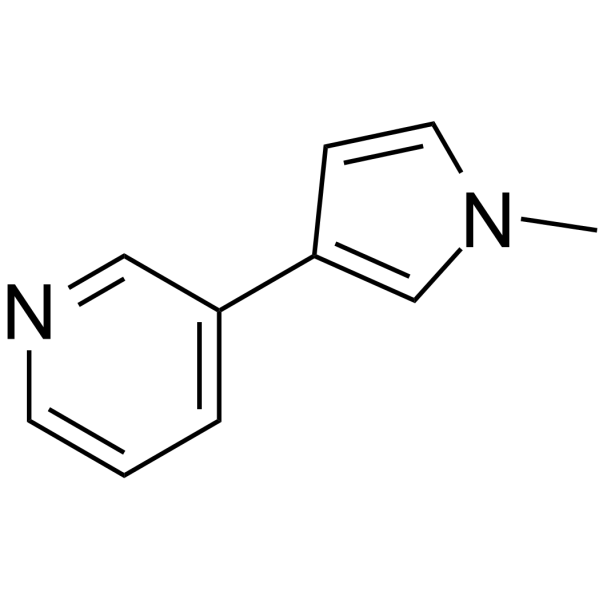
beta-Nicotyrine
CAS No. 487-19-4
beta-Nicotyrine( Nicotyrine | alpha-Nicotyrine )
Catalog No. M27260 CAS No. 487-19-4
beta-Nicotyrine is a tobacco alkaloids Metabolite in the liver.
Purity : >98% (HPLC)
 COA
Datasheet
HNMR
HPLC
MSDS
Handing Instructions
COA
Datasheet
HNMR
HPLC
MSDS
Handing Instructions
| Size | Price / USD | Stock | Quantity |
| 5MG | 239 | In Stock |


|
| 10MG | 376 | In Stock |
|
| 25MG | 630 | In Stock |
|
| 50MG | 862 | In Stock |
|
| 100MG | 1144 | In Stock |
|
| 200MG | 1562 | In Stock |
|
| 500MG | Get Quote | In Stock |
|
| 1G | Get Quote | In Stock |
|
Biological Information
-
Product Namebeta-Nicotyrine
-
NoteResearch use only, not for human use.
-
Brief Descriptionbeta-Nicotyrine is a tobacco alkaloids Metabolite in the liver.
-
Descriptionbeta-Nicotyrine is a tobacco alkaloids Metabolite in the liver.
-
In Vitro——
-
In Vivo——
-
SynonymsNicotyrine | alpha-Nicotyrine
-
PathwayOthers
-
TargetOther Targets
-
Recptor——
-
Research Area——
-
Indication——
Chemical Information
-
CAS Number487-19-4
-
Formula Weight158.204
-
Molecular FormulaC10H10N2
-
Purity>98% (HPLC)
-
Solubility——
-
SMILESCn1cccc1-c1cccnc1
-
Chemical Name——
Shipping & Storage Information
-
Storage(-20℃)
-
ShippingWith Ice Pack
-
Stability≥ 2 years
Reference



-
6-O-Acetyldaidzin
6"-O-Acetyldaidzin is an isoflavone glycoside isolated from soybeans. 6"-O-Acetyldaidzin significantly inhibits lipid peroxidation in rat liver microsome with an IC50 of 8.2 μM.
-
Prosaptide TX14(A)
Potent GPR37L1 and GPR37 agonist (EC50 values are 5 and 7 nM, respectively). Stimulates signaling through pertussis toxin-sensitive G proteins. Stimulates ERK phosphorylation. Protects against cellular stress. Promotes myelin lipid synthesis and prolongs cell survival in both Schwann cells and oligodendrocytes; neuroprotective and glioprotective.
-
5β-Hydroxybufotalin
5β-Hydroxybufotalin (compound 6) is an anticancer agent that can effectively inhibit the growth activity of cancer cells. 5β-Hydroxybufotalin is also a natural product obtained from the chinese traditional drug Ch'an Su.
