


 Cart
 sales@molnova.com


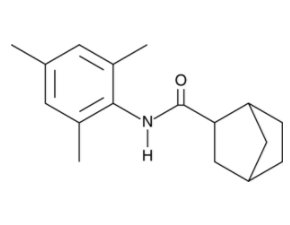
ML213
CAS No. 489402-47-3
ML213( ML213 | ML 213 | ML-213 | CID-3111211 )
Catalog No. M17522 CAS No. 489402-47-3
ML213 is a selective activator of Kv7.2 (KCNQ2) and Kv7.4 (KCNQ4) channels, enhances Kv7.2 and Kv7.4 channels with EC50s of 230 and 510 nM, respectively.
Purity : >98% (HPLC)
 COA
Datasheet
HNMR
HPLC
MSDS
Handing Instructions
| Size | Price / USD | Stock | Quantity |
| 1 mL x 10 mM in DMSO | 54 | In Stock |


|
| 2MG | 32 | In Stock |
|
| 5MG | 49 | In Stock |
|
| 10MG | 75 | In Stock |
|
| 25MG | 150 | In Stock |
|
| 50MG | 222 | In Stock |
|
| 100MG | 334 | In Stock |
|
| 200MG | Get Quote | In Stock |
|
| 500MG | Get Quote | In Stock |
|
| 1G | Get Quote | In Stock |
|
Biological Information
-
Product NameML213
-
NoteResearch use only, not for human use.
-
Brief DescriptionML213 is a selective activator of Kv7.2 (KCNQ2) and Kv7.4 (KCNQ4) channels, enhances Kv7.2 and Kv7.4 channels with EC50s of 230 and 510 nM, respectively.
-
DescriptionML213, also known as CID-3111211, is a selective KV7.2 (KCNQ2) and KV7.4 (KCNQ4) channel opener (EC50 values are 230 and 510 nM for KV7.2 and KV7.4 respectively). ML213 displays > 80-fold selectivity against KV7.1, KV7.3 and KV7.5 in a thallium-based fluorescence assay.
-
In VitroML213 (100 nM-30 μM) increases maximal conductance to a peak at 212% ± 27% of control, with an EC50 of 0.8 ± 0.3 μM. ML213 (10 μM) reduces the deactivation rates of Kv7.4 currents by 4.6-fold in the voltage range from ?130 mV to ?90 mV. ML213 is a potent and effective activator of homomeric Kv7.5 channels overexpressed in A7r5 cells. ML213 increases maximal conductance of Kv7.5 channels with an EC50 of 0.7 ± 0.2 μM. ML213 (10 μM) also reduces deactivation rates of Kv7.5 currents by 5.9-fold on average. ML213 produces similar effects on heteromeric Kv7.4/7.5 channels: 204% ± 11% maximal increase in conductance with an EC50 of 1.1 ± 0.6 μM and a 34.2 ± 3.3 mV maximal negative shift of the activation curve, with an EC50 of 3.8 ± 1.2 μM. ML213 causes a vasorelaxation in different precontracted rat blood vessels. ML213 (10 μM) also hyperpolarizes mesenteric artery smooth muscle cells. ML213 causes a concentration-dependent shift in the V1/2 for KCNQ2 activation with an EC50 340 ± 70 nM and a maximal shift of 37.4 mV.
-
In Vivo——
-
SynonymsML213 | ML 213 | ML-213 | CID-3111211
-
PathwayOthers
-
TargetOther Targets
-
RecptorKv7.2 (KCNQ2) channels| Kv7.4 (KCNQ4) channels
-
Research AreaOthers-Field
-
Indication——
Chemical Information
-
CAS Number489402-47-3
-
Formula Weight257.38
-
Molecular FormulaC17H23NO
-
Purity>98% (HPLC)
-
SolubilityDMSO : 30 mg/mL 116.56 mM;
-
SMILESC12C(CC(CC1)C2)C(=O)Nc1c(cc(cc1C)C)C
-
Chemical NameN-(2,4,6-trimethylphenyl)bicyclo[2.2.1]heptane-6-carboxamide
Shipping & Storage Information
-
Storage(-20℃)
-
ShippingWith Ice Pack
-
Stability≥ 2 years
Reference
1.Yu, H.,et al. ACS Chem.Neurosci. 2(10), 572-577 (2011).
molnova catalog



related products
-
NAI
NAI is an RNA SHAPE reagent.
-
Toralactone 9-O-β-D-...
Toralactone-9-O-β-D-glucopyranoside is a phenolic component that can be isolated from Eriocaulon buergerianum.
-
Sodium mesoxalate mo...
Mesoxalic acid is primarily located in the cytoplasm within the cell. Mesoxalic acid can be biosynthesized from malonic acid. Outside of the human body mesoxalic acid can be found in cereals and cereal products common pea and herbs and spices.
