


 Cart
Cart
 sales@molnova.com


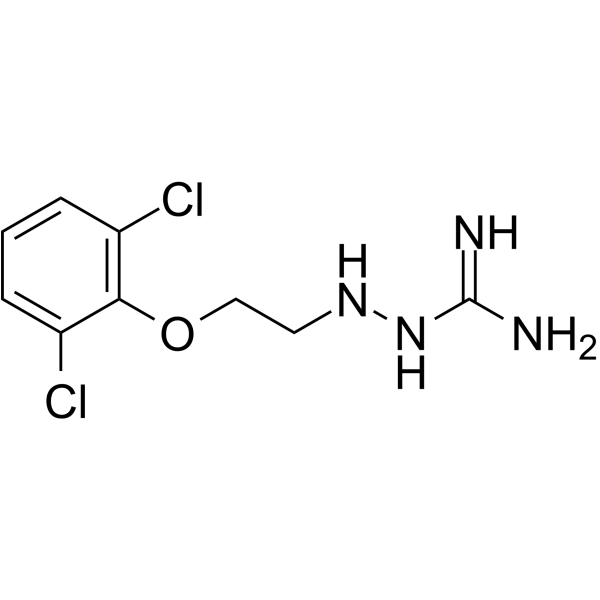
Guanoclor
CAS No. 5001-32-1
Guanoclor( VATENSOL )
Catalog No. M27119 CAS No. 5001-32-1
Guanoclor (INN), also known as guanochlor, is a sympatholytic drug. It is known to bind to non-adrenergic sites in pig kidney membranes.
Purity : >98% (HPLC)
 COA
Datasheet
HNMR
HPLC
MSDS
Handing Instructions
COA
Datasheet
HNMR
HPLC
MSDS
Handing Instructions
| Size | Price / USD | Stock | Quantity |
| 1 mL x 10 mM in DMSO | 29 | In Stock |


|
| 10MG | 35 | In Stock |
|
| 100MG | Get Quote | In Stock |
|
| 200MG | Get Quote | In Stock |
|
| 500MG | Get Quote | In Stock |
|
| 1G | Get Quote | In Stock |
|
Biological Information
-
Product NameGuanoclor
-
NoteResearch use only, not for human use.
-
Brief DescriptionGuanoclor (INN), also known as guanochlor, is a sympatholytic drug. It is known to bind to non-adrenergic sites in pig kidney membranes.
-
DescriptionGuanoclor (INN), also known as guanochlor, is a sympatholytic drug. It is known to bind to non-adrenergic sites in pig kidney membranes.
-
In Vitro——
-
In Vivo——
-
SynonymsVATENSOL
-
PathwayOthers
-
TargetOther Targets
-
RecptorVoltage-gated sodium channel
-
Research Area——
-
Indication——
Chemical Information
-
CAS Number5001-32-1
-
Formula Weight263.12
-
Molecular FormulaC9H12Cl2N4O
-
Purity>98% (HPLC)
-
Solubility——
-
SMILESNC(=N)NNCCOc1c(Cl)cccc1Cl
-
Chemical Name——
Shipping & Storage Information
-
Storage(-20℃)
-
ShippingWith Ice Pack
-
Stability≥ 2 years
Reference
1.Hlava GL, Reinhardt RA, Kalkwarf KL. Etidocaine HCl local anesthetic for periodontal flap surgery. J Periodontol. 1984 Jun;55(6):364-7.
molnova catalog



related products
-
AZ13705339
AZ13705339 is a potent and selective PAK1 inhibitor with IC50 of 0.33 nM.
-
Gliadin (43-49)(Glia...
α-Gliadin (43-49) is the major protein component of gluten. α-Gliadin (43-49) can be used in theimmunological response to α-gliadin.
-
R-7050
R-7050 is a tumor necrosis factor receptor (TNFR) antagonist with greater selectivity toward TNFα.
