


 Cart
Cart
 sales@molnova.com


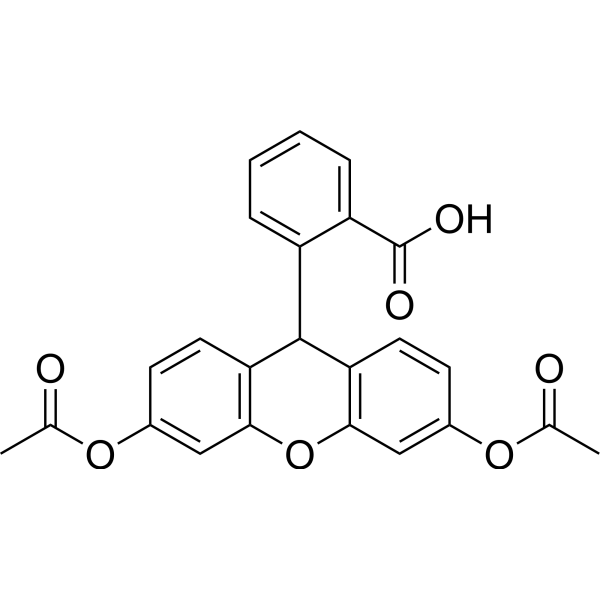
Dihydrofluorescein diacetate
CAS No. 35340-49-9
Dihydrofluorescein diacetate( Diacetyldihydrofluorescein )
Catalog No. M27035 CAS No. 35340-49-9
Dihydrofluorescein diacetate is a fluorescent probe for measuring oxidative stress in cell-free systems and cellular models.
Purity : >98% (HPLC)
 COA
Datasheet
HNMR
HPLC
MSDS
Handing Instructions
COA
Datasheet
HNMR
HPLC
MSDS
Handing Instructions
| Size | Price / USD | Stock | Quantity |
| 1 mL x 10 mM in DMSO | 28 | In Stock |


|
| 50MG | 27 | In Stock |
|
| 100MG | Get Quote | In Stock |
|
| 200MG | Get Quote | In Stock |
|
| 500MG | Get Quote | In Stock |
|
| 1G | Get Quote | In Stock |
|
Biological Information
-
Product NameDihydrofluorescein diacetate
-
NoteResearch use only, not for human use.
-
Brief DescriptionDihydrofluorescein diacetate is a fluorescent probe for measuring oxidative stress in cell-free systems and cellular models.
-
DescriptionDihydrofluorescein diacetate is a fluorescent probe for measuring oxidative stress in cell-free systems and cellular models.(In Vitro):Dihydrofluorescein diacetate is able to detect the presence of ROS in mitochondria. Dihydrofluorescein diacetate fluorescence sharply delineates filaments that correspond in all detail to TMRM-stained mitochondria. It enters mitochondria and reacts with ROS released in the matrix. Dihydrofluorescein diacetate may be a useful quantitative method to measure the oxidation potential of nanoparticle-treated cells. Dihydrofluorescein diacetate shows fluorescence of linear structures, consistent with mitochondria, in reoxygenated endothelium.
-
In VitroDihydrofluorescein diacetate may be a superior fluorescent probe for many cell-based studies. It is a better fluorescent probe for detecting intracellular oxidants because it is more reactive toward specific oxidizing species. Dihydrofluorescein diacetate demonstrates fluorescence of linear structures, consistent with mitochondria, in reoxygenated endothelium. Dihydrofluorescein diacetate is able to detect the presence of ROS in mitochondria. Dihydrofluorescein diacetate fluorescence was sharp and delineated thin filaments which corresponded in all details to TMRM-stained mitochondria. It enters mitochondria and reacts with ROS released in the matrix. Dihydrofluorescein diacetate could be an useful and quantitative method for measuring the oxidative potential of nanoparticle-treated cells.
-
In Vivo——
-
SynonymsDiacetyldihydrofluorescein
-
PathwayOthers
-
TargetOther Targets
-
RecptorS1P
-
Research Area——
-
Indication——
Chemical Information
-
CAS Number35340-49-9
-
Formula Weight418.401
-
Molecular FormulaC24H18O7
-
Purity>98% (HPLC)
-
SolubilityIn Vitro:?DMSO : ≥ 106.5 mg/mL (254.54 )
-
SMILESCC(=O)Oc1ccc2C(c3ccc(OC(C)=O)cc3Oc2c1)c1ccccc1C(O)=O
-
Chemical Name——
Shipping & Storage Information
-
Storage(-20℃)
-
ShippingWith Ice Pack
-
Stability≥ 2 years
Reference
1.Lee H, et al. 4-Deoxypyridoxine improves the viability of isolated pancreatic islets ex vivo. Islets. 2013 May-Jun;5(3):116-21.
molnova catalog



related products
-
2-Phenylethyl Acetat...
Phenethyl acetate (Phenethyl alcohol) is a natural product.
-
Cerdulatinib hydroch...
Cerdulatinib (PRT-062070) is an oral active, multi-targeted tyrosine kinase inhibitor with IC50 of 12 nM/6 nM/8 nM/0.5 nM and 32 nM for JAK1/JAK2/JAK3/TYK2 and Syk, respectively.
-
Fmoc-Gly-Thr(psi(Me,...
Fmoc-Gly-Thr(psi(Me,Me)pro)-OH is a dipeptide.
