


 Cart
Cart
 sales@molnova.com


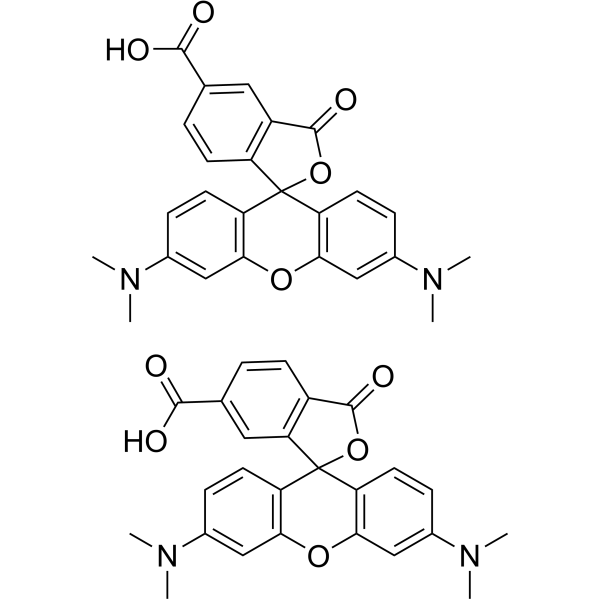
5(6)-TAMRA
CAS No. 98181-63-6
5(6)-TAMRA( 5(6)-Carboxytetramethylrhodamine )
Catalog No. M27029 CAS No. 98181-63-6
5(6)-TAMRA contains a carboxylic acid that can be used to react with primary amines via carbodiimide activation of the carboxylic acid.
Purity : >98% (HPLC)
 COA
Datasheet
HNMR
HPLC
MSDS
Handing Instructions
COA
Datasheet
HNMR
HPLC
MSDS
Handing Instructions
| Size | Price / USD | Stock | Quantity |
| 100MG | Get Quote | In Stock |


|
| 200MG | Get Quote | In Stock |
|
| 500MG | Get Quote | In Stock |
|
| 1G | Get Quote | In Stock |
|
Biological Information
-
Product Name5(6)-TAMRA
-
NoteResearch use only, not for human use.
-
Brief Description5(6)-TAMRA contains a carboxylic acid that can be used to react with primary amines via carbodiimide activation of the carboxylic acid.
-
Description5(6)-TAMRA contains a carboxylic acid that can be used to react with primary amines via carbodiimide activation of the carboxylic acid. It is bright, orange-fluorescent dye produces conjugates with absorption/emission maxima of ~555/580 nm.
-
In Vitro——
-
In Vivo——
-
Synonyms5(6)-Carboxytetramethylrhodamine
-
PathwayOthers
-
TargetOther Targets
-
RecptorHuman Endogenous Metabolite
-
Research Area——
-
Indication——
Chemical Information
-
CAS Number98181-63-6
-
Formula Weight860.92
-
Molecular FormulaC50H44N4O10
-
Purity>98% (HPLC)
-
SolubilityIn Vitro:?DMSO : ≥ 20.83 mg/mL (48.39 m)
-
SMILESCN(C)c1ccc2c(Oc3cc(ccc3C22OC(=O)c3cc(ccc23)C(O)=O)N(C)C)c1.CN(C)c1ccc2c(Oc3cc(ccc3C22OC(=O)c3ccc(cc23)C(O)=O)N(C)C)c1
-
Chemical Name——
Shipping & Storage Information
-
Storage(-20℃)
-
ShippingWith Ice Pack
-
Stability≥ 2 years
Reference
1.Groeseneken D, et al. Ethoxyacetic acid: a metabolite of ethylene glycol monoethyl ether acetate in man. Br J Ind Med. 1987 Jul;44(7):488-93.
molnova catalog



related products
-
2,3-Didehydrosomnife...
2,3-Didehydrosomnifericin is a natural product.
-
N-(4-benzamidobutyl...
N-(4-benzamidobutyl)benzamide
-
3-epi-Isocucurbitaci...
3-epi-Isocucurbitacin B.
