


 Cart
Cart
 sales@molnova.com


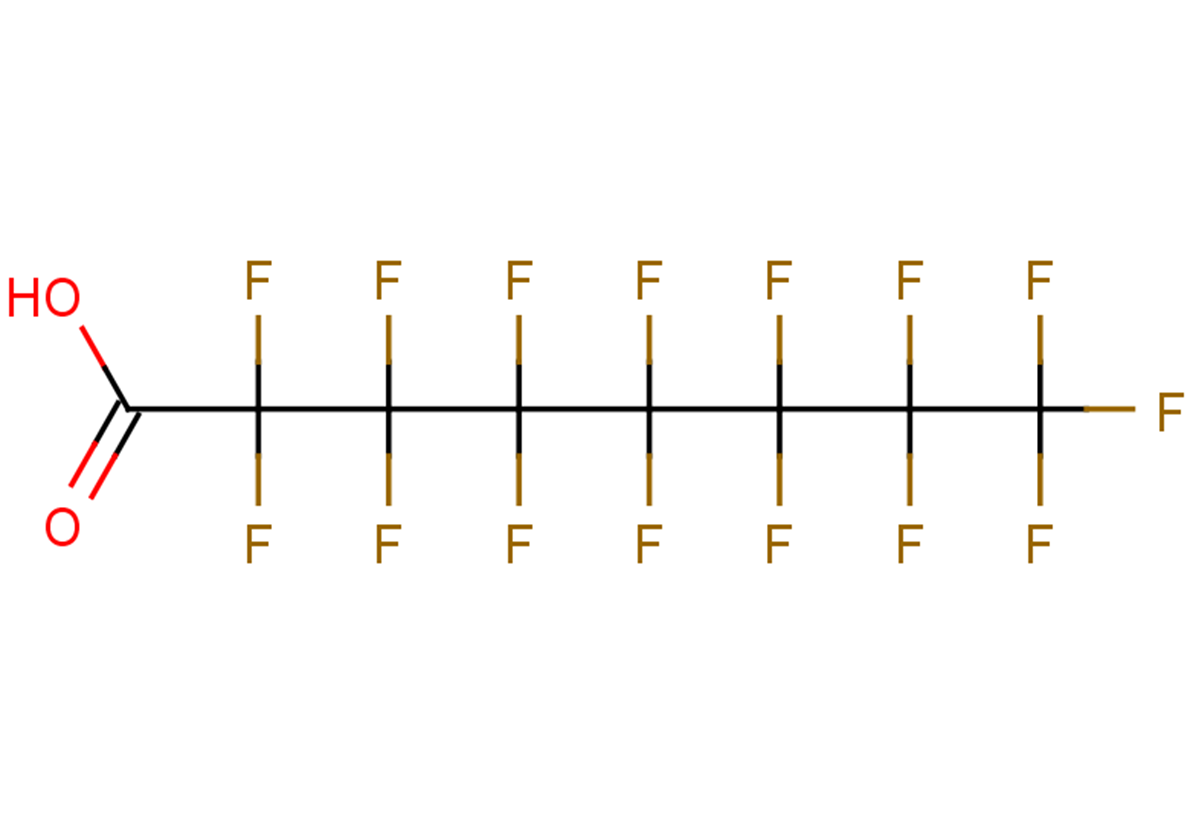
Perfluorooctanoic acid
CAS No. 335-67-1
Perfluorooctanoic acid( PFOA )
Catalog No. M24279 CAS No. 335-67-1
Perfluorooctanoic acid (PFOA) is a persistent and widespread industry-made chemical.
Purity : >98% (HPLC)
 COA
Datasheet
HNMR
HPLC
MSDS
Handing Instructions
COA
Datasheet
HNMR
HPLC
MSDS
Handing Instructions
| Size | Price / USD | Stock | Quantity |
| 1 mL x 10 mM in DMSO | 70 | In Stock |


|
| 5MG | 48 | In Stock |
|
| 10MG | 71 | In Stock |
|
| 25MG | 122 | In Stock |
|
| 50MG | 179 | In Stock |
|
| 100MG | 267 | In Stock |
|
| 200MG | 401 | In Stock |
|
| 500MG | 663 | In Stock |
|
| 1G | Get Quote | In Stock |
|
Biological Information
-
Product NamePerfluorooctanoic acid
-
NoteResearch use only, not for human use.
-
Brief DescriptionPerfluorooctanoic acid (PFOA) is a persistent and widespread industry-made chemical.
-
DescriptionPerfluorooctanoic acid (PFOA) is a persistent and widespread industry-made chemical.
-
In Vitro——
-
In Vivo——
-
SynonymsPFOA
-
PathwayOthers
-
TargetOther Targets
-
Recptor3β-HSD|17β-HSD3
-
Research Area——
-
Indication——
Chemical Information
-
CAS Number335-67-1
-
Formula Weight414.07
-
Molecular FormulaC8HF15O2
-
Purity>98% (HPLC)
-
Solubility——
-
SMILESOC(C(C(C(C(C(C(C(F)(F)F)(F)F)(F)F)(F)F)(F)F)(F)F)(F)F)=O
-
Chemical Name——
Shipping & Storage Information
-
Storage(-20℃)
-
ShippingWith Ice Pack
-
Stability≥ 2 years
Reference
1.Tien P T , Lin H J , Tsai Y Y , et al. Perfluorooctanoic acid in indoor particulate matter triggers oxidative stress and inflammation in corneal and retinal cells[J]. Scientific Reports.
molnova catalog



related products
-
Isoscopoletin
6-Hydroxy-7-methoxycoumarin is a predicted metabolite generated by BioTransformer1 that is produced by the metabolism of 6, 7-dimethoxy-2h-chromen-2-one.
-
p-Coumaric acid
Actions Hydroxycinnamic acid found in many fruits and vegetables.
-
THCA-A (CRM)
THCA-A (CRM) is a certified reference material categorized as a phytocannabinoid.1 THCA-A is a common component of hashish but is non-psychoactive until heated via smoking, which converts it to Δ9-THC.
