


 Cart
Cart
 sales@molnova.com


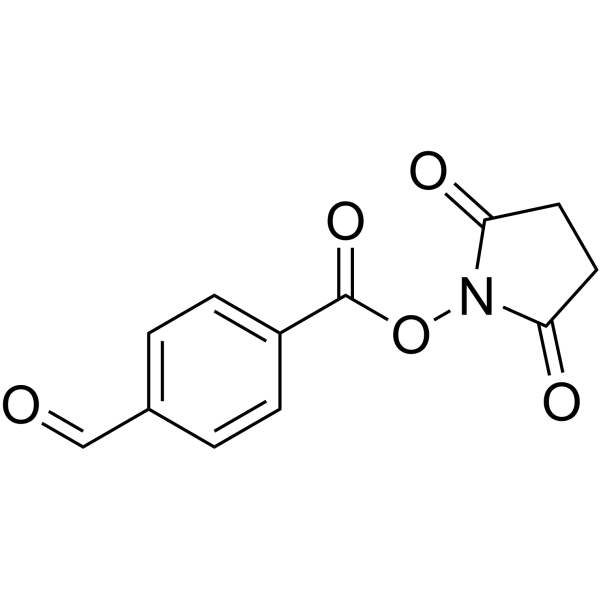
Ald-Ph-NHS ester
CAS No. 60444-78-2
Ald-Ph-NHS ester( —— )
Catalog No. M26878 CAS No. 60444-78-2
Ald-Ph-NHS ester is a nonclaevable linker for antibody-drug-conjugation (ADC).
Purity : >98% (HPLC)
 COA
Datasheet
HNMR
HPLC
MSDS
Handing Instructions
COA
Datasheet
HNMR
HPLC
MSDS
Handing Instructions
| Size | Price / USD | Stock | Quantity |
| 100MG | 31 | In Stock |


|
| 200MG | 52 | In Stock |
|
| 500MG | Get Quote | In Stock |
|
| 1G | Get Quote | In Stock |
|
Biological Information
-
Product NameAld-Ph-NHS ester
-
NoteResearch use only, not for human use.
-
Brief DescriptionAld-Ph-NHS ester is a nonclaevable linker for antibody-drug-conjugation (ADC).
-
DescriptionAld-Ph-NHS ester is a nonclaevable linker for antibody-drug-conjugation (ADC).
-
In Vitro——
-
In Vivo——
-
Synonyms——
-
PathwayOthers
-
TargetOther Targets
-
Recptorfactor D
-
Research Area——
-
Indication——
Chemical Information
-
CAS Number60444-78-2
-
Formula Weight247.206
-
Molecular FormulaC12H9NO5
-
Purity>98% (HPLC)
-
SolubilityIn Vitro:?DMSO : 100 mg/mL (404.53 mM)
-
SMILESO=Cc1ccc(cc1)C(=O)ON1C(=O)CCC1=O
-
Chemical Name——
Shipping & Storage Information
-
Storage(-20℃)
-
ShippingWith Ice Pack
-
Stability≥ 2 years
Reference
1.GADHACHANDA VR, et, al. Aryl, heteroaryl, and heterocyclic compounds for treatment of complement mediated disorders. WO2015130838A1.
molnova catalog



related products
-
Yakuchinone A
Yakuchinone A is a natural product isolated from Alpinia oxyphylla Miquel. Yakuchinone-A has strong inhibitory effects on the synthesis of prostaglandins and leukotrienes in vitro.
-
Histrelin acetate
Histrelin acetate is a nonapeptide analog of gonadotropin-releasing hormone (GnRH) with added potency. It acts on particular cells of the pituitary gland called gonadotropes when present in the bloodstream. Histrelin stimulates these cells to release luteinizing hormone and follicle-stimulating hormone. Thus it is considered a gonadotropin-releasing hormone agonist or GnRH agonist.
-
(D-Ala4)-Substance P...
(D-Ala4)-Substance P (4-11)
