


 Cart
Cart
 sales@molnova.com


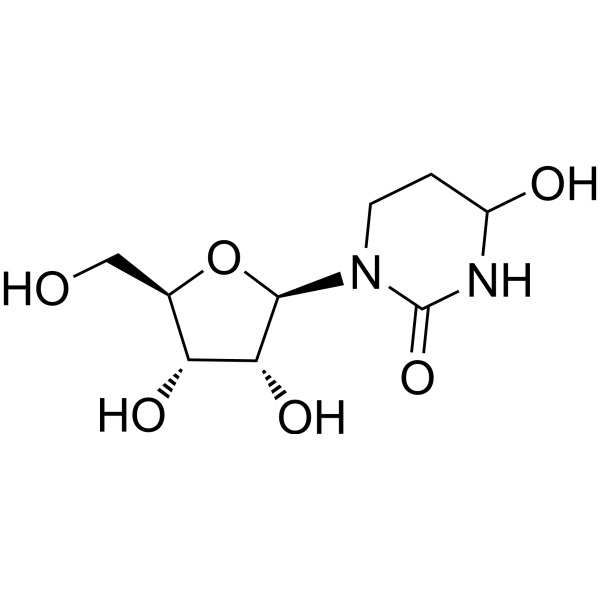
Tetrahydrouridine
CAS No. 18771-50-1
Tetrahydrouridine( NSC 112907 | NSC-112907 | NSC112907 )
Catalog No. M26842 CAS No. 18771-50-1
Tetrahydrouridine (THU) is a multidrug resistance modulator. It can be used in cancer treatment to make tumor cells more sensitive to radiation therapy.
Purity : >98% (HPLC)
 COA
Datasheet
HNMR
HPLC
MSDS
Handing Instructions
COA
Datasheet
HNMR
HPLC
MSDS
Handing Instructions
| Size | Price / USD | Stock | Quantity |
| 2MG | 178 | In Stock |


|
| 10MG | 565 | In Stock |
|
| 100MG | Get Quote | In Stock |
|
| 200MG | Get Quote | In Stock |
|
| 500MG | Get Quote | In Stock |
|
| 1G | Get Quote | In Stock |
|
Biological Information
-
Product NameTetrahydrouridine
-
NoteResearch use only, not for human use.
-
Brief DescriptionTetrahydrouridine (THU) is a multidrug resistance modulator. It can be used in cancer treatment to make tumor cells more sensitive to radiation therapy.
-
DescriptionTetrahydrouridine (THU) is a multidrug resistance modulator. It can be used in cancer treatment to make tumor cells more sensitive to radiation therapy. THU is a competitive cytidine deaminase(CDA) inhibitor that inhibits deamination in the catabolism of cytotoxic deoxycytidine analogs such as ara-C and Gemcitabine.(In Vitro):To test how Tetrahydrouridine affects the Gemcitabine-mediated anti-neoplastic effect on pancreatic and lung carcinoma cells, a combination therapy is performed. As expected, high CDA expression in BxPC-3 and H441 results in improved Gemcitabine sensitivity after a 100 μM Tetrahydrouridine treatment. The sensitivity of BxPC-3 and H441 cell lines increases by as much as approximately 2.1 and 4.4 fold respectively. On the other hand, MIAPaCa-2 and H1299 cells unexpectedly become more sensitive to Gemcitabine with low CDA expression. MIAPaCa-2 and H1299 cells show a change in an IC50 of 2.2 and 2.3 fold respectively. However, Panc-1 and H322 cells do not show significant changes in drug sensitivity. These data suggested that Tetrahydrouridine can sensitize some pancreatic and lung carcinoma cells to Gemcitabine-induced cell death regardless of CDA expression levels. Tetrahydrouridine inhibits S-phase without apoptosis.(In Vivo):Tetrahydrouridine (167 mg/kg) followed by DAC (1.0 mg/kg) results in death in one male and eight females. Animals surviving to scheduled termination are generally asymptomatic with no treatment related effects observed in body weights, food consumption, clinical chemistry and urinalysis for a treatment up to 1.0 mg/kg DAC in combination with 167 mg/kg Tetrahydrouridine in animals.
-
In VitroTetrahydrouridine (THU) is a specific inhibitor of cytidine deaminase (CDA) which can suppress deamination in the catabolism of cytotoxic deoxycytidine analogues like ara-C and Gemcitabine. To test how Tetrahydrouridine affects the Gemcitabine-mediated anti-neoplastic effect on pancreatic and lung carcinoma cells, a combination therapy is performed. As expected, high CDA expression in BxPC-3 and H441 results in improved Gemcitabine sensitivity after a 100 μM Tetrahydrouridine treatment. The sensitivity of BxPC-3 and H441 cell lines increases by as much as approximately 2.1 and 4.4 fold respectively. On the other hand, MIAPaCa-2 and H1299 cells unexpectedly become more sensitive to Gemcitabine with low CDA expression. MIAPaCa-2 and H1299 cells show a change in IC50 of 2.2 and 2.3 fold respectively. However, Panc-1 and H322 cells do not show significant changes in drug sensitivity. These data suggested that Tetrahydrouridine can sensitize some pancreatic and lung carcinoma cells to Gemcitabine-induced cell death regardless of CDA expression levels. Tetrahydrouridine inhibits S-phase without apoptosis.
-
In VivoAdministration of 167 mg/kg Tetrahydrouridine (THU) followed by 1.0 mg/kg DAC results in death in one male and eight females. Animals surviving to scheduled termination are generally asymptomatic with no treatment related effects observed in body weights, food consumption, clinical chemistry and urinalysis for a treatment up to 1.0 mg/kg DACin combination with 167 mg/kg Tetrahydrouridine in animals.
-
SynonymsNSC 112907 | NSC-112907 | NSC112907
-
PathwayCell Cycle/DNA Damage
-
TargetDNA/RNA Synthesis
-
RecptorASK1
-
Research Area——
-
Indication——
Chemical Information
-
CAS Number18771-50-1
-
Formula Weight248.235
-
Molecular FormulaC9H16N2O6
-
Purity>98% (HPLC)
-
Solubility——
-
SMILESOC[C@H]1O[C@H]([C@H](O)[C@@H]1O)N1CCC(O)NC1=O
-
Chemical Name——
Shipping & Storage Information
-
Storage(-20℃)
-
ShippingWith Ice Pack
-
Stability≥ 2 years
Reference
1.Xin Z, et al. Discovery of CNS-Penetrant Apoptosis Signal-Regulating Kinase 1 (ASK1) Inhibitors. ACS Med Chem Lett. 2020;11(4):485-490. Published 2020 Feb 12.
molnova catalog



related products
-
Osalmid
Osalmid is a choleretic drug.
-
dADP disodium
dADP disodium (2'-Deoxyadenosine 5'-di-phos-phate disodium) is widely found in plants and animals, competitively inhibits bacterial poly(A) polymerase, and is involved in the body's energy cycle.
-
Beaucage reagent
A potent DNA cleavage agent.
