


 Cart
Cart
 sales@molnova.com


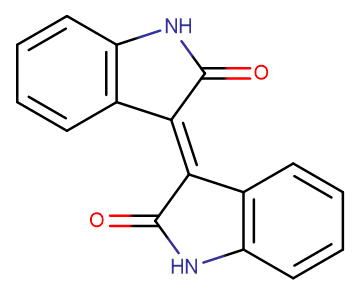
Isoindigotin
CAS No. 476-34-6
Isoindigotin( Isoindigotin )
Catalog No. M14589 CAS No. 476-34-6
isoindigotin is used to treat Y.
Purity : >98% (HPLC)
 COA
Datasheet
HNMR
HPLC
MSDS
Handing Instructions
COA
Datasheet
HNMR
HPLC
MSDS
Handing Instructions
| Size | Price / USD | Stock | Quantity |
| 1 mL x 10 mM in DMSO | 28 | In Stock |


|
| 25MG | 28 | In Stock |
|
| 100MG | Get Quote | In Stock |
|
| 200MG | Get Quote | In Stock |
|
| 500MG | Get Quote | In Stock |
|
| 1G | Get Quote | In Stock |
|
Biological Information
-
Product NameIsoindigotin
-
NoteResearch use only, not for human use.
-
Brief Descriptionisoindigotin is used to treat Y.
-
Descriptionisoindigotin is used to treat Y.
-
In Vitro——
-
In Vivo——
-
SynonymsIsoindigotin
-
PathwayCell Cycle/DNA Damage
-
TargetDNA/RNA Synthesis
-
RecptorDNA polymerase
-
Research AreaCancer
-
Indication——
Chemical Information
-
CAS Number476-34-6
-
Formula Weight262.26
-
Molecular FormulaC16H10N2O2
-
Purity>98% (HPLC)
-
SolubilityDMSO: 10 mM
-
SMILESO=C1NC2=C(C=CC=C2)/C1=C3C(NC4=C\3C=CC=C4)=O
-
Chemical Name(E)-[3,3'-biindolinylidene]-2,2'-dione
Shipping & Storage Information
-
Storage(-20℃)
-
ShippingWith Ice Pack
-
Stability≥ 2 years
Reference
1.Zhao P, et al. Eur J Med Chem. 2014 Oct 30;86:165-74.
molnova catalog



related products
-
Laromustine
Laromustine (VNP40101M) is a sulfonyl hydrolytic alkylating prodrug used in cancer therapy with significant anticancer activity.
-
Daptomycin
Daptomycin is a novel antibiotic with rapid in vitro bactericidal activity against gram-positive organisms.
-
Saframycin A
A heterocyclic quinone antibiotic that inhibits RNA synthesis in vivo and in vitro.
