


 Cart
Cart
 sales@molnova.com


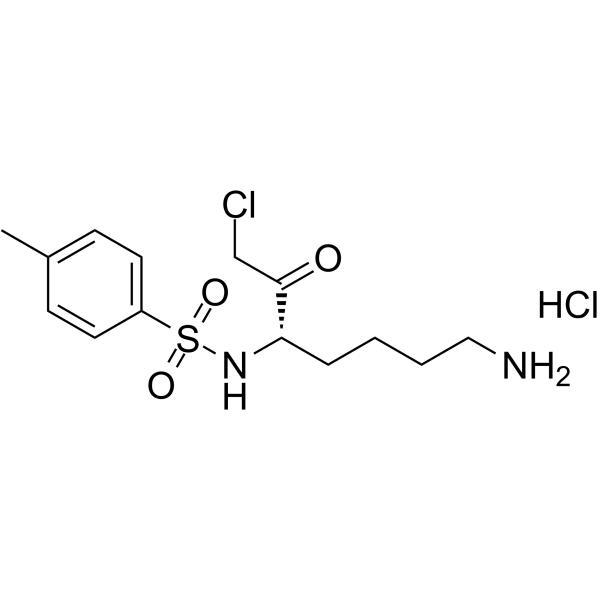
N-alpha-Tosyl-L-lysine chloromethyl ketone hydrochloride
CAS No. 4272-74-6
N-alpha-Tosyl-L-lysine chloromethyl ketone hydrochloride( N-alpha-Tosyl-L-lysine_chloromethyl_ketone_hydrochloride | N-alpha-Tosyl-L-lysine chloromethyl ketone hydrochloride )
Catalog No. M26766 CAS No. 4272-74-6
N-alpha-Tosyl-L-lysine chloromethyl ketone hydrochloride is an inhibitor of trypsin-like protease.
Purity : >98% (HPLC)
 COA
Datasheet
HNMR
HPLC
MSDS
Handing Instructions
COA
Datasheet
HNMR
HPLC
MSDS
Handing Instructions
| Size | Price / USD | Stock | Quantity |
| 1 mL x 10 mM in DMSO | 50 | In Stock |


|
| 2MG | 29 | In Stock |
|
| 5MG | 46 | In Stock |
|
| 10MG | 69 | In Stock |
|
| 25MG | 123 | In Stock |
|
| 50MG | 172 | In Stock |
|
| 100MG | Get Quote | In Stock |
|
| 200MG | Get Quote | In Stock |
|
| 500MG | Get Quote | In Stock |
|
| 1G | Get Quote | In Stock |
|
Biological Information
-
Product NameN-alpha-Tosyl-L-lysine chloromethyl ketone hydrochloride
-
NoteResearch use only, not for human use.
-
Brief DescriptionN-alpha-Tosyl-L-lysine chloromethyl ketone hydrochloride is an inhibitor of trypsin-like protease.
-
DescriptionN-alpha-Tosyl-L-lysine chloromethyl ketone hydrochloride is an inhibitor of trypsin-like protease. N-alpha-Tosyl-L-lysine chloromethyl ketone hydrochloride exhibits an inhibitory effect on IFN-γ activities.(In Vitro):A lower concentration of anti-Fas (10 ng/mL) is used to examine the interaction among the three effectors simultaneously, that is, anti-Fas, TLCK, and IFN-γ. N-alpha-Tosyl-L-lysine chloromethyl ketone hydrochloride (50 μM) exhibits a small decrease in cell viability. Beyond 50 μM, a dose-dependent decrease in cell viability is observed. IFN-γ slightly reduces cell viability on its own. The addition of anti-Fas (10 ng/mL) results in a slight decrease in cell survival, which is enhanced more than additively in the presence of TLCK, most prominently between 50 and 100 μM. Upon addition of both anti-Fas and IFN-γ, a decrease (≈46%) in cell viability is observed. Moreover, the decrease in cell survival is further enhanced by the addition of higher concentrations of TLCK, 25 μM, and more.
-
In VitroN-alpha-Tosyl-L-lysine chloromethyl ketone exhibits an inhibitory effect on IFN-γ activities. The effect of TLCK is studied on the IFN-γ sensitization of HeLa cells towards cell death mediated by anti-Fas. Lower concentration of anti-Fas (10 ng/mL) are used to examine the interaction among the three effectors simultaneously, that is, anti-Fas, TLCK and IFN-γ. TLCK by itself up to 50 μM concentration exhibits a small decrease in cell viability. Beyond 50 μM, a dose dependent decrease in cell viability is observed. IFN-γ slightly reduces cell viability on its own. Addition of anti-Fas (10 ng/mL) results in a slight decrease in cell survival, which is enhanced more than additively in the presence of TLCK, most prominently between 50 and 100 μM. Upon addition of both anti-Fas and IFN-γ, a decrease (≈46%) in cell viability is observed. Moreover, the decrease in cell survival is further enhanced upon addition of higher concentrations of TLCK, 25 μM and more.
-
In Vivo——
-
SynonymsN-alpha-Tosyl-L-lysine_chloromethyl_ketone_hydrochloride | N-alpha-Tosyl-L-lysine chloromethyl ketone hydrochloride
-
PathwayOthers
-
TargetOther Targets
-
Recptor——
-
Research Area——
-
Indication——
Chemical Information
-
CAS Number4272-74-6
-
Formula Weight369.31
-
Molecular FormulaC14H22Cl2N2O3S
-
Purity>98% (HPLC)
-
SolubilityIn Vitro:?DMSO : 250 mg/mL (676.94 mM)
-
SMILESO=S(C1=CC=C(C)C=C1)(N[C@H](C(CCl)=O)CCCCN)=O.Cl
-
Chemical Name——
Shipping & Storage Information
-
Storage(-20℃)
-
ShippingWith Ice Pack
-
Stability≥ 2 years
Reference
1.Lim B, et al. A Unique Recombinant Fluoroprobe Targeting Activated Platelets Allows In Vivo Detection of Arterial Thrombosis and Pulmonary Embolism Using a Novel Three-Dimensional Fluorescence Emission Computed Tomography (FLECT) Technology. Theranostics. 2017 Feb 26;7(5):1047-1061.
molnova catalog



related products
-
Biotin-PEG12-NHS est...
Biotin-PEG12-NHS ester is a PEG-based PROTAC linker that can be used in the synthesis of PROTACs.
-
3-Hydroxyphenylaceti...
3-Hydroxyphenylacetic acid is a rutin metabolite and an antioxidant. It has a protective biological activity in human.
-
pinoresinol-4-O-β-D-...
pinoresinol-4-O-β-D-apiosyl-(1→2)β-D-glucoside
