


 Cart
Cart
 sales@molnova.com


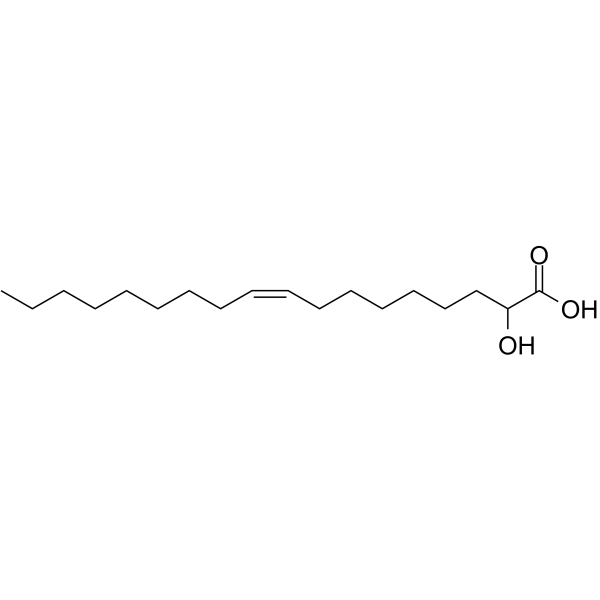
(Rac)-Idroxioleic acid
CAS No. 56472-29-8
(Rac)-Idroxioleic acid( Minerval | 2-Hydroxyoleic acid | 2-OHOA | (Rac)-Idroxioleic acid )
Catalog No. M26756 CAS No. 56472-29-8
Minerval is a fatty acid amide hydrolase inhibitor with anti-tumor effect.
Purity : >98% (HPLC)
 COA
Datasheet
HNMR
HPLC
MSDS
Handing Instructions
COA
Datasheet
HNMR
HPLC
MSDS
Handing Instructions
| Size | Price / USD | Stock | Quantity |
| 1 mL x 10 mM in DMSO | 166 | In Stock |


|
| 5MG | 101 | In Stock |
|
| 10MG | 163 | In Stock |
|
| 25MG | 337 | In Stock |
|
| 50MG | 529 | In Stock |
|
| 100MG | Get Quote | In Stock |
|
| 200MG | Get Quote | In Stock |
|
| 500MG | Get Quote | In Stock |
|
| 1G | Get Quote | In Stock |
|
Biological Information
-
Product Name(Rac)-Idroxioleic acid
-
NoteResearch use only, not for human use.
-
Brief DescriptionMinerval is a fatty acid amide hydrolase inhibitor with anti-tumor effect.
-
DescriptionMinerval is a fatty acid amide hydrolase inhibitor with anti-tumor effect. It binds to the plasma membrane and alters lipid organization.(In Vitro):Minerval (25-50 μM; 72 hours) causes a marked and concentration-dependent increase in the proteolytic cleavage of PARP, a molecular marker of apoptosis. Minerval (25-75 μM; 72 hours) impairs Jurkat cell growth in a time- and concentration-dependent manner (IC50: 40 μM).(In Vivo): In nude mice infected with Jurkat cells, Minerval significantly inhibits tumour growth.
-
In Vitro(Rac)-Idroxioleic acid (25-75 μM; 72 hours) impairs Jurkat cell growth in a time- and concentration-dependent manner, with an IC50 of ~40 μM.(Rac)-Idroxioleic acid (25-50 μM; 72 hours) also induces a marked and concentration-dependent increase in the proteolytic cleavage of PARP, a molecular marker of apoptosis.Cell Viability Assay Cell Line:Jurkat cells Concentration:25 μM, 50 μM, 75 μM Incubation Time:24 hours, 48 hours, 72 hours Result:Impaired Jurkat cell growth in a time- and concentration-dependent manner.Western Blot Analysis Cell Line:Jurkat cells Concentration:25 μM, 50 μM Incubation Time:72 hours Result:Induced a marked and concentration-dependent increase in the proteolytic cleavage of PARP.
-
In Vivo(Rac)-Idroxioleic acid markedly and significantly inhibits tumour growth in nude mice infected with Jurkat cells. Animal Model:6-week-old nude male mice (Jurkat cells xenograft model)Dosage:600 mg/kg Administration:Oral administration; daily; for 21 days Result:Markedly and significantly inhibited tumour growth.
-
SynonymsMinerval | 2-Hydroxyoleic acid | 2-OHOA | (Rac)-Idroxioleic acid
-
PathwayApoptosis
-
TargetApoptosis
-
RecptorHuman Endogenous Metabolite
-
Research Area——
-
Indication——
Chemical Information
-
CAS Number56472-29-8
-
Formula Weight298.467
-
Molecular FormulaC18H34O3
-
Purity>98% (HPLC)
-
SolubilityIn Vitro:?DMSO : 100 mg/mL (335.05 mM)
-
SMILESCCCCCCCC\C=C/CCCCCCC(O)C(O)=O
-
Chemical Name——
Shipping & Storage Information
-
Storage(-20℃)
-
ShippingWith Ice Pack
-
Stability≥ 2 years
Reference
1.Jones KH, Langley PF, Lees LJ. Bioavailability and metabolism of talampicillin. Chemotherapy. 1978;24(4):217-26.
molnova catalog



related products
-
(-)-Epipodophyllotox...
(-)-Epipodophyllotoxin (2) is an antiproliferative agent against cancer cells with GI50s of 0.36 and 0.24 μM in HeLa cells and MCF-7 cells, respectively. (-)-Epipodophyllotoxin can inhibit mitotic spindle assembly in vitro.
-
MC4033
MC4033 is a selective lysine acetyltransferase 8 (KAT8) inhibitor (IC50: 12.1 μM) with anticancer effects, induces apoptosis, and can be used for the study of non-small cell lung cancer.
-
K145 hydrochloride
K145 hydrochloride is a selective sphk2 inhibitor with substrate competitiveness and oral activity, with IC50 of 4.3 μM and Ki of 6.4 μM. K145 hydrochloride can induce apoptosis and has strong antitumor activity.
