


 Cart
Cart
 sales@molnova.com


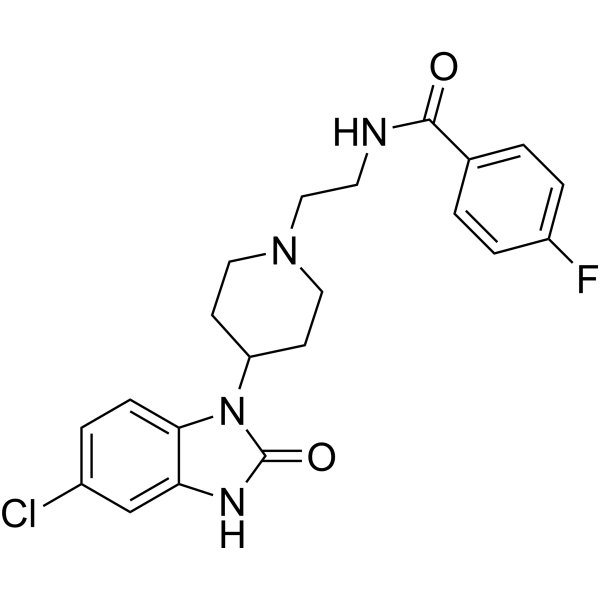
Halopemide
CAS No. 59831-65-1
Halopemide( —— )
Catalog No. M26708 CAS No. 59831-65-1
Halopemide is a potent inhibitor of PLD (IC50 = 220 and 310 nM for human PLD1 and PLD2). Halopemid is an antagonist of dopamine receptors. Halopemid can be used in psychotropic research.
Purity : >98% (HPLC)
 COA
Datasheet
HNMR
HPLC
MSDS
Handing Instructions
COA
Datasheet
HNMR
HPLC
MSDS
Handing Instructions
| Size | Price / USD | Stock | Quantity |
| 1 mL x 10 mM in DMSO | 82 | In Stock |


|
| 5MG | 73 | In Stock |
|
| 10MG | 122 | In Stock |
|
| 25MG | 244 | In Stock |
|
| 50MG | 356 | In Stock |
|
| 100MG | 518 | In Stock |
|
| 200MG | Get Quote | In Stock |
|
| 500MG | Get Quote | In Stock |
|
| 1G | Get Quote | In Stock |
|
Biological Information
-
Product NameHalopemide
-
NoteResearch use only, not for human use.
-
Brief DescriptionHalopemide is a potent inhibitor of PLD (IC50 = 220 and 310 nM for human PLD1 and PLD2). Halopemid is an antagonist of dopamine receptors. Halopemid can be used in psychotropic research.
-
DescriptionHalopemide is a potent inhibitor of PLD (IC50 = 220 and 310 nM for human PLD1 and PLD2). Halopemid is an antagonist of dopamine receptors. Halopemid can be used in psychotropic research.(In Vitro):In transdifferentiated MOVAS cells, Halopemide (1-2 μM; 21 days) influences calcification.(In Vivo):In the majority of monkeys tested, Halopemide (10 mg/kg; p.o.) causes dyskinesias.
-
In VitroHalopemide (1-2 μM; 21 day) affects calcification in transdifferentiated MOVAS cells.
-
In VivoHalopemide (10 mg/kg; p.o.) induces dyskinesias in the majority of monkeys tested.
-
Synonyms——
-
PathwayOthers
-
TargetOther Targets
-
RecptorCDK9
-
Research Area——
-
Indication——
Chemical Information
-
CAS Number59831-65-1
-
Formula Weight416.88
-
Molecular FormulaC21H22ClFN4O2
-
Purity>98% (HPLC)
-
SolubilityIn Vitro:?DMSO : 41.67 mg/mL (99.96 mM)
-
SMILESFc1ccc(cc1)C(=O)NCCN1CCC(CC1)n1c2ccc(Cl)cc2[nH]c1=O
-
Chemical Name——
Shipping & Storage Information
-
Storage(-20℃)
-
ShippingWith Ice Pack
-
Stability≥ 2 years
Reference
1.Sabbah M, et al. Fragment-Based Design of Mycobacterium tuberculosis InhA Inhibitors. J Med Chem. 2020 May 14;63(9):4749-4761.
molnova catalog



related products
-
[D-Pro2]-b-Casomorph...
[D-Pro2]-b-Casomorphin (1-5) ,bovine
-
Mirin
A small molecule inhibitor of MRN (Mre11-Rad50-Nbs1) pathway that inhibits Mre11-associated exonuclease activity.
-
Melittoside
Melittoside is a natural product and may have antioxidant activity.
