


 Cart
Cart
 sales@molnova.com


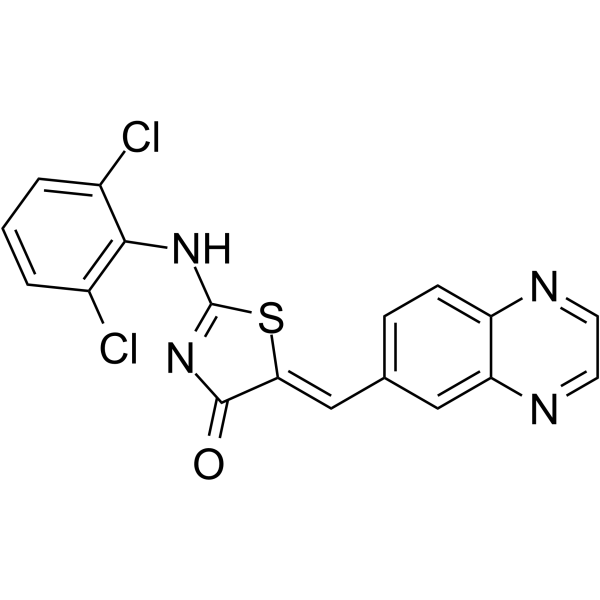
GSK-626616
CAS No. 1025821-33-3
GSK-626616( —— )
Catalog No. M26702 CAS No. 1025821-33-3
GSK-626616 is a potent and orally bioavailable DYRK3 inhibitor (IC50: 0.7 nM). It inhibits other members of the DYRK family with similar potency. GSK-626616 is a potential therapy for the treatment of anemia.
Purity : >98% (HPLC)
 COA
Datasheet
HNMR
HPLC
MSDS
Handing Instructions
COA
Datasheet
HNMR
HPLC
MSDS
Handing Instructions
| Size | Price / USD | Stock | Quantity |
| 1 mL x 10 mM in DMSO | 92 | In Stock |


|
| 5MG | 92 | In Stock |
|
| 10MG | 147 | In Stock |
|
| 25MG | 281 | In Stock |
|
| 50MG | 509 | In Stock |
|
| 100MG | 734 | In Stock |
|
| 200MG | Get Quote | In Stock |
|
| 500MG | Get Quote | In Stock |
|
| 1G | Get Quote | In Stock |
|
Biological Information
-
Product NameGSK-626616
-
NoteResearch use only, not for human use.
-
Brief DescriptionGSK-626616 is a potent and orally bioavailable DYRK3 inhibitor (IC50: 0.7 nM). It inhibits other members of the DYRK family with similar potency. GSK-626616 is a potential therapy for the treatment of anemia.
-
DescriptionGSK-626616 is a potent and orally bioavailable DYRK3 inhibitor (IC50: 0.7 nM). It inhibits other members of the DYRK family with similar potency. GSK-626616 is a potential therapy for the treatment of anemia.(In Vitro):GSK-626616 (serum-deprived HeLa cells) reduces EGF-induced phosphorylation of PRAS40 at Thr246. Binding of PRAS40 to mTORC1 is enhanced by GSK-626616.GSK-626616 abolishes the phosphorylation of S6K1 at Thr389 in nonstimulated HeLa cells. GSK-626616 reduces the phosphorylation of S6K1 at Thr389 in EGF- and insulin-stimulated HeLa cells, showing that mTORC1 activity is impaired.
-
In VitroGSK-626616 abolishes the phosphorylation of S6K1 at Thr389 in nonstimulated HeLa cells. GSK-626616 reduces the phosphorylation of S6K1 at Thr389 in EGF- and insulin-stimulated HeLa cells, showing that mTORC1 activity is impaired.GSK-626616 (serum-deprived HeLa cells) reduces EGF-induced phosphorylation of PRAS40 at Thr246. Binding of PRAS40 to mTORC1 is enhanced by GSK-626616.
-
In Vivo——
-
Synonyms——
-
PathwayOthers
-
TargetOther Targets
-
RecptorCereblon| Molecular Glues| TNF-α
-
Research Area——
-
Indication——
Chemical Information
-
CAS Number1025821-33-3
-
Formula Weight401.27
-
Molecular FormulaC18H10Cl2N4OS
-
Purity>98% (HPLC)
-
SolubilityIn Vitro:?DMSO : 50 mg/mL (124.60 mM)
-
SMILESClc1cccc(Cl)c1NC1=NC(=O)\C(S1)=C\c1ccc2nccnc2c1
-
Chemical Name——
Shipping & Storage Information
-
Storage(-20℃)
-
ShippingWith Ice Pack
-
Stability≥ 2 years
Reference
1.Lopez-Girona A, et al. Cereblon is a direct protein target for immunomodulatory and antiproliferative activities of lenalidomide and pomalidomide. Leukemia. 2012 Nov;26(11):2326-35.
molnova catalog



related products
-
Carbamazepine 10,11-...
Carbamazepine 10,11-epoxide is an active metabolite of the anticonvulsant carbamazepine.
-
GSK121
GSK121 is an inhibitor of selective PAD4.
-
5-Hydroxyindole
5-Hydroxyindole, a hydroxylated indole, can be found in a vast array of pharmacologically active agents and natural products. 5-Hydroxyindole slows desensitization of the 5-HT3 receptor-mediated ion current in N1E-115 neuroblastoma cells.
