


 Cart
Cart
 sales@molnova.com


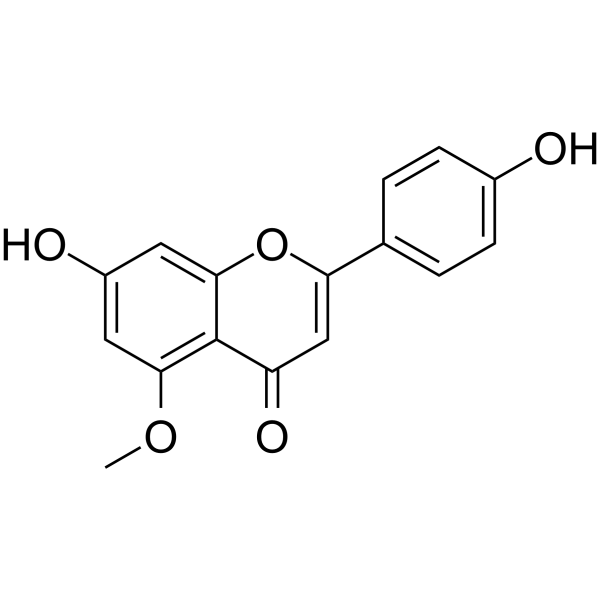
Thevetiaflavone
CAS No. 29376-68-9
Thevetiaflavone( Apigenin-5-methyl ether | 2-Genistein-5-methyl ether )
Catalog No. M26581 CAS No. 29376-68-9
Thevetiaflavone could up-regulate the expression of Bcl 2 and down-regulate that of Bax and caspase 3.
Purity : >98% (HPLC)
 COA
Datasheet
HNMR
HPLC
MSDS
Handing Instructions
COA
Datasheet
HNMR
HPLC
MSDS
Handing Instructions
| Size | Price / USD | Stock | Quantity |
| 5MG | 785 | Get Quote |


|
| 100MG | Get Quote | Get Quote |
|
| 200MG | Get Quote | Get Quote |
|
| 500MG | Get Quote | Get Quote |
|
| 1G | Get Quote | Get Quote |
|
Biological Information
-
Product NameThevetiaflavone
-
NoteResearch use only, not for human use.
-
Brief DescriptionThevetiaflavone could up-regulate the expression of Bcl 2 and down-regulate that of Bax and caspase 3.
-
DescriptionThevetiaflavone could up-regulate the expression of Bcl 2 and down-regulate that of Bax and caspase 3.(In Vitro):Thevetiaflavone reduces ROS overproduction and ameliorates ROS-mediated mitochondrial dysfunction, including collapse of mitochondrial membrane potential and opening of mitochondrial permeability transition pores, thereby reducing intracellular Ca2+ levels. Thevetiaflavone up-regulates the expression of Bcl-2, down-regulates the expression of Bax and caspase-3 and increases the activity of caspase-3 to inhibit the apoptosis of PC12 cells.
-
In VitroThevetiaflavone, a natural flavonoid obtained from Wikstroemia indica, could improve cell viability and suppresses the leakage of lactate dehydrogenase from the cytoplasm. Further investigation of the mechanisms demonstrated that Thevetiaflavone decreases overproduction of ROS and ameliorates ROS-mediated mitochondrial dysfunction, including collapse of mitochondrial membrane potential and mitochondrial permeability transition pore opening. Thevetiaflavone reduces the intracellular Ca2+ level, which is closely associated with mitochondrial function and interplays with ROS. Furthermore, Thevetiaflavone inhibits apoptosis in PC12 cells through upregulating the expression of Bcl-2 and downregulating that of Bax and caspase-3 in addition to increasing the activity of caspase-3. These results further indicate the protective effects of thevetiaflavone in vivo and its application in the clinic.
-
In Vivo——
-
SynonymsApigenin-5-methyl ether | 2-Genistein-5-methyl ether
-
PathwayAngiogenesis
-
TargetBcl-2
-
Recptor5-Lipoxygenase| prostaglandin synthetase (PGS)
-
Research Area——
-
Indication——
Chemical Information
-
CAS Number29376-68-9
-
Formula Weight284.267
-
Molecular FormulaC16H12O5
-
Purity>98% (HPLC)
-
Solubility——
-
SMILESCOc1cc(O)cc2oc(cc(=O)c12)-c1ccc(O)cc1
-
Chemical Name——
Shipping & Storage Information
-
Storage(-20℃)
-
ShippingWith Ice Pack
-
Stability≥ 2 years
Reference
1.Katsumi I, et al. Studies on styrene derivatives. I. Synthesis and antiinflammatory activities of alpha-benzylidene-gamma-butyrolactone derivatives. Chem Pharm Bull (Tokyo). 1986 Jan;34(1):121-9.
molnova catalog



related products
-
(22E)-Ergosta-4,6,8(...
Ergosta-4,6,8(14),22-tetraen-3-one (compound 2) is a ergosteroid is isolated from the fruiting bodies of ganoderma applanatum.
-
BCL6-IN-6
BCL6-IN-6 is an inhibitor of Bcl-6 and can be used in studies about diffuse large B-cell lymphoma. BCL6-IN-6 blocks the interaction of Bcl-6 with its corepressors and dose-dependently reactivates Bcl-6 target genes.
-
A 385358
A 385358 is a potent, selective, cell-permeable Bcl-XL inhibitor with Ki of 0.8 nM.
