


 Cart
Cart
 sales@molnova.com


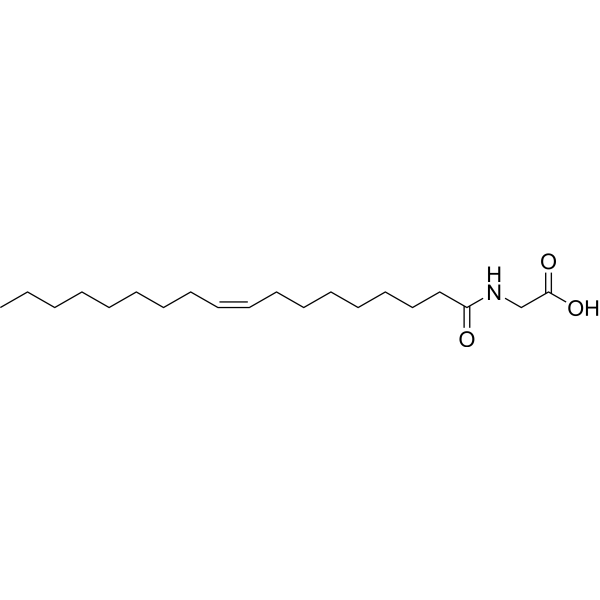
N-Oleoyl glycine
CAS No. 2601-90-3
N-Oleoyl glycine( —— )
Catalog No. M26577 CAS No. 2601-90-3
N-Oleoyl glycine, a lipoamino acid, was able to promote 3T3-L1 adipogenesis through the activation of CB1 receptor and the enhancement of insulin-mediated Akt signaling pathway.
Purity : >98% (HPLC)
 COA
Datasheet
HNMR
HPLC
MSDS
Handing Instructions
COA
Datasheet
HNMR
HPLC
MSDS
Handing Instructions
| Size | Price / USD | Stock | Quantity |
| 1 mL x 10 mM in DMSO | 67 | In Stock |


|
| 5MG | 37 | In Stock |
|
| 10MG | 61 | In Stock |
|
| 25MG | 93 | In Stock |
|
| 50MG | 142 | In Stock |
|
| 100MG | 213 | In Stock |
|
| 200MG | 318 | In Stock |
|
| 500MG | Get Quote | In Stock |
|
| 1G | Get Quote | In Stock |
|
Biological Information
-
Product NameN-Oleoyl glycine
-
NoteResearch use only, not for human use.
-
Brief DescriptionN-Oleoyl glycine, a lipoamino acid, was able to promote 3T3-L1 adipogenesis through the activation of CB1 receptor and the enhancement of insulin-mediated Akt signaling pathway.
-
DescriptionN-Oleoyl glycine, a lipoamino acid, was able to promote 3T3-L1 adipogenesis through the activation of CB1 receptor and the enhancement of insulin-mediated Akt signaling pathway.(In Vitro):N-Oleoyl glycine stimulated lipid accumulation and significantly increased adipogenic genes (PPARγ and aP2), in a dose- and time-dependent manner. Additionally, N-Oleoyl glycine markedly increased the mRNA expression of CB1 receptor and the inhibition of CB1R by its antagonist SR141716 abolished the promotive effects of N-Oleoyl glycine on lipid accumulation and the protein expression of PPARγ and aP2. Furthermore, N-Oleoyl glycine increased the ratio of p-Akt/Akt and p-FoxO1/FoxO1, which could be reversed by SR141716. Moreover, N-Oleoyl glycine-induced enhancement of adipogenesis, activation of insulin-mediated Akt signaling pathway and inactivation of FoxO1 were effectively blocked by Wortmannin, a specific PI3K/Akt inhibitor, indicating the essential role of Akt signaling pathway in the process of N-Oleoyl glycine-stimulated 3T3-L1 adipogenesis.
-
In VitroN-Oleoyl glycine is a lipoamino acid, which stimulates adipogenesis associated with activation of CB1 receptor and Akt signaling pathway in 3T3-L1 adipocyte. N-Oleoyl glycine (1, 5, 10, 20, 50 μM) dose- and time-dependently stimulates 3T3-L1 adipogenesis after treatment for 1-10 days via activation of CB1R. N-Oleoyl glycine also elevates Akt signaling pathway during the differentiation of 3T3-L1 adipocytes.
-
In Vivo——
-
Synonyms——
-
PathwayGPCR/G Protein
-
TargetCannabinoid Receptor
-
RecptorCYP3A
-
Research Area——
-
Indication——
Chemical Information
-
CAS Number2601-90-3
-
Formula Weight339.52
-
Molecular FormulaC20H37NO3
-
Purity>98% (HPLC)
-
SolubilityIn Vitro:?DMSO : 100 mg/mL (294.54 mM)
-
SMILESCCCCCCCC\C=C/CCCCCCCC(=O)NCC(O)=O
-
Chemical Name——
Shipping & Storage Information
-
Storage(-20℃)
-
ShippingWith Ice Pack
-
Stability≥ 2 years
Reference
1.Method for increasing HDL cholesterol levels?using?heteroaromatic phenylmethanes. United States Patent 6103733
molnova catalog



related products
-
CB1 antagonist 2
CB1 antagonist 2 is caimabinoid 1 (CB1) antagonist extracted from patent WO2016184310A1, compound 3. Which inhibits CB1 in vivo with an IC50 of 25.5 nM.
-
AM9405
AM9405 (AM-9405, GAT-379) is novel potent, peripherally active cannabinoid type 1 (CB1) and 5-HT3 receptor agonist.
-
Taranabant
A potent, selective and orally active cannabinoid-1 receptor (CB1R) inverse agonist with IC50 of 2.8 nM, Ki of 0.13 nM.
