


 Cart
Cart
 sales@molnova.com


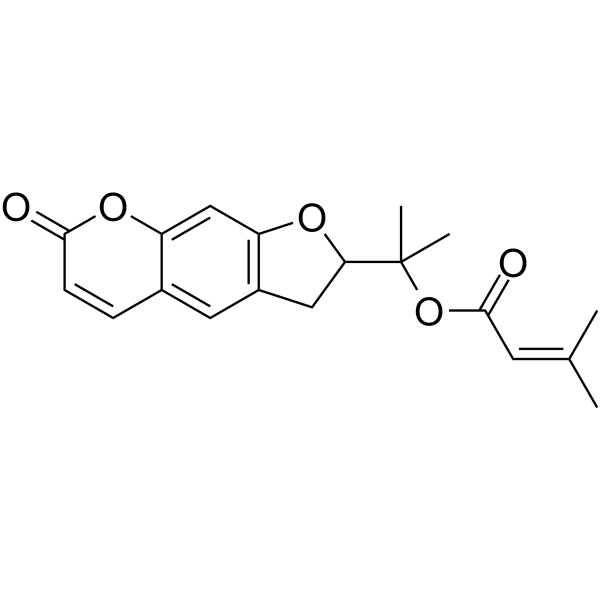
Isopropylidenylacetyl-marmesin
CAS No. 35178-20-2
Isopropylidenylacetyl-marmesin( (±)-Prantschimgin | Prantschimgin )
Catalog No. M26569 CAS No. 35178-20-2
Isopropylidenylacetyl-marmesin is a natural product derived from the roots of Notopterygium incisum and Ferulago bracteata.
Purity : >98% (HPLC)
 COA
Datasheet
HNMR
HPLC
MSDS
Handing Instructions
COA
Datasheet
HNMR
HPLC
MSDS
Handing Instructions
| Size | Price / USD | Stock | Quantity |
| 2MG | 201 | In Stock |


|
| 5MG | 283 | In Stock |
|
| 10MG | 493 | In Stock |
|
| 25MG | 796 | In Stock |
|
| 50MG | 1079 | In Stock |
|
| 100MG | Get Quote | In Stock |
|
| 200MG | Get Quote | In Stock |
|
| 500MG | Get Quote | In Stock |
|
| 1G | Get Quote | In Stock |
|
Biological Information
-
Product NameIsopropylidenylacetyl-marmesin
-
NoteResearch use only, not for human use.
-
Brief DescriptionIsopropylidenylacetyl-marmesin is a natural product derived from the roots of Notopterygium incisum and Ferulago bracteata.
-
DescriptionIsopropylidenylacetyl-marmesin is a natural product derived from the roots of Notopterygium incisum and Ferulago bracteata.
-
In Vitro——
-
In Vivo——
-
Synonyms(±)-Prantschimgin | Prantschimgin
-
PathwayOthers
-
TargetOther Targets
-
RecptorPEGs
-
Research Area——
-
Indication——
Chemical Information
-
CAS Number35178-20-2
-
Formula Weight328.36
-
Molecular FormulaC19H20O5
-
Purity>98% (HPLC)
-
Solubility——
-
SMILESC/C(C)=C\C(OC(C)(C(O1)CC2=C1C=C(O3)C(C=CC3=O)=C2)C)=O
-
Chemical Name——
Shipping & Storage Information
-
Storage(-20℃)
-
ShippingWith Ice Pack
-
Stability≥ 2 years
Reference
1.An S, et al. Small-molecule PROTACs: An emerging and promising approach for the development of targeted therapy drugs. EBioMedicine. 2018 Oct;36:553-562.
molnova catalog



related products
-
2β-Methoxy-2-deethox...
2β-Methoxy-2-deethoxy-8-O-deacylphantomolin-8-O-tiglinate is a sesquiterpene lactone that can be isolated from Elephantopus mollis. 2β-Methoxy-2-deethoxy-8-O-deacylphantomolin-8-O-tiglinate exhibits cytotoxicity in mouse neuroblastoma B104 cells with an IC50 of 3.85 μM.
-
Endothelin-1 (1-15),...
Endothelin-1 (1-15), amide, human
-
7-Xylosyl-10-deacety...
7-Xylosyl-10-deacetyltaxol B is a natural product.
