


 Cart
Cart
 sales@molnova.com


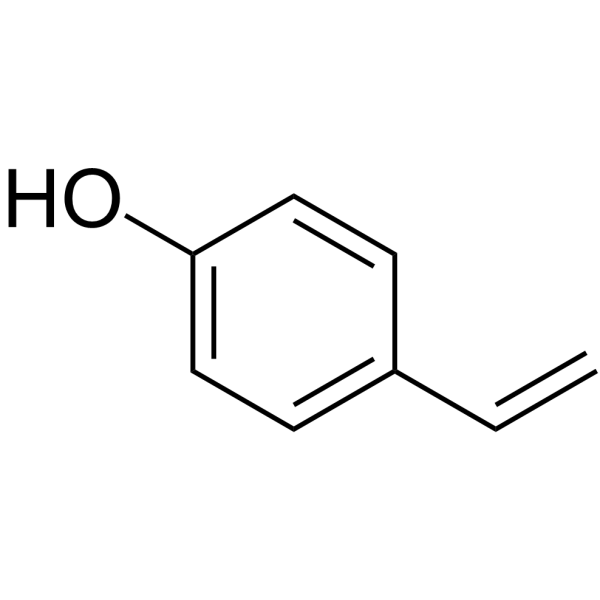
4-Vinylphenol
CAS No. 2628-17-3
4-Vinylphenol( —— )
Catalog No. M26541 CAS No. 2628-17-3
4-Vinylphenol is the metabolite of p-coumaric and ferulic acid by lactic acid bacteria in wine found in Hedyotis diffusa Willd. 4-Vinylphenol induces apoptosis in vivo.
Purity : >98% (HPLC)
 COA
Datasheet
HNMR
HPLC
MSDS
Handing Instructions
COA
Datasheet
HNMR
HPLC
MSDS
Handing Instructions
| Size | Price / USD | Stock | Quantity |
| 1 mL x 10 mM in DMSO | 29 | In Stock |


|
| 100MG | Get Quote | In Stock |
|
| 200MG | 33 | In Stock |
|
| 500MG | 52 | In Stock |
|
| 1G | 83 | In Stock |
|
Biological Information
-
Product Name4-Vinylphenol
-
NoteResearch use only, not for human use.
-
Brief Description4-Vinylphenol is the metabolite of p-coumaric and ferulic acid by lactic acid bacteria in wine found in Hedyotis diffusa Willd. 4-Vinylphenol induces apoptosis in vivo.
-
Description4-Vinylphenol is the metabolite of p-coumaric and ferulic acid by lactic acid bacteria in wine found in Hedyotis diffusa Willd. 4-Vinylphenol induces apoptosis in vivo.(In Vitro):4-Vinylphenol (100 μg/mL) significantly increases the expressions of caspase 3, likely sensitizing CSC-enriched MDAMB-231 cells to apoptosis. 4-Vinylphenol (50, 100 μg/mL) significantly suppresses cell proliferation in CSC-enriched MDA-MB-231 cells. 4-Vinylphenol (12.5-200 μg/mL) significantly reduces cell viability in parental MDA-MB-231 cells, and the IC50 value is 109 μg/mL. 4-Vinylphenol (0.15, 0.3 μg/mL) reduces sphere formation and vimentin expression on CSCs in breast cancer. 4-Vinylphenol significantly reduces ALDH1A1 expression by 50% in CSC-enriched MDA-MB-231 cells.
-
In Vitro4-Vinylphenol (12.5-200 μg/mL) significantly reduces cell viability in parental MDA-MB-231 cells, and the IC50 value is 109 μg/mL. 4-Vinylphenol (0.15 or 0.3 μg/mL; 3 days) reduces sphere?formation and vimentin expression on CSCs in breast cancer. 4-Vinylphenol (50, 100 μg/mL; 72 hours) significantly suppresses cell proliferation in CSC-enriched MDA-MB-231 cells. 4-Vinylphenol significantly reduces ALDH1A1 expression by 50% in CSC-enriched MDA-MB-231 cells. 4-Vinylphenol (100 μg/mL) significantly increases the expressions of caspase 3, likely sensitizing CSC-enriched MDAMB-231 cells to apoptosis.
-
In Vivo——
-
Synonyms——
-
PathwayApoptosis
-
TargetApoptosis
-
RecptorHCV NS5A
-
Research Area——
-
Indication——
Chemical Information
-
CAS Number2628-17-3
-
Formula Weight120.151
-
Molecular FormulaC8H8O
-
Purity>98% (HPLC)
-
SolubilityIn Vitro:?DMSO : 100 mg/mL (832.29 mM)
-
SMILESOc1ccc(C=C)cc1
-
Chemical Name——
Shipping & Storage Information
-
Storage(-20℃)
-
ShippingWith Ice Pack
-
Stability≥ 2 years
Reference
1.Gao Y, et al. Coblopasvir and sofosbuvir for treatment of chronic hepatitis C virus infection in China: A single-arm, open-label, phase 3 trial. Liver Int. 2020;40(11):2685-2693.
molnova catalog



related products
-
NBDHEX
NBDHEX is a potent inhibitor of glutathione S-transferase P1-1 (GSTP1-1).
-
2-Thiocytidine
2-Thiocytidine is a purine nucleoside analog that targets malignant tumors of the inert lymphatic system and possesses a broad spectrum of antitumor activity. It induces apoptosis by inhibiting DNA synthesis.
-
p53 Activator 7
p53 Activator 7 is a highly potent and cell-permeable activator of the p53 mutation Y220C (MDM-2/p53), which induces apoptosis.
