


 Cart
Cart
 sales@molnova.com


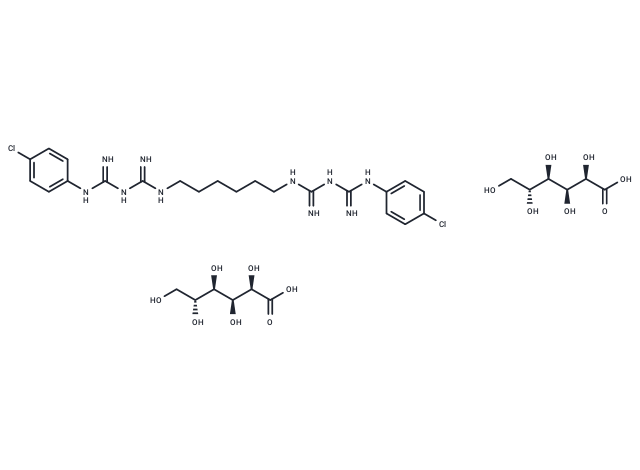
Chlorhexidine digluconate
CAS No. 18472-51-0
Chlorhexidine digluconate( —— )
Catalog No. M33315 CAS No. 18472-51-0
Chlorhexidine digluconate is a broad-spectrum antiseptic and disinfectant with broad-spectrum antimicrobial activity, inhibits both Gram-positive and Gram-negative bacteria, induces necrosis and apoptosis, and can be used in the study of bacterial infections.
Purity : >98% (HPLC)
 COA
Datasheet
HNMR
HPLC
MSDS
Handing Instructions
COA
Datasheet
HNMR
HPLC
MSDS
Handing Instructions
| Size | Price / USD | Stock | Quantity |
| 100MG | Get Quote | In Stock |


|
| 200MG | Get Quote | In Stock |
|
| 500MG | Get Quote | In Stock |
|
| 1G | Get Quote | In Stock |
|
Biological Information
-
Product NameChlorhexidine digluconate
-
NoteResearch use only, not for human use.
-
Brief DescriptionChlorhexidine digluconate is a broad-spectrum antiseptic and disinfectant with broad-spectrum antimicrobial activity, inhibits both Gram-positive and Gram-negative bacteria, induces necrosis and apoptosis, and can be used in the study of bacterial infections.
-
DescriptionChlorhexidine digluconate is a chlorophenyl biguanide with broad antibacterial action against both Gram (+) and (-) bacteria and fungi. Chlorhexidine digluconate is a broad-spectrum antiseptic and disinfectant. Chlorhexidine digluconate is effective to prevent and control infectious diseases of the mouth by killing bacteria in saliva and tongue. Chlorhexidine digluconate is a cytotoxic agent and induces cell necrosis and apoptosis.
-
In VitroCell Cytotoxicity Assay Cell Line:Chinese hamster ovary cells Concentration:0.00001%, 0.00005%, 0.0001%, 0.0005% Incubation Time:1, 2, 4 h Result:Demonstrated a cytotoxic effect on CHO cells.Apoptosis Analysis Cell Line:Chinese hamster ovary cells Concentration:0.00005%, 0.0001%, 0.0005% Incubation Time:1 h Result:After a 1 hour treatment, the amount of cell apoptosis was about 1.62%, 5.51%, and 5.47%, respectively. The amount of cell necrosis was 2.38%, 8.62%, and 22.50%, respectively.
-
In VivoModel:Male Imprinting Control Region (ICR) mice at 6 to 8-wk-old (body weight, 25g)Dosage:Chlorhexidine gluconate 0.05% and 0.025% Administration:One-time intraperitoneal injection Result:With 0.05% lavage had significantly lower incidence of postoperative intra-abdominal abscesses compared with the mice that had saline lavage only.
-
Synonyms——
-
PathwayApoptosis
-
TargetApoptosis
-
RecptorApoptosis | Antibiotic
-
Research Area——
-
Indication——
Chemical Information
-
CAS Number18472-51-0
-
Formula Weight897.76
-
Molecular FormulaC34H54Cl2N10O14
-
Purity>98% (HPLC)
-
SolubilityIn Vitro:?H2O : 100 mg/mL (111.39 mM; Ultrasonic) DMSO : ≥ 38 mg/mL (42.33 mM)
-
SMILESClC(C=C1)=CC=C1NC(NC(NCCCCCCNC(NC(NC2=CC=C(C=C2)Cl)=N)=N)=N)=N.OC[C@@H](O)[C@@H](O)[C@H](O)[C@@H](O)C(O)=O.OC[C@@H](O)[C@@H](O)[C@H](O)[C@@H](O)C(O)=O
-
Chemical Name——
Shipping & Storage Information
-
Storage(-20℃)
-
ShippingWith Ice Pack
-
Stability≥ 2 years
Reference
1. Wael E Shams, et al. Peritoneal Lavage Using Chlorhexidine Gluconate at the End of Colon Surgery Reduces Postoperative Intra-Abdominal Infection in Mice. J Surg Res. 2015 May 1;195(1):121-7.?
molnova catalog



related products
-
2-Thiocytidine
2-Thiocytidine is a purine nucleoside analog that targets malignant tumors of the inert lymphatic system and possesses a broad spectrum of antitumor activity. It induces apoptosis by inhibiting DNA synthesis.
-
Clitocine
Clitocine, an adenosine analogue derived from mushrooms, is a potent transcriptional readout agent, an inhibitor of nonsense mutations, and has anticancer activity, inducing the production of p53 protein in cells carrying the p53 nonsense mutation allele.
-
2,5-dimethyl Celecox...
2,5-dimethyl Celecoxib is a celecoxib derivative and a targeted inhibitor of microsomal prostaglandin E synthase-1 (mPGES-1), a key enzyme in the PGE2 synthesis pathway of inflammatory mediators.
