


 Cart
 sales@molnova.com


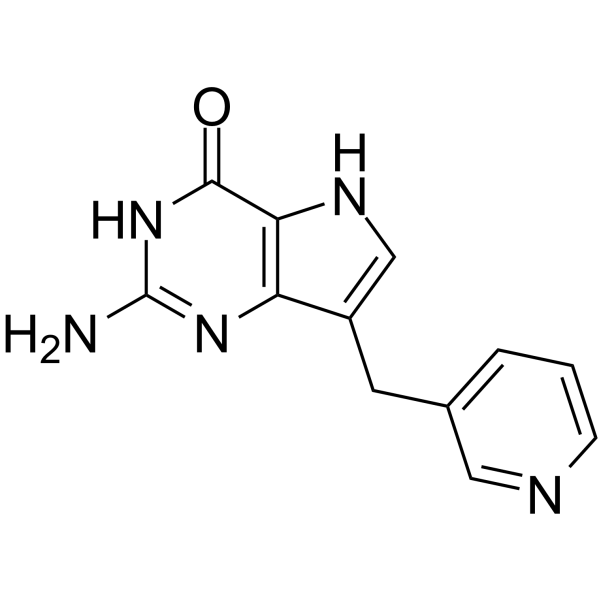
Peldesine
CAS No. 133432-71-0
Peldesine( BCX 34 )
Catalog No. M26363 CAS No. 133432-71-0
Peldesine is an effective, competitive, reversible, and orally active inhibitor of purine nucleoside phosphorylase.
Purity : >98% (HPLC)
 COA
Datasheet
HNMR
HPLC
MSDS
Handing Instructions
| Size | Price / USD | Stock | Quantity |
| 1 mL x 10 mM in DMSO | 302 | In Stock |


|
| 5MG | 275 | In Stock |
|
| 10MG | 440 | In Stock |
|
| 25MG | 728 | In Stock |
|
| 50MG | 995 | In Stock |
|
| 100MG | 1349 | In Stock |
|
| 200MG | Get Quote | In Stock |
|
| 500MG | 2678 | In Stock |
|
| 1G | Get Quote | In Stock |
|
Biological Information
-
Product NamePeldesine
-
NoteResearch use only, not for human use.
-
Brief DescriptionPeldesine is an effective, competitive, reversible, and orally active inhibitor of purine nucleoside phosphorylase.
-
DescriptionPeldesine is an effective, competitive, reversible, and orally active inhibitor of purine nucleoside phosphorylase. Peldesine inhibits T-cell proliferation with an IC50 of 800 nM. Peldesine can be used in research on cutaneous T-cell lymphoma, psoriasis and HIV infection.(In Vitro):The IC50s are 36 nM, 5 nM, and 32 nM for human, rat, and mouse red blood cell purine nucleoside phosphorylase, respectively. In Jurkat cells, Peldesine (BCX 34; 0-50 μM; 72 hours) inhibits the T-cell proliferation completely at a concentration of less than 10 μM, in the presence of dGuo (10 μM). In contrast, the B-cell proliferation is not affected by Peldesine.(In Vivo):Peldesine is orally active in elevating plasma inosine in rats (2-fold at 30 mg/kg), in suppressing ex vivo RBC PNP activity in rats (98% at 3 h. 100 mg/kg), and in suppressing ex vivo skin PNP in mice (39% at 3 h, 100 mg/kg). Oral bioavailability of Peldesine in rats is 76%.
-
In VitroPeldesine (BCX 34; 0-50 μM; 72 hours; Jurkat cells) could inhibit the T-cell proliferation completely at a concentration of less than 10 μM, in the presence of dGuo (10 μM). In contrast, the B-cell proliferation is not affected by Peldesine. Peldesine (BCX 34) suppresses T-cell immune reaction in an IL-2-independent manner, and this means that Peldesine might affect a late phase rather than an early stage in T-cell activation.Peldesine also, in the presence but not in the absence of deoxyguanosine, inhibits human leukemia CCRF-CEM T-cell proliferation with an IC50 of 0.57 μM but not rat or mouse T-cell proliferation up to 30 μM. Cell Proliferation Assay Cell Line:Jurkat cells Concentration:0 μM, 10 μM, 20 μM, 30 μM, 40 μM, 50 μM Incubation Time:72 hours Result:In the presence of 10 μM dCuo, had a complete inhibitory effect for T-cell lines.
-
In VivoOral bioavailability of Peldesine in rats is 76%. Peldesine is orally active in elevating plasma inosine in rats (2-fold at 30 mg/kg), in suppressing ex vivo RBC PNP activity in rats (98% at 3 h. 100 mg/kg), and in suppressing ex vivo skin PNP in mice (39% at 3 h, 100 mg/kg).
-
SynonymsBCX 34
-
PathwayOthers
-
TargetOther Targets
-
RecptorGSTP1| Gutathione S-transferase
-
Research Area——
-
Indication——
Chemical Information
-
CAS Number133432-71-0
-
Formula Weight241.254
-
Molecular FormulaC12H11N5O
-
Purity>98% (HPLC)
-
SolubilityIn Vitro:?DMSO : 200 mg/mL (829.02 mM)
-
SMILESNc1nc2c(Cc3cccnc3)c[nH]c2c(=O)[nH]1
-
Chemical Name——
Shipping & Storage Information
-
Storage(-20℃)
-
ShippingWith Ice Pack
-
Stability≥ 2 years
Reference
1.Ruscoe JE, et al. Pharmacologic or genetic manipulation of glutathione S-transferase P1-1 (GSTpi) influences cell proliferation pathways. J Pharmacol Exp Ther. 2001 Jul;298(1):339-45.
molnova catalog



related products
-
Ascorbyl Propyl Hyal...
Ascorbyl propyl hyaluronate is a perfect combination of hyaluronic acid and vitamin C, to overcome the instability of vitamin C, is to improve wrinkles, moisturize, calm the skin, whitening quality raw materials.
-
Angiotensin II type ...
Angiotensin II type 1 receptor (181 - 187), AT1, ATE.
-
(Nle8·18,Tyr34)-pTH ...
(Nle8,18,Tyr34)-pTH (1-34) (human) is a polypeptide that can be found by peptide screening. Peptide screening is a research tool that pools active peptides primarily by immunoassay. Peptide screening can be used for protein interaction, functional analysis, epitope screening, especially in the field of agent research and development.
