


 Cart
Cart
 sales@molnova.com


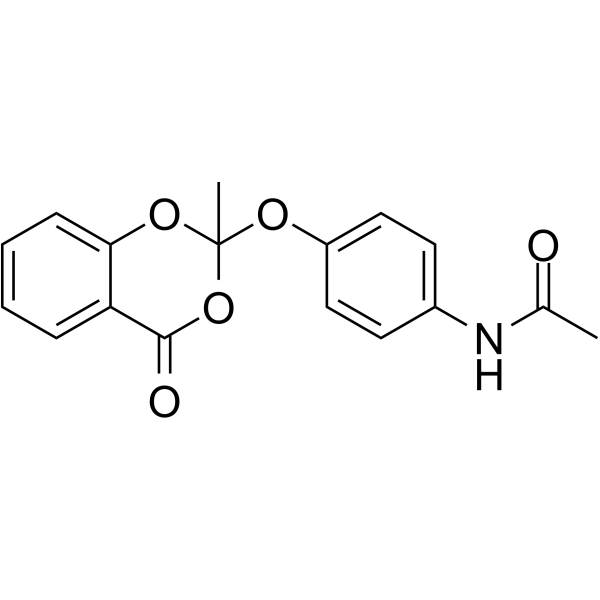
Parcetasal
CAS No. 87549-36-8
Parcetasal( MR-897 )
Catalog No. M26358 CAS No. 87549-36-8
Parcetasal is a non-steroidal anti-inflammatory agent that can be used in pain relief studies.
Purity : >98% (HPLC)
 COA
Datasheet
HNMR
HPLC
MSDS
Handing Instructions
COA
Datasheet
HNMR
HPLC
MSDS
Handing Instructions
| Size | Price / USD | Stock | Quantity |
| 1 mL x 10 mM in DMSO | 74 | In Stock |


|
| 5MG | 112 | In Stock |
|
| 10MG | 187 | In Stock |
|
| 25MG | 326 | In Stock |
|
| 50MG | 457 | In Stock |
|
| 100MG | 631 | In Stock |
|
| 200MG | 853 | In Stock |
|
| 500MG | Get Quote | In Stock |
|
| 1G | Get Quote | In Stock |
|
Biological Information
-
Product NameParcetasal
-
NoteResearch use only, not for human use.
-
Brief DescriptionParcetasal is a non-steroidal anti-inflammatory agent that can be used in pain relief studies.
-
DescriptionParcetasal is a non-steroidal anti-inflammatory agent that can be used in pain relief studies.
-
In Vitro——
-
In Vivo——
-
SynonymsMR-897
-
PathwayOthers
-
TargetOther Targets
-
RecptorS1P1
-
Research Area——
-
Indication——
Chemical Information
-
CAS Number87549-36-8
-
Formula Weight313.309
-
Molecular FormulaC17H15NO5
-
Purity>98% (HPLC)
-
SolubilityIn Vitro:?DMSO : 125 mg/mL (398.98 mM)
-
SMILESCC(=O)Nc1ccc(OC2(C)OC(=O)c3ccccc3O2)cc1
-
Chemical Name——
Shipping & Storage Information
-
Storage(-20℃)
-
ShippingWith Ice Pack
-
Stability≥ 2 years
Reference
1.Nakamura T, Asano M, Sekiguchi Y, et al.Synthesis and evaluation of CS-2100, a potent, orally active and S1P(3)- sparing S1P(1) agonist. Eur J Med Chem. 2012 May;51:92-8.
molnova catalog



related products
-
Somatostatin
Somatostatin, also known as growth hormone-inhibiting hormone, is a naturally-occurring peptide hormone of 14 or 28 amino acid residues that regulates the endocrine system. It is secreted by the D cells of the islets to inhibit the release of insulin and glucagon, and is also generated in the hypothalamus, where it inhibits the release of growth hormone and thyroid-stimulating hormones from the anterior pituitary.Somatostatin is a tetradecapeptide which can suppress the growth hormone (GH) secretion and control the pituitary hormone secretion in human CNS.
-
Ginkgolic acid C15:1
Ginkgolic acid C15:1 represses curli genes and prophage genes in EHEC.
-
2-(2,4-Dihydroxyphen...
2-(2,4-Dihydroxyphenyl)-5,6-methylenedioxybenzofuran (ABF).
