


 Cart
Cart
 sales@molnova.com


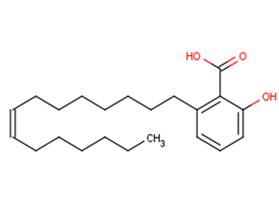
Ginkgolic acid C15:1
CAS No. 22910-60-7
Ginkgolic acid C15:1( Ginkgoic acid | AK-46666 | AK 46666 | HY-N0077 )
Catalog No. M18270 CAS No. 22910-60-7
Ginkgolic acid C15:1 represses curli genes and prophage genes in EHEC.
Purity : >98% (HPLC)
 COA
Datasheet
HNMR
HPLC
MSDS
Handing Instructions
COA
Datasheet
HNMR
HPLC
MSDS
Handing Instructions
| Size | Price / USD | Stock | Quantity |
| 1 mL x 10 mM in DMSO | 57 | In Stock |


|
| 2MG | 31 | In Stock |
|
| 5MG | 48 | In Stock |
|
| 10MG | 67 | In Stock |
|
| 25MG | 107 | In Stock |
|
| 50MG | 152 | In Stock |
|
| 100MG | 222 | In Stock |
|
| 200MG | Get Quote | In Stock |
|
| 500MG | Get Quote | In Stock |
|
| 1G | Get Quote | In Stock |
|
Biological Information
-
Product NameGinkgolic acid C15:1
-
NoteResearch use only, not for human use.
-
Brief DescriptionGinkgolic acid C15:1 represses curli genes and prophage genes in EHEC.
-
DescriptionGinkgolic acid is an HIV protease and fatty acid synthase inhibitor found in Ginkgo. It suppresses HIV infection, inhibits growth of Staphyloccus, Escherichia, and Bacillus, increases activity of PP2C in neurons, and induces apoptosis in cancer cells.
-
In VitroGinkgolic acid inhibits the in vitro SUMOylation of RanGAP1-C2 with the IC50 values of 3.0 μM. The level of SUMOylated p53 is markedly reduced by the ginkgolic acid treatment. Importantly, ginkgolic acid does not affect protein ubiquitination in cells. Ginkgolic acid inhibits the binding between E1 and GA-BODIPY in a dose-dependent manner. Ginkgolic acid (31.2 μg/mL) inhibits HIV protease activity by 60%, compared with the negative control, and the effect is concentration-dependent. Ginkgolic acid treatment (50 and 100 μg/mL) effectively inhibits HIV infection in human PBMC cells. Ginkgolic acid at the concentrations up to 150 μg/mL does not cause any significant cytotoxicity in Jurkat cells. GA only inhibits the growth of tumorogenic cell lines in a both dose- and time-dependent manner. Tumor cells are treated with GA for 72 h, 70.53±4.54% Hep-2 and 63.5±7.2% Tca8113 cells are retarded at GO/G1 phase, and the percentage of apoptosis is 40.4±1.58 and 38.4±1.7%, respectively. GA-treated activated caspase-3 downregulates the expression of anti-apoptotic Bcl-2 protein and upregulates the expression of pro-apoptotic Bax protein, eventually leading to a decrease in the Bcl-2/Bax ratio in tumor cellsin human PBMC cells. Ginkgolic acid at the concentrations up to 150 μg/mL does not cause any significant cytotoxicity in Jurkat cells.
-
In Vivo——
-
SynonymsGinkgoic acid | AK-46666 | AK 46666 | HY-N0077
-
PathwayOthers
-
TargetOther Targets
-
RecptorOthers
-
Research AreaCancer
-
Indication——
Chemical Information
-
CAS Number22910-60-7
-
Formula Weight346.51
-
Molecular FormulaC22H34O3
-
Purity>98% (HPLC)
-
SolubilityDMSO : ≥ 100 mg/mL 288.60 mM; H2O : < 0.1 mg/mL
-
SMILESCCCCCCC=CCCCCCCCC1=C(C(=CC=C1)O)C(=O)O
-
Chemical Name(Z)-2-hydroxy-6-(pentadec-8-en-1-yl)benzoic acid
Shipping & Storage Information
-
Storage(-20℃)
-
ShippingWith Ice Pack
-
Stability≥ 2 years
Reference
molnova catalog



related products
-
NSC-41589
N-[2-(methylsulfanyl) phenyl]acetamide.
-
Sodium caprate
Sodium decanoate is the sodium salt of caproic acid, a 10-carbon saturated fatty acid. It has an amphiphilic character and can form liquid crystalline phases and micelles in an aqueous solution.
-
Laurocapram
Laurocapram is a percutaneous enhancer. Upon application to the skin, laurocapram interacts with lipids in the stratum corneum and may enhance the ability of the skin to absorb a hydrophilic chemical.
